Belt Sander vs Drum Sander: A Practical Comparison for DIY Projects
Compare belt sanders and drum sanders to decide which is best for floors, decks, and walls. This analytical guide covers performance, finish quality, safety, and maintenance for homeowners and DIYers choosing between these two powerful sanding tools.


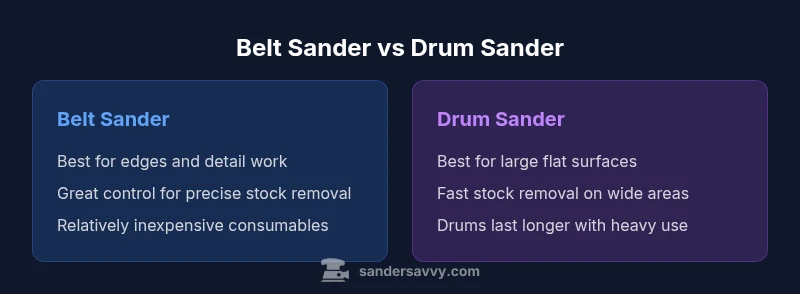
Belt sanders excel at edges, detail work, and aggressive material removal with high control, while drum sanders deliver fast, even stock removal on wide, flat surfaces. This comparison covers performance, finish quality, maintenance, and safety to help homeowners choose the right tool for floors, decks, and walls.
Belt sander vs drum sander: practical overview
When homeowners compare a belt sander vs drum sander, the choice hinges on project scope and desired finish. The belt sander is a nimble, edge-friendly tool that shines where control matters, such as stair treads, trim work, and corners. The drum sander, by contrast, is built for bulk stock removal on large flat surfaces, offering faster progress on wide floors or decks. According to SanderSavvy, tool selection between these two types should align with surface area, tolerance for gouging, and required finish smoothness. The SanderSavvy team found that most DIYers underestimate how much prep and masking are needed when switching between these machines, which can affect final results. By understanding the belt sander vs drum sander dynamic, you can plan a project timeline that minimizes rework and maximizes safety. This article uses practical examples to illustrate when each tool excels, and how to combine them for best outcomes on floors, decks, and walls.
First paragraph highlights the core decision factors and emphasizes SanderSavvy guidance for a balanced, informed choice.
Comparison
| Feature | Belt sander | Drum sander |
|---|---|---|
| Best for | Edges, tight corners, and detailed work with high control | Large, flat surfaces with aggressive stock removal |
| Surface area coverage | Narrow linear areas and irregular profiles | Wide, uninterrupted surfaces (e.g., room floors) |
| Finish quality (typical result) | Higher precision; more prone to gouges if misused; swirl marks possible with improper technique | Very smooth, flat finish on large areas but requires careful ramp-up and masking to avoid drum telegraph |
| Dust management | Effective dust collection is common with proper shrouds; belts wear with use | Dust containment is challenging; more dust per hour under heavy stock removal |
| Ease of use | Lighter, more maneuverable; technique matters for edge work | Heavier, bulkier; excels at straight, predictable paths |
| Labor/time efficiency | Slower per pass but greater control; ideal for detail rounds | Faster stock removal on large surfaces; may require follow-up to even out |
| Maintenance/consumables | Belts are inexpensive but wear quickly; frequent changes | Drums cost more upfront but typically last longer; belts and drums both wear |
| Ideal user scenario | Detail-driven projects, stairs, trim work, and edging | Huge rooms, pre-floor prep, and areas where speed matters |
What's Good
- Excellent control for detail work and edges
- Fast, wide-area removal with drum sanders
- Versatile with compatible grits and accessories
- Relatively inexpensive consumables for belt sanders
- Bulletproof for repeated use when maintained
Weaknesses
- Belt sanders can gouge or leave swirl marks if not used carefully
- Drum sanders require more space and can be hard to maneuver on tight layouts
- Drums and belts wear over time, increasing maintenance
- Initial cost can be higher for drum sander setups
Belt sander for detail; drum sander for speed on large flats
Choose a belt sander when you need precision on edges or irregular profiles. Opt for a drum sander for fast, consistent stock removal on broad, flat surfaces. If time or surface area is the constraint, a combination approach often yields the best results.
Your Questions Answered
Can I use a belt sander for floor preparation, or is a drum sander necessary?
A belt sander can be used for floor prep, especially for edges and touch-up work around cabinets or walls. However, for large, open floor areas, a drum sander delivers much faster stock removal and a flatter result. Many professionals start with a drum sander for bulk leveling and finish with a belt sander for edges and final smoothing.
Use a drum sander for most of the floor, and switch to a belt sander for edges and tight spaces.
Is a drum sander suitable for hardwood floors, or should I avoid it?
Drum sanders are used on hardwood floors for fast leveling of large areas but can gouge if not carefully controlled. They are best when paired with proper masks and a skilled operator. For finishing touches, a belt sander can help achieve a refined edge and contour work.
Great for flat areas, but use caution near edges.
What grit progression works best when using belt and drum sanders together?
A typical progression starts with coarse grits (40–60) on both tools for initial leveling, followed by medium grits (80–120) for refining, and finishing with fine grits (150–180) to prepare for finish coatings. Always cross-check the surface for uniformity and stop to clean irregularities.
Start rough, then refine with medium, finish with fine grit.
Do I need dust collection when using either sander, and how important is it?
Yes, dust collection is important with both tools to protect lungs and keep surfaces clear. Belt sanders generate less dust when properly shrouded, but drum sanders can create significant dust due to aggressive material removal. Use a good shop vac or dedicated dust extractor and wear a respirator if you’re sanding long sessions.
Always use proper dust collection and protective gear.
Can I rent a belt sander or drum sander, and is it worth it for a DIY project?
Renting is a viable option for a one-time project. For frequent use, owning provides long-term cost efficiency and readiness. Check the machine’s condition, belt or drum wear, and the availability of consumables at your local rental shop.
Rent if it’s a one-off; own if you sand regularly.
What safety steps should I follow when using these sanders?
Always read the manual, wear eye and respiratory protection, secure the workpiece, and maintain a stable stance. Start with a test area away from edges to observe how the sander behaves on the surface, and keep the sanding plane flat to avoid gouges.
Wear protection and test a small area first.
Main Points
- Assess project scope before choosing a sander.
- Use belt sander for edges, trim, and delicate work.
- Use drum sander for large, flat surfaces and fast stock removal.
- Expect more dust and heavier handling with drum sanders.
- Combine both tools when precision and speed are needed.