Can You Use a Sander on Concrete? A DIY Guide
Explore whether you can sand concrete, when to use a sander vs. a grinder, and how to do it safely with dust control, PPE, and finishing tips for floors, patios, and walls.


Concrete sanding is feasible only with the correct equipment. In practice, use a concrete floor grinder or an orbital/angle sander equipped with diamond cup wheels or silicon carbide discs for light smoothing. Avoid aggressive removal with handheld sanders, and always manage dust and safety. Concrete surfaces may vary in hardness, so test a small area first.
Can you use a sander on concrete? A practical overview
According to SanderSavvy, can you use a sander on concrete? The short answer is yes, but with important caveats. Concrete is hard and abrasive, and defects such as cracks or high spots require different tools and techniques. In this guide, you'll learn when a sander is appropriate, what equipment to choose, and how to control dust and safety. We cover light surface smoothing, patch work, and the boundaries where grinding or diamond tooling becomes the better option. The goal is to achieve a safer, smoother finish without compromising the structure or sealers. This guidance applies to garage floors, basements, patios, and interior slabs where a finish matters. Throughout, you’ll see references to practical sanding methods you can apply at home, with professional tips from the SanderSavvy team.
Concrete is hard: why you can't treat it like wood
Concrete is not a forgiving substrate like soft wood. Its hardness varies with mix design, curing age, and exposure. Surfaces may be crowned, pitted, or have exposed aggregate, all of which demand different approaches. Attempting to treat concrete like wood with a light orbital sander can glaze the surface, clog discs, overheat the pad, and leave an uneven finish. The SanderSavvy approach emphasizes diagnosing the surface first, selecting the right tool (grinder vs. sander), and using the appropriate grit for controlled material removal. This is essential to avoid damage and to set up a smooth, durable final surface.
Tools that actually work on concrete (and why common wood sanders fall short)
For meaningful results on concrete, you generally need a grinder or a sander designed for heavy materials. A concrete floor grinder with a diamond cup wheel is ideal for rapid material removal and leveling. A random orbital or belt sander with silicon carbide discs can handle light smoothing over small areas, but only when used with caution and the correct grit. Always attach a dust collection system. The key is to use the right tool for the task rather than forcing a wood-oriented sander to do concrete work.
When to choose sanding vs grinding
If you need to remove a coating, level minor high spots, or feather edges lightly, sanding with a high-grit disc can work. For deep leveling, removing stubborn coatings, or flattening uneven slabs, grinding with a diamond cup wheel is faster and safer. The decision depends on the surface condition, the desired final appearance, and the structural integrity of the concrete. Start with a test patch and scale up your approach as needed.
Surface prep and dust control before you start
Before any material removal, protect nearby finishes and seal off the work area. Vacuum up loose debris, cover nearby walls, and seal doors with plastic sheeting if indoors. The dust from concrete can contain crystalline silica; use a HEPA filter backpack or inline dust extractor connected to your grinder or sander. Wetting the surface lightly can help reduce fine dust, but check moisture compatibility with coatings planned after sanding. Always test a small area first to gauge dust behavior and surface readiness.
Safety gear and dust-control best practices
Wear a properly fitted respirator rated for silica dust (P100 or NIOSH-approved), safety goggles, hearing protection, and sturdy gloves. Use a HEPA vacuum or dust extractor with each pass and keep your mask/filters clean. Ensure good ventilation if sanding indoors and avoid creating a cloud of fine particles. For beginners, practice on a scrap area first to build confidence and master consistent passes.
Finishing touches: sealing and evaluating results
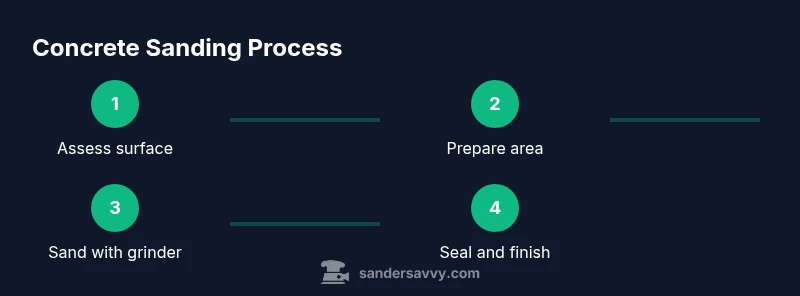
After sanding, the surface should feel smooth and uniform to the touch. Plan your sealing or finishing step based on the resin or coating you intend to apply. Clean the dust thoroughly, then use a compatible sealer or epoxy system according to manufacturer directions. A well-sealed concrete floor or slab improves stain resistance, wear protection, and the long-term look of the finish. Always test coating compatibility on a hidden patch before full application.
Authority sources and further reading
For foundational safety guidance on dust control and silica exposure, see: • OSHA: https://www.osha.gov/silica • CDC/NIOSH: https://www.cdc.gov/niosh/topics/silica/
For best practices on concrete sanding and safety, consult these reputable sources and apply the guidelines to your project.
Tools & Materials
- Concrete floor grinder with diamond cup wheel(Best for heavy material removal and leveling; use with dust extraction)
- Random orbital sander or belt sander with silicon carbide discs(For light smoothing over small areas; grit 60-120 for initial passes)
- Silicon carbide sanding discs (various grits)(Grit progression: 60/80 for rough, 120-220 for finish passes)
- Dust collection system (HEPA)(Attach to grinder or sander; essential for indoor work)
- PPE: respirator (P100 or NIOSH-approved), safety goggles, hearing protection, gloves(Silica dust protection is critical; ensure proper fit)
- Drop cloths, painter's tape, and plastic sheeting(Contain dust and protect adjacent areas)
- Water spray bottle or misting system (optional)(Light moisture can help control dust on some surfaces; test first)
Steps
Estimated time: 2-4 hours
- 1
Assess surface
Inspect the concrete for cracks, patches, and coatings. Decide whether the surface needs heavy removal (grinder) or light smoothing (sander) based on the condition and the intended final coating.
Tip: Document problem areas with a marker to guide subsequent passes. - 2
Choose tool and grit
Select the appropriate tool and start with a suitable grit. For heavy removal use a grinder with a diamond cup; for light smoothing, begin with 60-80 grit on a sander and progress to 120-220 grit.
Tip: Always start coarse if you must remove coatings, then switch to finer grits for finishing. - 3
Prepare workspace
Clear the area, seal doors, cover nearby surfaces, and connect the dust extractor. Ensure proper ventilation if indoors and lay drop cloths to catch debris.
Tip: Set up a dedicated dust zone and never leave tools unattended mid-pass. - 4
Set up dust control and PPE
Put on a P100 respirator, safety goggles, and hearing protection. Attach a HEPA vacuum and confirm it runs before starting.
Tip: Check filters and replace if clogged to maintain suction efficiency. - 5
Test patch on inconspicuous area
Run a small trial area to gauge effectiveness, surface heat, and dust behavior. Adjust pressure and speed based on the result.
Tip: A poor test patch can mask deeper issues; take the time to evaluate before proceeding. - 6
Begin passes with controlled overlapping
Make light, consistent passes in one direction, then slightly overlap on the return stroke. Avoid staying in one spot to prevent gouges.
Tip: Keep the tool flat against the surface and avoid rocking to maintain levelness. - 7
Check for high spots and rework
Periodically check flatness with a straightedge or level. Rework any areas that feel or look uneven until the surface is uniform.
Tip: Mark high spots and revisit them after the surrounding area is smooth. - 8
Clean and evaluate finish readiness
Vacuum and wipe the surface to remove dust. Inspect the surface texture to ensure it’s ready for sealing or coating.
Tip: If the surface shows glazing or dull patches, re-sand with a finer grit.
Your Questions Answered
Can I sand concrete indoors safely?
Yes, with proper dust collection, PPE, and ventilation. Use a HEPA vacuum and a respirator to minimize silica exposure. Limit dust generation by using appropriate tooling and working in controlled passes.
Yes, indoors you can if you have good dust collection and PPE, and you ventilate well.
Can I use an orbital sander on concrete?
For light smoothing on small areas, yes—use a high-quality pad and silicon carbide discs. Do not rely on an orbital sander for heavy removal or large-area leveling; a grinder is typically needed for that.
Yes, for light smoothing in small patches, but not for heavy removal.
What grit should I start with?
Start with 60-80 grit for light smoothing or to remove slight coatings. If you need heavier removal, switch to a grinder with a diamond cup and coarser grit, then finish with finer grits (120-220) for a smooth finish.
Start with 60-80 grit for smoothing; switch to finer grits for finishing.
Do I need to seal after sanding?
Yes. Sealing or coating protects the surface, improves stain resistance, and helps lock in the smooth finish you created during sanding. Choose a sealer compatible with your coating plan and the concrete type.
Yes, sealing is recommended after sanding.
How long does it take to sand a floor?
Time varies with area size, surface condition, and equipment. Plan for several hours for a small area and significantly more time for large floors or multiple passes.
It depends on the area; expect several hours for a small patch and more for larger floors.
Can I remove epoxy coatings by sanding?
Light sanding may scuff epoxy, but thick coatings typically require grinding with a diamond cup wheel. Start with a patch to determine feasibility and layer depth before committing to larger areas.
Epoxy may be challenging; you’ll likely need grinding for thick coatings.
Watch Video
Main Points
- Use appropriate tools: grinders for heavy removal, sanders for light smoothing.
- Dust control and PPE are essential for safety.
- Test a patch to validate technique and material behavior.
- Seal the surface after sanding to protect the finish.
- Work methodically with overlapping passes for an even result.