Cordless Orbital Sander vs Corded: A Practical Comparison
A thorough side-by-side review of cordless orbital sanders and corded models, covering power, run-time, weight, price, and maintenance to help DIY homeowners decide.


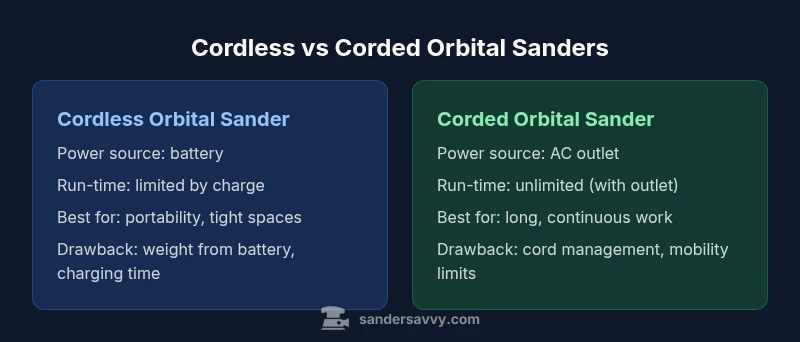
Cordless orbital sander vs corded: cordless models win on portability, quick setup, and maneuverability in tight spaces, while corded sanders deliver steady, unbroken power for long sessions and heavy stock removal. For small, remote projects, choose cordless; for big jobs or shops with consistent outlets, a corded sander often saves time and reduces downtime.
Defining cordless orbital sander vs corded orbital sander
In the world of sanding tools, the cordless orbital sander vs corded comparison centers on how the tool draws power and how that power translates into practical performance. A cordless orbital sander relies on a rechargeable battery, typically a lithium-ion pack, to deliver its oscillating motion. A corded orbital sander plugs into an electrical outlet and draws constant power through a cord. Both share the same sanding action and pad geometry, but the power source drives differences in weight, runtime, and convenience. For DIY homeowners, the choice often comes down to where you’ll be working, how long you’ll sand, and how much space you have to maneuver. The cordless option excels in hard-to-reach corners, outdoor decks, and areas without nearby outlets, while corded models shine when you need sustained speed for extensive material removal. The topic cordless orbital sander vs corded is not just about power delivery; it’s about managing fatigue, workflow, and downtime in real-world projects.
From the SanderSavvy perspective, both designs aim to deliver predictable swirls with consistent contact, but the reality of a battery's charge cycle vs a wall outlet changes everything from weight to heat generation. In practice, most homeowners find cordless models ideal for quick refinishing tasks, cabinet touch-ups, or sanding on a temporary scaffold where a cord would be cumbersome. Conversely, for a long weekend to refinish an entire floor, corded units reduce constant battery swapping and avoid performance dips as battery charge diminishes. A well-chosen cordless model balances weight and runtime, while a capable corded unit leverages uninterrupted power for efficiency. The bottom line in this cordless orbital sander vs corded comparison is to match the tool to the job profile while keeping comfort and safety in mind.
As you read, remember that dust management, pad type, and the ability to swap sanding sheets quickly are universal considerations. The battery’s state of health and the availability of compatible chargers also influence long-term satisfaction. In the end, the right choice depends on how you plan to work, not just how you plan to buy.
Power and performance: what actually changes from source
Power delivery is the most tangible difference in the cordless orbital sander vs corded debate. Corded models provide constant electrical power, which translates to stable RPM and more consistent orbital action under load. This is especially noticeable during aggressive stock removal or when working with hardwoods and dense composites. Cordless models rely on battery voltage and pack condition; as a battery ages or discharges, you may encounter subtle slowdowns or heat buildup if you push the tool hard. In practice, a high-quality cordless sander with a well-matched battery can approach the performance of a corded unit for many tasks, but it may still taper off under sustained load. Speed settings and mechanical design (orbital vs random orbital) influence both types, yet cordless units must balance speed with battery efficiency to maximize runtime. The key is to pick a model whose speed range aligns with the material and desired finish. If your project involves delicate finishes, both corded and cordless options can be tuned for fine, clean results by selecting appropriate grit and keeping the pad flat against the surface.
From a practical perspective, you’ll often notice that corded sanders defend against heat buildup during extended work, while cordless tools excel in portability but demand mindful energy management to avoid overheating a battery during aggressive material removal.
Runtime, charging, and planning for real-world use
When you compare cordless orbital sander vs corded in terms of runtime and charging, the difference becomes a planning exercise. Cordless sanders depend on battery life, which varies with battery health, ambient temperature, and the level of effort you apply. Expect to swap or recharge batteries after a stretch of work, which adds a staged approach to sanding sessions. Charging times can be lengthy, and you’ll often want a spare battery on hand for larger projects. Corded sanders, by contrast, offer continuous operation as long as you have access to a power outlet. For professional users, this means fewer interruptions and a more predictable workflow during multi-day tasks. A practical strategy is to reserve cordless sanding for on-site or remote work where cords are impractical, and reserve corded sanding for workshops or wall-to-wall project days where power outlets and extension cords are readily available. The result is a hybrid approach: use cordless for layout, trim, and quick corrections; switch to corded when the work demands constant, uninterrupted power.
Weight, balance, and ergonomics over the course of a project
Weight and balance are essential factors when evaluating cordless orbital sander vs corded choices. Battery packs add mass, especially on mid- to large-capacity tools, and fatigue can creep in during long sessions atop ladders or scaffolds. Corded sanders typically feel lighter since there is no battery pack to carry, but you may notice the cord’s presence as you maneuver and reach awkward angles. Ergonomics—handle shape, trigger placement, and vibration control—are equally important, because they influence how long you can sand comfortably. In both categories, manufacturers address vibration through dual-plane handles, rubberized grips, and damping features that reduce fatigue. If you anticipate many hours of sanding on a single project, prioritize a model with a well-balanced feel and a low vibration rating (or a user-replaceable pad). For cordless options, pay attention to the weight of the complete tool with battery installed; some configurations can be noticeably heavier, which affects control and stamina on vertical or overhead work.
Choosing between cordless and corded means evaluating how much you value light handling versus uninterrupted runtime. If your tasks demand precision and steady control over long periods, consider a corded option with a comfortable grip and a high-quality dust collection system. If you need flexibility and the ability to move around without plugging in, a well-designed cordless model can deliver surprisingly solid results for many common projects.
Dust control, bags, vacuums, and checkout-ready accessories
Dust management is a crucial element in any sanding project. Both cordless and corded orbital sanders share common dust collection approaches, including dust bags, vacuum attachments, and integrated cyclone or filter systems in some premium models. Corded sanders have the advantage of not worrying about battery dust buildup or grid limits, but they still benefit from external vacuums for cleaner finishes. Cordless models commonly rely on a bag or a small dust port, which may be less efficient than a robust shop vac, particularly when sanding dense wood or finishing coats. Regardless of power source, you should consider maintenance: clean the dust port after use, empty bags before they seal tight, and check filters regularly. If you frequently work in dusty environments, a connected shop vacuum and a sander with a wide, well-sealed dust port offer the most reliable results. Investing in a good vacuum adapter can dramatically reduce airborne dust and improve finish quality while protecting your lungs and your sanding equipment.
Cost of ownership: upfront, operating, and maintenance considerations
From a cost perspective, the cordless orbital sander vs corded debate involves more than the sticker price. Cordless tools typically cost more upfront when you add a battery and charger, but you gain portability and the ability to work where outlets are scarce. Corded sanders tend to have a lower initial price but can incur ongoing costs related to extension cords, outlet availability, and longer setup times. Long-term maintenance adds another layer: battery packs have finite lifespans and will eventually need replacement, while corded tools may require more frequent servicing of moving parts and brushes depending on usage. A practical approach is to estimate your project profile: how many hours you’ll sand, how often you’ll move between spaces, and whether you’ll perform tasks away from outlets. This helps determine whether a cordless system with spare batteries or a corded model with a reliable power source provides the best value over the project’s duration.
Project scenarios: decks, floors, and walls—what to pick
Your decision should be guided by typical project types. For outdoor decks or rooms without convenient power, a cordless orbital sander is a clear winner due to its portability and ease of setup. For large interior floor refinishing or ongoing shop work where you’re sanding continuous surfaces, a corded sander often delivers faster results with less downtime. Walls, ceilings, and trim work can benefit from the nimbleness of cordless tools in tight spaces, yet if the surface is extensive or the finish demands long sustained stock removal, a corded option may be more practical. When in doubt, consider a hybrid approach: own a capable cordless sander for quick hits and hard-to-reach spots, then have a dependable corded model on standby for the long, demanding tasks. A well-designed dust management plan and the right sanding grits for each phase of your project will maximize results regardless of which power source you choose.
Comparison
| Feature | cordless orbital sander | corded orbital sander |
|---|---|---|
| Power source | battery-powered (Li-ion), removable pack | AC powered, constant supply |
| Run-time / endurance | Limited by battery life and charge status | Uninterrupted operation as long as power is available |
| Weight (with typical battery) | Moderate to heavy depending on pack size | Typically lighter without a battery attached |
| Power consistency under load | Performance can drop as battery drains or in cold conditions | Stable power under load across sessions |
| Mobility and setup | High mobility, no cord management | Dependent on outlet location, but always full power |
| Best use case | Remote tasks, quick touch-ups, tight spaces | Large-area sanding and continuous work in workshop |
| Cost considerations | Higher upfront (tool plus battery) | Lower upfront for the tool, ongoing energy costs minimal |
What's Good
- Portability and true cordless operation for tight, remote spaces
- Fast setup without cord management and trip hazards
- Quiet, fine control in finish work when battery is fresh
Weaknesses
- Battery management: run-time, charging time, and replacement cycles
- Battery adds weight and can affect balance during long sessions
- Higher upfront cost and potential future battery investments
- Potential power drop under heavy load if battery is weak
Cordless wins for portability; corded wins for endurance and continuous power
Choose cordless for mobility and quick jobs, but prefer corded for long, uninterrupted sanding sessions and heavy stock removal.
Your Questions Answered
What is the main difference between cordless orbital sanders and corded models?
The main difference is the power source: cordless sanders run on batteries while corded models draw power from an outlet. This impacts runtime, weight, and mobility. Corded sanders offer uninterrupted power for long sessions, whereas cordless sanders provide portability and flexibility for off-grid work.
The key difference is power source: cordless runs on batteries, corded uses an outlet. Corded gives uninterrupted power for long sessions; cordless gives you mobility for off-grid work.
Can cordless orbital sanders match the performance of corded models?
High-quality cordless sanders can approach corded performance for many tasks, but under sustained heavy load, corded tools often maintain steadier RPM and finish. Choose based on your typical work duration and material density.
Cordless sanders can match many tasks, but for long runs, corded usually maintains steadier RPM.
How should I plan for battery life during a project?
Estimate project length and have at least one spare battery or charger handy. Plan quick swaps to minimize downtime, especially on remote sites where outlets are scarce.
Have a spare battery or charger handy to minimize downtime, especially away from outlets.
Is weight a major concern with cordless sanders?
Yes, battery packs add weight, which can affect control and fatigue over long sessions. If you sand overhead or for hours, try a lighter configuration or a model with good weight balance.
Battery weight can affect control, so balance matters for long or overhead work.
What features should I check when buying a cordless orbital sander?
Look for a comfortable grip, low vibration design, effective dust extraction, variable speed range, and compatibility with widely available sanding discs. Also check battery chemistry, cycle life, and charger compatibility.
Check grip comfort, vibration, dust extraction, variable speeds, and battery compatibility.
Should I rent or buy when starting a sanding project?
For short projects or trial use, renting can be sensible to test different models. For ongoing projects or frequent work, owning the right cordless and a corded option often saves time and money in the long run.
Rent to test models, but owning the right tool is usually more economical for ongoing work.
How important is dust control with cordless vs corded sanders?
Dust management matters with both power sources. Pair either sander with a good vacuum or dust port and keep filters clean to protect your lungs and improve finish quality.
Dust control matters for both. Use a vacuum or dust port and keep filters clean.
Can I use the same sanding discs on cordless and corded sanders?
In most cases, sanding discs are interchangeable if the pad size matches. Check the tool’s pad type and hook-and-loop system to ensure proper fit and finish.
Discs are usually interchangeable if the pad size matches.
Main Points
- Evaluate project length to decide power needs
- Plan battery management for cordless use
- Factor weight and vibration into tool choice
- Prioritize dust control for better results
- Consider a hybrid approach for versatile projects