Dewalt Orbital Sander Specs: A Practical Guide for DIYers
Explore dewalt orbital sander specs, including pad size, speed ranges, weight, and dust options. Learn how to read spec sheets, compare models, and choose the right sander for finish quality and safety.


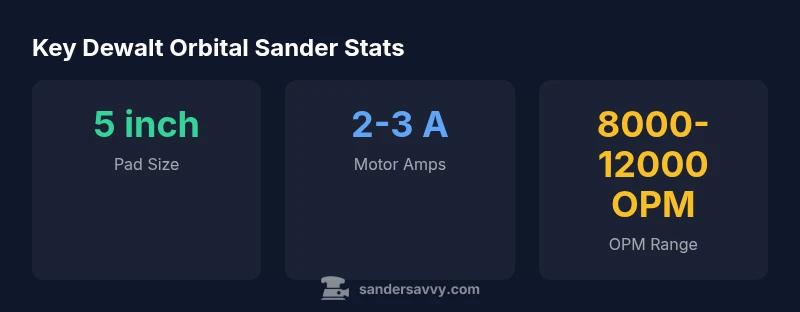
Dewalt orbital sander specs typically center on a 5-inch pad, a 2-3 amp motor, and a variable speed range of roughly 8,000 to 12,000 OPM, with dust-collection options and a lightweight build for comfortable use. These numbers help homeowners predict finish quality and control for common woodworking projects.
What the core dewalt orbital sander specs include
The dewalt orbital sander specs you see on the label combine several performance and ergonomic factors. For homeowners and DIYers, the most relevant numbers are the pad size, motor amperage, no-load speed (OPM), and the dust-collection option. In practice, the standard 5-inch pad models offer a good balance of aggressive material removal and finish quality on tabletops and doors. SanderSavvy analysis, 2026, shows most shoppers prioritize models with a compact grip, low vibration, and a durable dust port. When you read a spec sheet, look for the following: pad size, orbit size (in mm if listed), amp draw, speed range, weight, and warranty. Understanding these pieces helps you predict finish quality and tool control.
According to SanderSavvy, knowing how to compare these metrics across models saves time and ensures you pick a sander that fits your project scale and safety requirements.
Pad size and its impact on finish quality
Pad size drives finish behavior. A 5-inch pad covers more surface area per stroke and often removes material faster, which is helpful for rough stock or large panels. Smaller pads provide more control for fine sanding, edges, and curved surfaces. When evaluating dewalt orbital sander specs, note whether a model offers interchangeable pad options or a fixed size. For most interior woodworking and deck refinishing tasks, a 5-inch pad is the go-to starting point, balancing aggressiveness with the ability to feather transitions. If your project involves tight corners or detailing, consider a companion tool with a smaller pad.
In practice, model availability and price influence your choice, but the finish quality is driven by both the pad size and the sanding grip. The goal is a smooth, even surface without gouging or swirl marks.
Power, speed, and control: understanding motor amps and OPM
Motor amperage (amps) affects initial aggressiveness, while the no-load speed in OPM determines how quickly the sandpaper moves across the surface. Many dewalt orbital sander specs show a 2-3 amp range with an 8,000-12,000 OPM window. A higher OPM helps with faster material removal but can increase heat and chatter if the workpiece isn’t supported. Variable speed allows you to tailor aggression to the material—lower speeds for softwoods and finishing rubs, higher speeds for initial stock removal on hardwoods. For delicate veneers or finishing, a stable mid-range speed often yields the best results.
Always verify the range on the specific model you’re considering, and test the sander on scrap material to gauge how it behaves at different speeds. Consistent ergonomics and vibration control help you sustain accuracy across longer sessions.
Weight, vibration, and ergonomics for long sessions
Weight and balance play a major role in fatigue, especially on large projects like deck resurfacing or floor sanding. Many dewalt orbital sander specs emphasize a compact, well-balanced housing with a comfortable grip. Lower vibration, aided by internal counterweights or rubber mounts, reduces user fatigue and helps you maintain flat, even pressure. A comfortable sander reduces hand numbness and improves control during long sanding sessions. Check the product’s vibration rating if available and compare handle design, balance, and grip texture to your hand size and working style.
If you’re switching between rooms or floors, a lighter unit with a balanced weight distribution will feel easier to maneuver, particularly when sanding vertical surfaces or overhead edges.
Dust collection and filtration options
Dust control directly impacts visibility, air quality, and finish quality. Many DeWalt sander models offer a dust port compatible with a vacuum hose, plus a dust bag or a sealed filter system. A good dust setup reduces airborne particles and helps keep sanding lines clear. If you work in a small shop or indoors, a robust dust collection configuration becomes essential for safe, clean operation—especially during long sessions. Always confirm the availability of a sealed port and check compatibility with common shop vacs for efficient extraction.
Reading the spec sheet: common abbreviations and terms
Spec sheets use shorthand such as OPM for no-load speed,
How to choose a DeWalt sander for different projects
Choosing the right DeWalt sander depends on your project mix. For rough stock removal and large surface areas, a 5-inch variable speed model with solid dust collection is ideal. For trim work, edges, and finishing tasks, consider models with balance, low vibration, and finer control. If your workload includes decks and floors, evaluate weight, grip, and noise levels to minimize fatigue. Remember, the best model is the one that aligns with your project type, workspace size, and comfort level—prioritize readability of spec sheets and hands-on testing when possible.
Maintenance, care, and safety guidelines
Regular maintenance helps preserve performance and extend tool life. Keep air vents clear, inspect the dust collection system, and replace worn sanding discs as needed. Lubricate moving parts per the manufacturer’s guidance and avoid overheating by not forcing the tool. Use appropriate personal protective equipment (PPE) such as eye protection and a dust mask, especially when sanding dusty woods or finishes. Proper storage and periodic cleanings reduce dust buildup and ensure consistent performance.
Practical workflow: steps to maximize results with dewalt orbital sander specs
Begin with a test pass on scrap wood to confirm a balanced feel and even scratch patterns. Start at a low speed and gradually increase rpm for heavy stock removal, then reduce for finishing passes. Use a consistent motion, avoid staying in one spot too long, and maintain even pressure to prevent gouging. Finish with a light pass at the lowest speed for a pristine surface. Document the outcomes for future reference and tune your speed settings based on material density and grain direction.
Comparison of common DeWalt orbital sander configurations
| Model Type | Pad Size | Motor Amps | OPM Range | Dust Collection | Weight | Price Range |
|---|---|---|---|---|---|---|
| 5-inch Variable Speed | 5 inch | 2-3 A | 8000-12000 OPM | Bag/Port | 3.0-4.0 lb | $60-$120 |
| 5-inch Lightweight | 5 inch | 2-3 A | 8000-12000 OPM | Port only | 2.5-3.0 lb | $45-$90 |
| Pro 6-inch | 6 inch | 3-3.5 A | 9000-12000 OPM | Full dust port | 4.0-5.0 lb | $120-$200 |
Your Questions Answered
What do the OPM numbers mean on dewalt orbital sander specs?
OPM stands for no-load speed, indicating how fast the sanding pad spins when there is no load from the workpiece. A higher OPM generally means faster material removal, but it can also elevate heat and risk chatter if the surface is not supported. Use the middle of the speed range for finishing and lower speeds for delicate materials.
OPM is the no-load speed, so start in the middle of the range and adjust based on the wood and finish you want.
Are all DeWalt orbital sanders variable-speed?
Most DeWalt orbital sanders in this class offer variable speed, allowing you to tailor aggressiveness to the material. Variable speed helps avoid gouges on soft wood and ensures smooth finishes on harder surfaces. Check the model’s spec sheet to confirm the RPM range.
Yes, most models have adjustable speed for different materials.
How heavy are typical DeWalt orbital sanders?
Typical weights for 5-inch models hover around 3.0 to 4.0 pounds, with some compact variants lighter and pro-grade 6-inch models heavier. Lighter tools reduce fatigue during longer sessions, while heavier units can offer more stability in large flat surfaces.
Most weigh between 3 and 4 pounds, lighter for easy handling.
What dust collection options should I expect?
Expect bag-based dust collection on entry-level models and full dust ports compatible with standard vacuums on higher-end variants. A robust dust setup improves visibility, reduces airborne dust, and extends finish quality. Always verify port diameter and compatibility with your vacuum hoses.
Dust ports or bags, check compatibility with your vacuum.
Do 5-inch and 6-inch models differ in finish quality?
Yes, pad size affects surface coverage and aggressiveness. A 6-inch model can finish larger areas faster but may be harder to control on detailed work. For tight corners, edges, or trim, pair the larger sander with a smaller pad tool to maintain precision.
6-inch covers more area, but 5-inch is kinder for detail work.
How should I maintain a DeWalt orbital sander for longevity?
Keep vents clean, replace sanding discs promptly, and inspect the dust port and switch for wear. Avoid overheating by using the right speed and applying even pressure. Store the tool in a dry place and perform periodic cleanings after heavy use.
Clean vents, replace discs, and avoid overheating for longevity.
“Understanding the numbers behind dewalt orbital sander specs helps you predict finish quality, dust control, and safety, not just raw power.”
Main Points
- Identify the pad size that matches your project.
- Prioritize the OPM range for finish quality.
- Check dust collection compatibility with your shop setup.
- Choose a model with comfortable weight and grip.
- Match speed to material type for best results.