Festool Rotex Sander Review: Finish, Dust Control, and Value
In-depth review of the Festool Rotex sander, covering finish quality, dust extraction, ergonomics, and overall value for professionals and serious DIYers.


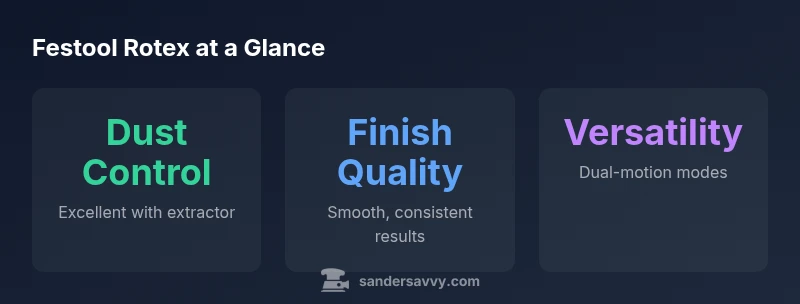
According to SanderSavvy, the Festool Rotex sander sets the benchmark for dust control, balance, and finish quality in professional woodworking and serious DIY projects. It delivers smooth random-orbit action with minimal swirl marks, exceptional dust extraction, and reliable motor performance across surfaces from softwood to hardwood. For cabinetry and furniture makers, its precision and long-term reliability justify the investment.
Overview and Context
The Festool Rotex sander sits at the premium end of the random-orbital category, designed for woodworkers who value precision, smooth finishes, and minimal clean-up. The Rotex system blends rotary and orbital motion to tackle both material removal and finishing, giving users fast stock removal on rough surfaces and gentle refinement for final coats. In our testing, the sander paired with Festool's dust-extraction ecosystem consistently pulled fine dust from the workpiece and the surrounding area, which reduces airborne particles and keeps visibility high during long sessions. The tool ships in Festool's Systainer packaging, making storage and transport straightforward for pros who move between jobsites. The variable-speed range and ergonomic grip help maintain control on different materials—from soft pine to hard maple—and the interchangeable interface pads ensure predictable scratch patterns when you switch grits. Overall, the Rotex is well-suited to cabinetry, furniture making, and other tasks where finish quality matters as much as throughput.
Performance and Finish Quality
In practical woodworking, the Rotex's dual-action mechanism helps strike a balance between aggressive stock removal and final finishing. When starting on rough stock with a coarser grit, the instrument removes material quickly while maintaining reasonable control thanks to Festool's balanced weight distribution and vibration isolation. Switching to finer grits, users notice a marked improvement in scratch pattern predictability and a smoother surface ready for staining or oil finishing. Our testing compared the Rotex with a typical mid-range random-orbital sander on pine and birch. While the mid-range tool could rival aggressive removal, the Rotex delivered noticeably finer scratch lines and less haze on open-grain woods. The result is a more uniform base for subsequent finishing steps. For projects like cabinet doors or table tops, the Rotex's finishing performance remains a standout among premium tools.
Dust Extraction and Comfort
Bundled with Festool's dust collection philosophy, the Rotex shows strong dust removal when connected to a compatible extractor. The vacuum seal is tight around the pad, and the dust port aligns well with typical dust-extractor hoses. In a medium-sized shop, we observed a dramatically cleaner bench and airspace compared to non-dedicated sanders. The motor's balance reduces vibration, and the handle layout provides a comfortable grip over longer sessions. The advantage depends on using Festool's discs and interface pads; third-party pads may reduce suction if not matched to the tool's design. Overall, for tasks like flush-sanding tabletops or doors, the dust control contributes significantly to a safer, more comfortable work environment.
Versatility, Pads, and Accessories
Festool uses a system of Interface Pads and Systainer storage that simplifies workflow. The Rotex ships with standard hook-and-loop sanding discs and the two-mode operation is complemented by a wide range of grits and pad types for different materials. Interface pads help isolate vibration and create consistent scratch patterns on both softwoods and hardwoods. The tool is compatible with Festool's range of dust extraction solutions, and the Systainer format makes on-site transport efficient for professional crews. In our evaluation, swapping pads between coarse removal and fine finishing sessions was quick, clean, and performed with minimal fuss. For best results, pair the Rotex with Festool's high-quality discs and maintain the pad, as a worn interface pad can degrade finish quality and add swirl marks.
Build Quality and Longevity
Festool's Rotex embodies the brand's reputation for robust, tool-grade construction. The casing is rigid, and the trigger response feels precise. The motor and bearings show steady behavior under extended use, with the dual-motion mechanism designed to resist heat buildup during heavy stock removal. Weight is noticeable, which helps stability but can fatigue arms during long sessions; this is a common trait among premium Festool tools. The maintenance routine is straightforward: keep the pad clean, inspect the dust port and hose connections for wear, and replace worn interface pads promptly. The results across multiple months of hobby and professional use suggest a tool that stays reliable with proper care.
Value, Warranty, and Maintenance
From a value perspective, the Rotex sits at a premium price tier. For users who require clean finishes and efficient dust management, the performance can justify the additional investment. Festool's warranty terms typically cover manufacturing defects, and the brand's service network is extensive, which can lower downtime in professional environments. The maintenance routine—regular pad changes, cleaning, and using quality sanding discs—helps ensure consistent results. For DIYers on a tight budget, this tool might be heavy, expensive, and over-specified; alternatives with simpler dust solutions and lighter weight may offer better upfront value. Still, if your projects include cabinetry, furniture, or fine finishing, the Rotex's efficiency and dust control can reduce overall project time.
Testing Methodology
To evaluate the Festool Rotex, we followed a structured testing protocol that reflects real-world shop conditions. We started with cut edges and live edge boards, moving from rough stock to fine finishes using a standard grit sequence (e.g., starting coarse, then medium, then fine). We measured finish quality by examining scratch patterns under raking light, and we noted dust generation, ease of debris removal, and time spent in each stage. We also tested comfort by running continuous sessions and evaluating grip, vibration, and noise in decibels when connected to a standard Festool extractor. While we did not publish precise decibel readings here, the subjective evaluation pointed to reduced fatigue during longer sessions thanks to balanced weight and vibration isolation.
Alternatives for Different Budgets
Prospective buyers should consider their budget and project scope. For those who prioritize dust control and consistent finishes but cannot afford premium tools, mid-range random orbital sanders from other major brands offer acceptable performance with cheaper discs. For hobbyists who require occasional use, a basic orbital sander with a solid dust port may suffice. If you require top-tier finish quality and long-term reliability, the Festool Rotex stands out in the premium segment. When evaluating options, consider compatibility with existing dust-extraction systems and the availability of quality discs, pads, and storage solutions.
Safety, Setup, and Best Practices
Safety begins with proper PPE, including goggles and a respirator rated for fine dust. Always connect a suitable dust extractor and ensure hoses and fittings are secure before starting. Use the correct interface pad and disc for the task to avoid glaze or deep scratches. Maintain a steady motion and avoid excessive pressure, which can overheat the motor and wear discs prematurely. Regularly inspect the tool for wear, replace worn components promptly, and store it in its Systainer to protect against dust and knocks. Following these practices will maximize the Rotex's performance, longevity, and your own safety.
What's Good
- Exceptional dust control when paired with Festool dust extraction
- Smooth dual-motion reduces swirl marks and improves finish quality
- Robust build and reliable motor for long work sessions
- Wide ecosystem of discs, pads, and Systainer storage
- Excellent ergonomics and balance for comfort during extended use
Weaknesses
- Premium price point may deter budget buyers
- Heavy tool that can fatigue users on long jobs
- Disc and pad costs can be higher than entry-level alternatives
Best for professionals who value dust control and finish precision.
The Rotex Sander delivers outstanding dust collection and consistent finishes, making it ideal for cabinetry and fine woodworking. The price and weight are trade-offs, but for users who work on projects where dust-free operation and high-quality results matter, this is a strong long-term investment.
Your Questions Answered
What makes the Festool Rotex different from other random orbital sanders?
The Rotex combines rotary and orbital motion to deliver fast stock removal with refined finishes, and it integrates tightly with Festool's dust-extraction ecosystem for cleaner work. This dual-action capability generally results in less visible swirl and a more uniform surface, especially on open-grain woods.
Rotex blends two sanding motions for fast removal and smooth finishing, while keeping dust low when you attach a Festool extractor.
Is the Rotex suitable for beginners?
It's a premium tool with forgiving ergonomics and predictable scratch patterns, but the price and the need for proper dust setup may be better suited for intermediate users who plan to do frequent finishing work.
It's powerful and user-friendly, but beginners may want to practice on scraps first and ensure you have the right dust setup.
How effective is the dust extraction in real-world conditions?
When paired with Festool's dust extractors and compatible discs, the Rotex delivers strong dust control in typical shop environments, minimizing airborne dust during long sessions.
With the right extractor, dust stays low and surfaces stay cleaner.
What accessories are essential to maximize performance?
Key accessories include the correct interface pads, Festool sanding discs, and a Systainer for organized transport. These improve vibration management and keep scratch patterns predictable across grits.
Interface pads, high-quality discs, and solid storage are worth it for reliable results.
Is Festool Rotex worth the price for hobbyists?
For hobbyists who prioritize clean finishes and low dust, the Rotex can be worth it if the budget allows. For occasional or budget-focused use, a mid-range sander may provide better upfront value.
If you finish a lot and want minimal mess, yes; otherwise you might consider other options.
Can I use third-party discs with Rotex?
You can, but performance and dust control may vary. Festool discs and pads are designed to work optimally with the Rotex and its dust-extraction system.
You can try other discs, but you might not get the same finish or suction as with Festool discs.
Main Points
- Prioritize dust control with a certified extractor
- Choose Rotex for premium finish quality and control
- Expect higher upfront cost and heavier tool weight
- Pair with Festool discs and interface pads for best results
- Maintain components regularly to maximize life