Lowest Grit Sandpaper for Orbital Sander: Practical Guide
Explore the lowest grit options for orbital sanding, how grit sequences impact prep and finish readiness, plus safety and best practice tips. Learn from SanderSavvy insights for a smoother, safer project.


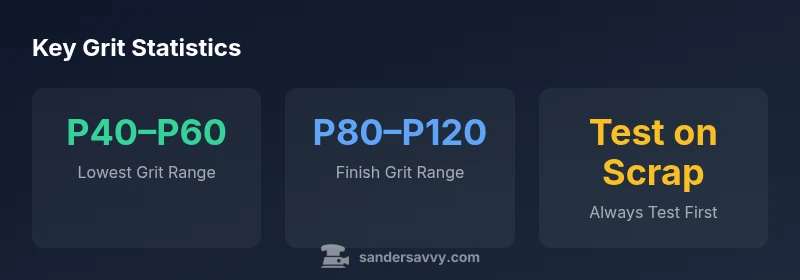
The lowest grit range commonly used for orbital sanding is P40–P60, chosen for initial material removal, with P60 being the rough end and P40 the roughest; after roughing, move to P80–P120 for smoothing depending on wood type and finish goals. Always test on scrap and observe scratches. This approach balances material removal with surface integrity.
Why the lowest grit matters for orbital sanding
When you’re preparing wood with an orbital sander, the choice of the lowest grit sandpaper for orbital sander sessions sets the pace for material removal and surface texture. According to SanderSavvy, starting with the lowest practical grit helps control tear-out and avoids gouges on soft woods. This initial step isn’t about finishing quickly; it’s about creating a surface that won’t require excessive correction later. The goal is to remove roughness without creating new flaws that complicate subsequent steps. By selecting P40–P60 as the starting point, you establish a controlled aggressive pass that can be refined later with finer grits. Remember, the surface you expose at this stage dictates how well the finish will adhere and how evenly it will absorb stain or sealant over time. Starting with the correct grit reduces the risk of deep scratches that demand heavy correction later in the process.
Understanding grit numbers and what they mean
Grit numbers describe the abrasive coarseness of sanding paper. In wood finishing, lower numbers indicate rougher grits, which remove material faster but leave larger scratches. For orbital sanders, P40–P60 is typically considered the lowest practical starting point for many woods, with P40 being the roughest. Higher numbers (P80, P120, etc.) offer finer abrasion and a smoother final surface. The key is to align grit choice with the wood’s hardness and defect level. Softer woods tolerate a slightly rougher start, while hard or dense species may require more controlled passes on the same grit to avoid tearing grain. Dosages and pressure should be controlled; never push aggressively with the lowest grit alone.
How grit progression affects wood type and finish
Different wood species respond differently to aggressive sanding. Softwoods like pine can tear easily if the starting grit is too coarse, while hardwoods such as oak may require more deliberate transitions to avoid fuzzy grain or burn marks. Moving from P40–P60 to P80–P120 typically smooths the surface and prepares it for stain or finish. On some woods, especially those with open grain, you might incorporate a slightly finer initial grit (P60) to balance removal and grain texture. The progression is not a race; it’s a controlled plan that minimizes scratches and prepares the surface for an even coat.
Practical guidelines for choosing the lowest grit for your project
Define the project goals before choosing the starting grit. For rough stock removal on soft woods, P40–P60 often works well; for pre-finishing smoothing, you may wind up at P80–P120 after a light initial pass. Always prep a scrap piece to validate the grit choice; evaluate scratch pattern, surface feel, and finish readiness. Adjust pressure and speed to maintain heat at bay—overheating can melt resin and negate grit effectiveness. If the wood has knots or dense grain, consider a lighter touch and a wider pass to avoid gouging.
Common mistakes with low-grit sanding
Common errors include starting too coarse on hardwoods, skipping grit progression, and over-sanding with low grits. Another frequent mistake is relying solely on the lowest grit to achieve a finished appearance without testing on scrap. Pro tip: document the grit sequence for each project and keep a scrap sample to compare scratch patterns. Don’t neglect masking or dust extraction, as coarse sanding generates significant airborne particles that can irritate eyes and lungs.
Safety, dust management, and PPE for low-grit sanding
Low-grit sanding generates substantial dust and fine particles. Always use a dust-collection system compatible with your orbital sander and wear a respirator or a P100 mask and eye protection. Ensure good ventilation and clean up thoroughly after completing rough passes. Sanding dust can cause allergic reactions and respiratory issues, so PPE and containment are essential even for shorter sessions. Regularly check and replace filters on your dust extraction system to maintain efficiency.
Maintenance and sandpaper care for orbital sanding
To extend the life of your sanding discs, store them flat in a clean, dry place and avoid bending the discs when mounting. Clean the sandpaper surface by tapping or brushing off accumulated dust; clogged discs lose efficiency and may burn the wood. If a disc gets worn in a localized spot, rotate its position on the pad to even out wear. Inspect the pad adhesive or hook-and-loop surface for defects and replace pads as needed to ensure consistent results.
How to test and validate your grit choice on scrap
Begin with the lowest grit you plan to use (P40–P60), then move to P80 and P120 as needed. Run the sander at a moderate speed, using light, even pressure. Compare the test piece to a known-good reference: check scratch visibility, surface uniformity, and stain acceptance. If deep scratches persist or the grain is damaged, adjust to a finer initial grit or modify the sanding plan. Document your results so future projects follow a proven workflow.
Between coats and final sanding tips
If your project requires staining or multiple coats, plan a light, progressive finish sanding after the rough pass. Typically, after roughing with P40–P60, you’d move to P80–P120 for a smooth final surface before sealing. Between coats, wipe down the surface to remove dust and inspect for uneven areas. A well-planned grit progression ensures better adhesion and color uniformity, contributing to a more durable finish.
Tooling and accessories to pair with grit choices
Choose sanding discs that pair with your orbital sander’s pad type (hook-and-loop or adhesive) and ensure the backing paper matches your dust collection needs. For coarse grits, look for discs with reinforced paper to resist tearing and to maintain abrasive integrity under load. Pair with a high-quality dust collection hood or vacuum attachment to minimize airborne dust. Consider using a micro-filter vacuum for finer grits to keep the workspace clean and safe.
Grit mapping for orbital sanding
| Grit | Typical Use | Notes |
|---|---|---|
| P40 | Rough material removal on softwoods | Aggressive; leaves deep scratches |
| P60 | Rough to mid-range prep on softwoods | More controllable than P40 |
| P80 | Mid-grade finishing on most woods | Reduces scratch visibility; good for prep |
| P120 | Finish prep on hardwoods | Smoother finish; prepares for sealer/finish |
Your Questions Answered
What is the lowest grit recommended for initial rough sanding with an orbital sander?
Typically P40 to P60; test on a scrap to confirm scratch pattern and finish readiness.
Start with P40 to P60, then test on scrap to confirm the scratches and readiness for the next grit.
Can I skip grits between roughing and finishing?
No. A proper grit progression minimizes visible scratches and yields a smoother final surface.
No—progressing through grits helps avoid rough patches and ensures a uniform finish.
Is P24 ever appropriate for orbital sanding?
Generally not recommended for most woods; can cause deep scratches and grain tear-out.
Usually not appropriate for standard woodworking; it can leave deep scratches.
How do I know when to switch grits?
Switch when scratches from the current grit are minimized and the surface feels uniformly smooth to the touch.
Switch grits when the surface feels smooth and the scratches are no longer visible.
What safety measures should I take during sanding?
Use dust collection, wear a respirator or mask, and protect eyes; ensure good ventilation.
Wear PPE and use dust collection for safe sanding.
Which mask rating is best for woodworking dust?
NIOSH-approved respirators such as P100 or equivalent provide strong protection against fine dust.
Choose a P100 or equivalent respirator for better protection.
“Starting with the right starting grit isn't just about speed—it protects grain, reduces tear-out, and sets up a clean finish.”
Main Points
- Start with the lowest practical grit (P40–P60) for roughing.
- Progress through grits to avoid deep scratches.
- Test on scrap to confirm scratch pattern and finish readiness.
- Clean and inspect surfaces before proceeding to finish.
- Pair grit choice with proper dust control and PPE.