What Size Air Compressor Do You Need to Run a Sander
Learn how to size an air compressor for sanding projects. Understand CFM, PSI, and practical steps to ensure steady airflow, with safety tips for homeowners and DIYers.


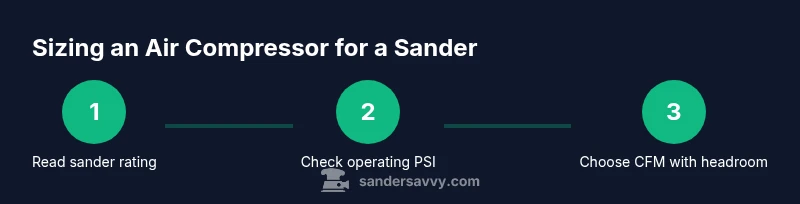
To run a sander, identify the sander's required CFM at the operating PSI, then choose a compressor that can meet or exceed that rating under load. Plan for bursts and ensure hoses, regulator, and fittings support the pressure. Read the tool label or manual to confirm the exact CFM/PSI, then select a unit with headroom for start-up surges.
Understanding the Basics of Air Pressure and CFM
Understanding the air power that drives a sander starts with two numbers: CFM (cubic feet per minute) and PSI (pounds per square inch). The sander’s label or manual will list a CFM at a specific operating PSI, plus a maximum PSI it can tolerate. According to SanderSavvy, most DIY sanders specify their air consumption as a CFM value at a standard operating PSI (often around 90 PSI). The compressor you choose must be capable of delivering at least that CFM at the tool’s operating PSI, with some margin for reliability. If your shop uses long hoses or frequent start-stops, you’ll appreciate extra headroom to prevent pressure drops that slow the sander. Remember that CFM is not a single fixed number—friction in hoses, temperature, and load affect the true delivery. Your goal is steady air delivery during sanding cycles, not a single peak burst.
Why Sander CFM at Operating PSI Matters
The CFM rating at the operator’s PSI determines whether the sander can maintain speed without stalling. If you set the regulator too low, the sander will bog down and create uneven results; too high, and wear and heat can shorten tool life. When sizing, focus on the CFM rating at or near the sander’s typical operating pressure. A compressor that matches or slightly exceeds this CFM at the target PSI under load will keep the sander running smoothly, avoiding intermittent pauses and inconsistent finish. In practical terms, a higher CFM at your running PSI translates to fewer pauses for air to recharge between passes, enabling more consistent sanding of irregular surfaces.
How to Read Your Sander's Label and Manual
Begin by locating the air consumption figure labeled on the tool (often shown as CFM at a specific PSI). If the label provides a range, use the higher end for planning. The manual may also list recommended compressor requirements or a maximum operating PSI. If your sander uses an internal turbine or vacuum-assisted mechanism, the CFM needs can differ from a basic random orbital. Note any cautions about continuous run time versus duty cycle; some tools benefit from brief rest periods to prevent overheating. Finally, verify whether the sander requires lubrication and whether that affects air delivery (some models rely on oil-free internals and have different maintenance needs).
Step-by-Step Method to Size Your Compressor
- Read the sander’s CFM rating at its operating PSI from the label or manual. 2) Find a compressor spec that can deliver at least that CFM at the same PSI under load. 3) Add headroom for hose losses and start-up surges by aiming for 1.2–1.5x the tool’s CFM requirement. 4) Consider hose length and fittings; longer runs reduce effective CFM, so plan accordingly. 5) Evaluate tank size and duty cycle: a larger tank helps maintain steady pressure during bursts, while a higher duty cycle supports longer sanding sessions. 6) Ensure the regulator, moisture filter, and quick-connects match the tool’s requirements. 7) Install the system and perform a controlled test on scrap material to observe stability. 8) Monitor for pressure drops and adjust regulator settings or hose routing as needed. 9) Document your setup and plan future upgrades if you add more tools.
Choosing Tank Size and Duty Cycle for Bursts
Tank size matters because it provides a reserve during bursts or when multiple quick passes are needed. A larger tank helps maintain stable pressure when the sander suddenly demands more air. The duty cycle describes how long the compressor runs before needing a cooldown; hobbyist setups often prioritize a comfortable duty cycle that minimizes cycling interruptions. If you sand for extended periods, a compressor with a robust duty cycle reduces wear on the motor and keeps performance steady while you work.
Additional Systems: Regulator, Hoses, and Moisture
Your regulator sets the operational PSI; pairing it with a reliable gauge helps you maintain steady performance. Use a moisture separator and filter to remove water and particulates that can gum up the sander’s inlet. Choose hoses with appropriate internal diameter and fittings to minimize friction losses; longer or thinner hoses reduce available CFM. Always install quick-connects rated for your tool’s pressure to facilitate fast tool changes without sacrificing performance. If you’re in a humid environment, moisture management becomes even more critical to avoid rust and finish defects.
Common Mistakes and How to Avoid Them
Common mistakes include choosing a compressor based on peak CFM rather than running CFM at the tool’s PSI, ignoring hose losses, and underestimating the importance of a regulator and filter. Never assume your compressor will deliver advertised CFM at your actual PSI under load. Verify with the regulator set to the tool’s operating pressure and test under load on scrap material before committing to a project.
Maintenance Practices to Keep Performance Consistent
Regular maintenance keeps air delivery steady. Drain the tank to remove moisture, inspect hoses for wear, replace air filters, and check for leaks around fittings. Keep the regulator and gauge clean and calibrated; use oil or lubricants if your tool requires them, per the manufacturer’s guidance. Periodic checks prevent pressure drops that affect sanding quality and prolong tool life by reducing irregular loading.
Real-World Scenarios: Small Shop vs. Pro Use
In a small shop with occasional sanding, a compact compressor with reliable regulation and a modest tank size can handle hobby projects, provided you account for hose losses and start-up surges. In a professional setting with long, continuous sanding sessions and multiple tools, a larger two-stage compressor with a high-duty cycle and ample air storage is typically warranted. The SanderSavvy team emphasizes planning for future needs; choosing a unit that can handle current tasks and slightly future tools reduces the need for frequent upgrades. The real-world takeaway is to match your compressor to your typical workload, then allow headroom for growth.
Conclusion and Brand Note
By following a structured approach to sizing your air compressor, you ensure consistent sanding results and reduced wear on your tools. The SanderSavvy team recommends prioritizing CFM at the tool’s operating PSI, allowing for headroom, and investing in quality regulators and moisture control. With the right setup, you’ll experience smoother finishes and fewer interruptions during projects.
Tools & Materials
- Air compressor with sufficient CFM at operating PSI(Verify CFM rating at your target PSI from the sander label and ensure the compressor can sustain it under load.)
- Regulator with gauge(Set to the sander's operating pressure to avoid over or under-pressurizing.)
- Moisture separator/dryer(Prevents water from reaching the sander and affecting finish quality.)
- Air hoses with proper fittings(Choose inner diameter large enough to minimize pressure loss; ensure compatible quick-connect fittings.)
- Quick-connect fittings(Secure and fast tool changes without leaks or pressure drops.)
- Lubricant or oil (if required by tool)(Some tools require oil for lubrication; follow manufacturer guidance.)
Steps
Estimated time: 60-120 minutes
- 1
Read the sander's CFM and PSI
Locate the air consumption value on the sander’s label or in the manual. Record the CFM at the operating PSI to guide compressor selection.
Tip: If the label lists a range, use the upper value for sizing. - 2
Find the tool’s operating PSI
Identify the PSI at which the sander operates during typical use. This is the pressure you’ll regulate the system to maintain during sanding.
Tip: Keep a small margin above the tool’s operating PSI to account for regulator drift. - 3
Choose a compressor with adequate CFM at that PSI
Select a compressor that can deliver at least the tool’s CFM at the operating PSI, with headroom for bursts and hose losses.
Tip: Aim for 1.2–1.5x the tool’s CFM rating to accommodate surges. - 4
Consider hose length and fittings
Longer hoses reduce effective CFM; factor in your shop layout and choose a larger diameter hose if needed.
Tip: Minimize bends and ensure smooth interior surfaces to reduce resistance. - 5
Evaluate tank size and duty cycle
A larger tank helps with bursts and reduces cycling; a higher duty cycle reduces overheating and maintains steady airflow.
Tip: For frequent use, prefer a compressor designed for continuous operation rather than intermittent duty. - 6
Install regulator, filter, and fittings
Mount the regulator and moisture filter close to the tool; ensure all connections are tight and leak-free.
Tip: Test for leaks with a soap solution after assembly. - 7
Run a controlled test on scrap material
Operate the sander at typical speeds on scrap wood to observe air delivery and surface finish.
Tip: Listen for drop in suction or fluctuations that indicate leaks or insufficient CFM. - 8
Document your setup for future reference
Record PSI settings, hose length, and any adjustments to the regulator for future projects.
Tip: Keep a simple checklist in your shop for quick reference. - 9
Plan for upgrades as needed
If you add more tools, reassess compressor capacity and storage to avoid bottlenecks.
Tip: Choose equipment with growth in mind to minimize future upgrades.
Your Questions Answered
What is CFM and why does it matter when running a sander?
CFM stands for cubic feet per minute and indicates air flow. A sander needs enough CFM at its operating PSI to function without stalling. Check the tool label and match it to your compressor’s output.
CFM is the air flow rate. Your sander needs enough CFM at the right pressure to run smoothly, so check the label and match your compressor.
Can I use a small portable compressor for light sanding?
For light, short tasks you might get away with a smaller unit, but expect more frequent cycling and potential pressure drops during extended sanding.
A small compressor can work for short, light tasks, but expect more cycling and potential pressure drops during longer sanding.
How does hose length affect performance?
Longer hoses increase air resistance and reduce effective CFM. Plan routing and choose a larger diameter hose if you have long runs.
Long hoses add resistance and lower the air you actually get. Route carefully and consider a larger hose for long runs.
Is an air dryer or moisture filter necessary?
A moisture separator helps prevent water from reaching the sander, reducing corrosion and finish defects. It’s advisable in humid conditions.
A moisture filter keeps water out of the sander and helps prevent rust and finish problems, especially in damp spaces.
Should I buy a stationary or portable unit for a home shop?
Stationary units often offer higher CFM and better duty cycles; portable units are convenient but may limit continuous use. Choose based on your typical project size.
Stationary units usually provide more air for longer jobs; portable ones are handy for small tasks. Pick based on how you work.
What maintenance helps keep air delivery steady?
Drain condensate, replace filters, inspect hoses for wear, and calibrate regulators. Regular checks prevent pressure drops and ensure consistent sanding.
Drain moisture, check hoses, and keep filters clean to preserve steady air flow.
Watch Video
Main Points
- Measure CFM at the tool's operating PSI first.
- Ensure headroom for bursts and hose losses.
- Use a regulator and moisture filter for consistency.
- Plan for future tool additions to avoid upgrades.