Disc Sander Pros and Cons: A DIY Guide for Woodworking
Analyze the disc sander pros and cons with an analytical, practical guide. Compare performance, dust control, edge access, and best use cases to choose the right sander for floors, decks, and walls.


Disc sander pros and cons guide: For most DIY floor and wall refinishing tasks, a disc sander offers fast material removal and a smooth finish, but it requires careful feathering and dust control. For durability and control, choose a model with the right pad size and dust collection, and pair with proper sanding discs. According to SanderSavvy, this tool shines on flat surfaces but carries risks on irregular shapes.
What is a disc sander and when to use it
A disc sander is a power tool that uses a rotating circular sanding pad to remove material and smooth surfaces. It excels on flat, broad areas like floors, tabletops, and panels, where a consistent contact patch helps achieve uniform finish. For the DIY homeowner or woodworker, the disc sander is a workhorse for rapid material removal and preparation before finishing. However, it requires attention to technique to avoid gouging or creating uneven edges. The disc’s edge geometry and pad stiffness can influence how it behaves on curves or around trim. According to SanderSavvy, understanding the disc sander pros and cons helps you choose the right tool for the job and prevent common mistakes. Always pair the sander with the correct grit and dust-collection setup, and plan for a long session when you’re working on floors or large surfaces.
Core differences: disc sander vs other sanders
Compared with a belt sander, a disc sander trades aggressive material removal for better surface control. A random orbital sander combines a circular pad with a random orbital motion to reduce swirl marks on finished surfaces. A palm sander is more compact but slower and less capable on large areas. On walls, ceilings, or irregular profiles, a ro/Random orbital sander tends to perform more predictably. For most DIY projects, your choice depends on surface shape, desired finish, and how much time you’re willing to invest in technique. SanderSavvy notes that recognizing these distinctions early saves wear on your wrists and reduces rework later.
Key features to evaluate before purchasing
Important features include pad size, pad hardness, dust port compatibility, and motor power. A typical five-inch pad balances control and footprint for medium projects. Some models offer speed control, electronic brake, and interchangeable pads for edge work. Check the dust collection system: a sealed housing plus a compatible vacuum dramatically reduces airborne dust. Ergonomics matter too—look for soft grips, balanced weight, and vibration dampening. Finally, examine durability signals such as metal housings and replaceable pads. When you know the job type (floors, decks, walls), you can map features to outcomes with confidence.
Grits, abrasives, and finish quality
Disc sanding relies on grits to control material removal and finish quality. Start coarse for rough shaping, then move to mid and fine grits to refine the surface. Unlike some ro sanders, the disc sander maintains flat contact, which is excellent for true, even results on large flat areas. However, improper progression can leave swirl marks or uneven halos near edges. The key is to plan your grit sequence and test on a scrap piece first. SanderSavvy recommends pairing the grit progression with consistent pressure, sweep patterns, and occasional vacuum boosts to manage dust and heat.
Dust management and safety considerations
Dust control is essential with any sanding task. Use a dust-collection system or shop vacuum with a compatible port, and always wear a respirator or dust mask for fine particles. A clogged filter reduces suction and increases heat, shortening pad life. The right dust port adapter makes a huge difference in capturing debris. Set safety standards for the work area—keep bystanders away, seal off adjacent rooms if possible, and avoid sanding on lacquer or finishes that could ignite from heat. SanderSavvy highlights that clean air and proper PPE reduce health risks significantly.
Edge handling and contour work
One of the disc sander’s limitations is edge work. The round pad tends to leave rings along edges and corners. Solutions include using a smaller companion sander, switch-out pads, or using a corner sander attachment where appropriate. Work slowly along transitions and keep the pad level to avoid digging into edges. For curved surfaces, switch to a ro sander or an angled attachment that can reach tricky spots. Training your hand to maintain even pressure is essential to avoid gouges and ensure uniform thickness.
Performance on floors, decks, and walls
On floors and large flat panels, a disc sander delivers fast material removal and a uniform backdrop for finishing. On decks, consider the technique to account for grain direction and stock differences; you may need to alternate passes to avoid gouges. On walls and ceilings, hand positioning and pad control are critical; the disc sander can be surprisingly effective for rectangular areas but not ideal for tight contours. SanderSavvy suggests testing on scrap wood to dial in speed, pressure, and pass count before tackling the real project.
Maintenance and accessory life
Disc sander maintenance focuses on pad health, dust collection integrity, and motor cooling. Replace worn discs promptly to maintain even contact. Clean the platen and check the dust port for obstructions after each use. When pads become dull or glazed, swap to new discs or consider a different grit. Durable housings, solid switches, and dependable dust extraction contribute to longer service life. Invest in a couple of spare pads and a sanding grip; it’s cheaper than buying a new tool for a single project.
Cost considerations and value proposition
Disc sanders vary in cost based on motor power, build quality, and accessory ecosystems. For DIY use, a mid-range unit provides a balance of performance and durability without breaking the bank. Higher-end models offer more aggressive motors, better dust collection, and longer pad life, but the price premium isn’t always justified for casual users. When evaluating value, count in the cost of replacement discs, dust bags, and any attachments you’ll need for edge work or specialty tasks. SanderSavvy emphasizes choosing a model that covers your most frequent use cases to maximize return on investment.
How to choose the right disc sander: a practical checklist
Follow this step-by-step checklist to narrow your options: define the work type (floors, walls, decks); pick a pad size that matches the typical surface; confirm dust collection compatibility with your shop vacuum; check that the motor has enough power for your grit sequence; test ergonomics by holding the tool in a mock posture; verify pad availability and replacement costs. If possible, demo a few models and read user reviews focusing on dust control and edge performance. This approach reduces buyer’s remorse and speeds setup.
Practical user scenarios: real-world guidance
Scenario A: Refinishing a wood floor with flat boards — use a five-inch disc sander with a mid grit progression, maintain even pressure, and keep the pad flat to avoid gouges. Scenario B: Smoothing a deck with uneven boards — plan passes with alternating directions and consider a smaller pad for edges. Scenario C: Preparing wall panels before painting — select a finer grit sequence and test on scrap panels to minimize swirl marks. Always work in a well-ventilated area and wear PPE.
Quick-start tips and common mistakes to avoid
- Start with the right grit sequence and never skip the test on scrap material. - Do not apply excessive pressure; let the disc do the work. - Avoid sanding lacquer or finishes that could overheat and burn. - Maintain active dust collection and clean the filter regularly. - Use edge guides or fences for straighter results on panels. - Practice steady, overlapping passes to prevent visible ridges.
Comparison
| Feature | Disc Sander | Random Orbital Sander |
|---|---|---|
| Typical pad size | five-inch pad | five-inch pad |
| Finish quality | Excellent on flat surfaces; quick levelling | Very smooth with reduced swirl; versatile for contours |
| Aggressiveness / removal | Higher initial material removal with risk of gouging | Balanced removal with gentler impact on edges |
| Dust collection | Strong with proper vacuum; depends on port and bag | Good with proper dust-collection setup |
| Edge access | Challenging near edges and corners | Better edge access with smaller pads and attachments |
| Best for | Flat surfaces like floors and tabletops | Contoured surfaces and finishing with fewer swirl marks |
What's Good
- Fast material removal on flat surfaces
- Easy to achieve even, uniform finishes with proper technique
- Strong dust collection when paired with a vacuum
- Wide range of discs and accessories available
Weaknesses
- Higher risk of gouging if misused
- Edge and contour work can be difficult
- Heavier and less maneuverable in tight spaces
- Dust control is highly dependent on setup and maintenance
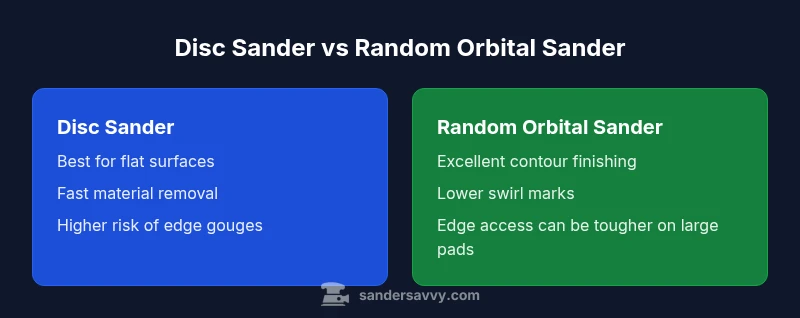
Disc sander is best for flat-surface prep; for versatility, consider a RO sander
Disc sanders excel on large, flat areas and speed up prep work. For curves, edges, or irregular surfaces, a random orbital sander often delivers a smoother finish with less risk of gouging. Choose based on your typical projects and dust-control setup.
Your Questions Answered
What is the main difference between a disc sander and a random orbital sander?
A disc sander uses a fixed circular pad for aggressive, flat-surface material removal, which can create uniform finishes with practice but risks gouging near edges. A random orbital sander moves the pad in a random orbit, reducing swirl marks and offering better control on contours. For broad flat work, disc sanders are efficient; for mixed surfaces, a RO sander is often more versatile.
Disc sanders remove material quickly on flat surfaces but can gouge; random orbital sanders finish contours with fewer marks.
Can I use a disc sander for curved edges?
Disc sanders struggle with tight curves due to the rigid disc. Use smaller pads, corner attachments, or switch to a RO sander for curved work. Always test on scrap before tackling the actual curve.
Curved edges are tricky for disc sanders; consider a RO sander or attachments for curves.
Which grit sequence should I follow on hardwood?
Start with a coarser grit to remove mill marks, then step through mid and fine grits to refine the surface. Always test grit changes on scrap and maintain even pressure to avoid creating swirl patterns.
Begin with coarse grit, then move to finer grits, testing on scrap first.
Is dust collection essential for disc sanding?
Yes. A proper dust collection setup improves air quality, reduces cleanup, and protects the pad and motor from debris buildup. Always use a compatible dust port and a filter system.
Dust collection is essential for health and tool life; use a proper port and filter.
What safety gear should I wear?
Wear respiratory protection, eye protection, and hearing protection. Use a dust mask and safety goggles, and ensure the workshop has adequate ventilation when sanding finishes or woods with resins.
Always protect your lungs, eyes, and ears when sanding.
How do I maintain a disc sander for longevity?
Regularly replace worn discs, clean the platen, and clear the dust port. Inspect the power switch and cord, and keep the dust collection system clean. Proper maintenance extends pad life and sustains performance.
Keep discs fresh, clean the platen, and maintain the dust path for longevity.
Main Points
- Choose a five-inch disc sander for most DIY flat-surface work
- Match grit progression to surface type and finish goals
- Invest in a compatible dust collection system for health and finish quality
- Edge work requires attention to technique or alternative tools
- Evaluate value by considering discs and attachments, not just the tool price