What Can Replace Sandpaper? Practical Substitutes for DIY
Discover practical substitutes for sandpaper to finish wood, drywall, and metal projects. Learn sanding sponges, pads, steel wool, and backed sheets with safety tips and grit guidance for DIYers.


Alternative materials to sandpaper can smoothly finish surfaces and remove material when used correctly, often at lower cost or with less waste. Options include sanding sponges, abrasive pads, steel wool, copper wool, non-woven pads, and backed abrasive sheets. Choose based on surface type (wood, drywall, or metal), desired finish, and tool compatibility. For DIYers, starting with a sponge or pad often yields safer, controllable results.
What replacing sandpaper means for DIY
Sanding substitutes are not a one-size-fits-all solution; the best choice depends on the workpiece and finish. According to SanderSavvy, for most home projects the combination of a flexible sanding sponge and a non-woven pad can replace many uses of abrasive sheets. These substitutes reduce material waste and can adapt to curved or intricate surfaces where rigid sheets struggle. Understanding the task—whether you’re leveling a rough frame, smoothing a tacky glaze, or feathering edges—helps you pick the right substitute and prevent gouges or swirl marks. Remember that “replacement” often means using a different tool, not abandoning safety practices. Proper ventilation, eye protection, and dust containment remain essential no matter which substitute you choose. SanderSavvy’s guidance emphasizes testing on scrap wood or drywall before committing to a full project, especially when moving from coarse to fine substitutions.
Why substitutes matter in your workflow
Using substitutes like sponges or pads can speed up light refinishing jobs and reduce dust generation compared to aggressive sheet sanding. They’re flexible, cover contours better, and can be paired with power tools or hand techniques. For busy DIYers, substitutes offer safer handling for beginners and cost-effective options for ongoing maintenance tasks. The trade-off is sometimes finish consistency; you may need to work in multiple passes with progressively finer substitutes to achieve a uniform surface. In practice, you’ll often start with a sponge or pad for initial material removal, then switch to a non-woven pad or backing sheet to refine the surface.
How to evaluate substitutes by surface type
- Wood: start with a sanding sponge in a medium grit to flatten rough patches, then move to a finer pad for smoothing. For open pores or soft pine, a non-woven pad can produce a uniform finish without heavy gouging.
- Drywall: non-woven abrasive pads and light-scuff sponges work well to remove joint compound highs without ripping paper.
- Metal: copper wool or steel wool can deburr and brighten, but avoid blocked finishes or places with epoxy coatings unless you test first.
- Finishes: always test nearby an inconspicuous area before broad application; some finishes react differently to pads than to paper.
How substitutes relate to tool compatibility
Some substitutes pair better with hand sanding, while others are designed for use with orbital or palm sanders. Bent blocks or flexible sponges can hold shapes better than rigid sheets, helping you maintain even pressure across curved edges. If you rely on power tools, check that the accessory attaches securely to your sander and that the grit range remains within the tool’s recommended range to prevent overheating or glazing. The goal is to achieve the desired finish with controlled material removal and minimal dust.
Testing and calibration: a practical approach
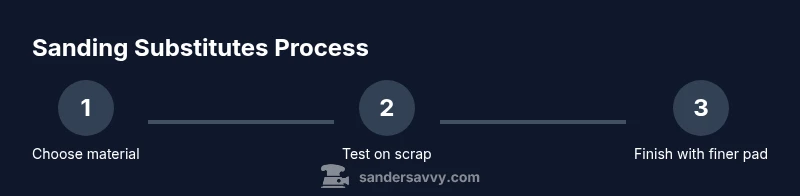
Before tackling a full project, perform a small-scale test on scrap material. This validates the chosen substitute’s effect, heat generation, and finish quality. If the test reveals scratch marks or uneven texture, switch to a finer substitute or adjust pressure. Documentation of your test results helps you refine your process for future jobs and ensures consistent outcomes across similar surfaces.
When to choose substitutes over sandpaper
Substitutes are especially useful for intricate surfaces, quick-dial maintenance, and projects requiring less aggressive material removal. They excel at feathering edges, smoothing before finishing coats, and addressing delicate veneers where sandpaper could gouge or delaminate. While sandpaper remains indispensable for heavy stock removal, substitutes extend your options and reduce waste, making DIY refinishing safer and more economical over time.
Tools & Materials
- Sanding sponge(Choose grit range appropriate to project; flexible for curves)
- Abrasive pads (non-woven, e.g., maroon/gray pads)(Effective for finishing and light deburring)
- Steel wool(Use on hard, open-grain woods with care; avoid finishes prone to staining)
- Copper wool(Less rust risk than steel wool; suitable for delicate surfaces)
- Backed abrasive sheets/blocks(Good for flat surfaces and straight edges; pair with a sanding block)
- Surface prep dust containment (dust mask, eye protection, vacuum)(Essential for safe sanding and cleanup)
- Drop cloths or old newspapers(Contain dust and protect adjacent areas)
- Rags or tack cloths(Remove dust between passes)
Steps
Estimated time: 45-75 minutes
- 1
Identify surface and finish
Assess the material and the desired final look. For curved wood, start with a flexible sponge and move to pads as needed. For drywall, plan several light passes with non-woven pads to avoid tearing paper.
Tip: Document the current surface conditions to guide grit choice later. - 2
Select a substitute material
Choose a sanding sponge for broad removal, a non-woven pad for finishing, or steel/copper wool for deburring and brightening. Ensure tool compatibility if using power tools.
Tip: If in doubt, start with the finest option that still achieves the goal. - 3
Prepare the workspace
Cover nearby surfaces and set up a vacuum or dust extraction. Wear safety gear and ensure adequate ventilation to manage dust.
Tip: Keep a dedicated scrap area for test passes. - 4
Test on scrap material
Run a small test to observe the effect of your chosen substitute, adjusting pressure and motion as needed.
Tip: If finish color changes unexpectedly, pause and switch to a milder substitute. - 5
Apply with controlled passes
Use long, even strokes and minimal pressure. Move across the surface with a consistent pattern to avoid gouges.
Tip: Work with the grain on wood whenever possible. - 6
Progress through grits or pad densities
Begin with a coarser option only if necessary, then progressively switch to finer substitutes to refine the surface.
Tip: Clean the surface between passes to prevent clogging. - 7
Inspect and adjust finish
Wipe down and visually inspect. If rough patches or scratches remain, repeat with a finer material.
Tip: Use a light raking pass across edges to blend transitions. - 8
Final cleanup and storage
Remove dust, seal or store unused substitutes in a labeled container to extend life.
Tip: Label pads by grit for quick retrieval on future projects.
Your Questions Answered
What can replace sandpaper?
Sanding sponges, abrasive pads, steel wool, copper wool, non-woven sheets, and backed abrasive sheets can replace sandpaper in many cases.
You can replace sandpaper with sponges, pads, steel wool, copper wool, and backed sheets, depending on the task.
Are sanding sponges effective on hardwood?
Sanding sponges work well for leveling softwood and smoothing edges without gouging. For hardwoods, start with a coarser sponge and finish with a finer pad to avoid scratch marks.
Yes, sanding sponges can be effective on hardwood when used with care and the right grit progression.
Can I use steel wool on veneered surfaces?
Steel wool can scratch veneer and should be avoided on thin surfaces. Use non-woven pads or backing sheets for veneers to prevent damage.
Steel wool is risky on veneer; use pads or backed sheets instead.
What grit equivalents exist for sponges?
Sponges come in a range of grits from coarse to fine. Pair them with a mild abrasive pad for finishing to approximate the effect of fine paper grits.
Sponges have varied grits; choose based on the task and finish required.
Is it faster to use substitutes?
Substitutes can be faster for light finishing and contour work, but for heavy stock removal paper or coarse pads may still be needed. Balance speed with finish quality.
Yes, substitutes can be faster for light finishing; for heavy removal, paper may be better.
How should I clean and maintain substitutes?
Regularly clean pads and sponges to prevent clogging. Store them dry and labeled to preserve grit integrity and readiness for next use.
Keep sponges and pads clean and dry, and label them for easy reuse.
Watch Video
Main Points
- Use substitutes like sponges and pads for contour-friendly sanding.
- Test on scrap to confirm finish and avoid damage.
- Match substitute choice to surface type and desired finish.
- Always prioritize safety and clean up thoroughly.