Difference Between Orbital Sander and Palm Sander
A comprehensive, objective comparison of orbital sanders and palm sanders, covering design, performance, and best-use scenarios for floors, decks, and walls.


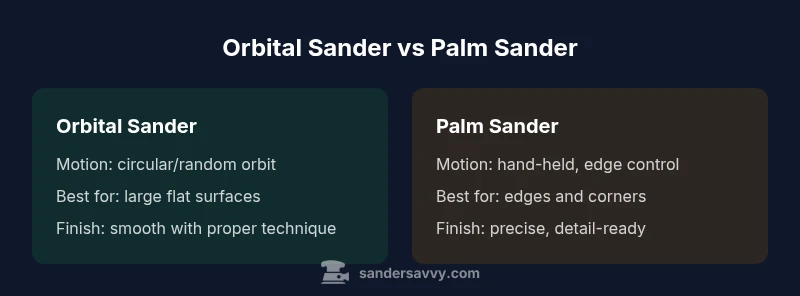
When weighing the difference between orbital sander and palm sander, consider surface area, access to edges, and finish texture. Orbital sanders excel on large flat surfaces for fast material removal with a smoother finish, while palm sanders shine in edges, corners, and detail work. For versatile projects, use a palm sander alongside an orbital sander; for broad, uniform results, prioritize the orbital sander.
Understanding the difference between orbital sander and palm sander: definitions and scope
The difference between orbital sander and palm sander is not just about size; it hinges on how the tool moves, how aggressively it removes material, and where you can reach on a workpiece. An orbital sander (often marketed as a random-orbit sander) uses a round sanding pad mounted on a motor that drives a circular motion while the pad also orbits in tiny paths. This combination yields consistent surface removal with relatively smooth finishes on broad, flat areas. A palm sander, by contrast, is a compact, hand-held tool with a square or rectangular pad that delivers material removal through a back-and-forth, vibrating action. It’s easier to maneuver in corners, along edges, and over curves. Understanding the difference between orbital sander and palm sander helps homeowners pick the right tool for the job, especially when sanding floors, decks, and walls. According to SanderSavvy, the choice is driven by task size, required finish, and workspace constraints. The difference between orbital sander and palm sander becomes a practical decision once you map project needs to tool capabilities.
How orbital sanders work: motion, cadence, and finish
The difference between orbital sander and palm sander is most evident in motion. An orbital sander places a round sanding pad on a central orbit, combining spinning and orbital movement to produce an even, fine finish on flat surfaces. The pad typically travels in tiny ellipses, reducing the likelihood of deep gouges when you keep the tool moving. This motion makes orbital sanders ideal for larger, uninterrupted areas like wood floors, tabletops, and wide decks. The sanding discs used on orbital sanders come in standard grits, and many models offer dust collection ports that connect to vacuums, further improving finish quality. The key is to maintain consistent speed and avoid applying excessive downward pressure, which can hinder the tool’s motion and lead to swirl marks. The difference between orbital sander and palm sander is how much you rely on the tool’s motion to do the work versus how much you apply downward force with your hands.
Palm sanders in detail: grip, weight, and maneuverability
The difference between orbital sander and palm sander also shows up in ergonomics. Palm sanders are lighter, typically under 2 pounds, and feature a square or rectangular pad that makes edge work and near-wall sanding straightforward. Because of their compact size and controllable vibration, palm sanders excel at soffits, window frames, crown molding, and other tight spaces where an orbital sander would feel cumbersome. The grip style—often a pistol grip or inline handle—gives precise control for delicate material, which is critical when you want to avoid gouges near joints. When used correctly, a palm sander complements broader projects by handling intricate areas that the orbital model cannot access comfortably. The difference between orbital sander and palm sander here is practicality: the palm sander provides fine control in restrictive areas, while the orbital sander covers large surfaces with speed and consistency.
Surface finish outcomes: swirl patterns, gouges, and uniformity
Finish quality is a primary factor in deciding between the difference between orbital sander and palm sander. Orbital sanders tend to produce a uniform, smooth finish on large surfaces, with fewer visible swirl marks when you maintain steady motion and a consistent distance from the surface. However, if pressure is uneven or the pad jams, swirl patterns can appear. Palm sanders, due to their smaller pad and lower mass, offer great control and precise edge finishing, but may create slightly coarser finishes if the operator isn’t moving methodically or selecting appropriate grits. The difference between orbital sander and palm sander manifests in how you balance speed against control: use the orbital sander for bulk removal and leveling, then switch to a palm sander for detail work and final smoothing near edges and corners. In practice, most projects benefit from using both tools in tandem to optimize finish quality and time.
Application scenarios: floors, decks, and walls
The difference between orbital sander and palm sander becomes practically evident when you compare common project scenarios. For floors and large deck surfaces, the orbital sander’s rapid material removal can dramatically reduce labor time, especially when paired with coarse to medium grits and a steady, technique-driven approach. For walls, ceilings, trim, and closets, the palm sander shines due to its compact footprint and ability to reach tight corners without rounding edges or leaving flat-spot gouges. When preparing drywall or plaster walls, consider using lighter grits and checking for dust containment, because both tool types generate fine dust. The difference between orbital sander and palm sander in material selection and surface preparation is a matter of matching the tool’s strengths to the portion of the job being addressed. SanderSavvy recommends planning a workflow where the orbital sander does the heavy lifting on flat areas, while a palm sander handles perimeters and corners for a flawless finish.
Setup: grit selection, discs, and dust control
Choosing the right grits and discs is essential to exploiting the difference between orbital sander and palm sander. For initial leveling on wood floors, start with a coarse grit (often around 40–60) on the orbital sander to remove high spots quickly, then progress through medium grits (80–120) to prepare for finishing. For palm sanding near edges, edges, and trim, use finer grits (60–120) and smaller pads to maintain control. The dust collection systems on modern orbital sanders are a major advantage for workspace cleanliness and safety; always connect a vacuum to the port and wear a suitable mask whenever sanding, especially indoors. The difference between orbital sander and palm sander here is in dust management: keep the workspace clean and the tool moving smoothly to minimize airborne dust and improve finish quality.
Ergonomics, safety, and maintenance tips
Ergonomics matter when applying the difference between orbital sander and palm sander to long jobs. If your project spans several hours, alternate between the two tools to reduce fatigue and vibration exposure. Always clamp or secure long boards and use push blocks to keep hands away from the sanding surface. Inspect pads regularly for wear and tear, replace damaged discs promptly, and clean dust ports after each session to keep suction strong. Safety reminders include wearing eye protection, a dust mask or respirator, and hearing protection for extended use. Following maintenance routines preserves the performance advantage of both tools, ensuring consistent results across different tasks. The difference between orbital sander and palm sander extends to long-term tool reliability when you invest in routine upkeep and proper usage practices.
Common mistakes and troubleshooting tips
Frequent mistakes in applying the difference between orbital sander and palm sander include pressing too hard, staying in one spot too long, or neglecting dust management. Pressing down can saturate the pad, reduce orbital action, and create gouges or swirl marks. Moving too slowly in one area can lead to dark, uneven patches that require additional passes. Always keep the weight balanced and let the tool dynamics do the work, selecting appropriate grits and a sequence that matches the surface condition. If you notice tracks or scratches, switch to a finer grit and recheck the tool’s speed and trajectory. Proper technique and timely maintenance help you avoid these common issues and realize the best possible finish when using the difference between orbital sander and palm sander.
Quick-start project plan: map, test, and execute
Begin by mapping your project into zones: use the orbital sander for broad, flat areas first to establish evenness and remove most of the material quickly. In corners and along edges, switch to the palm sander to preserve edges while preparing for finish. Test a small area with a coarse grit, then progressively refine with finer grits as you expand coverage. Maintain consistent speed, pressure, and motion to minimize swirl marks and achieve uniform final results. Finally, confirm that the dust collection system is functioning and monitor pad wear throughout the project. The difference between orbital sander and palm sander becomes a practical workflow when you apply methodical steps and verify results in stages.
Final considerations: scope, budget, and tool pairing
The difference between orbital sander and palm sander is not about choosing one tool exclusively; it’s about pairing tools to optimize efficiency, control, and finish quality. For large, open surfaces like floors and decks, an orbital sander is typically the best starting point. For edges, trim, and corners, a palm sander becomes indispensable to achieve precise work without sacrificing surface integrity. When budgeting, consider purchasing a mid-range orbital sander and a compact palm sander with compatible discs and pads, which can cover a broad range of tasks without requiring specialty tools. The difference between orbital sander and palm sander should be viewed through the lens of project phases—bulk removal followed by refined details—and the two tools can work in harmony to produce a professional result. SanderSavvy’s approach emphasizes using the right tool for the right moment to maximize efficiency and finish quality.
Comparison
| Feature | Orbital Sander | Palm Sander |
|---|---|---|
| Motion / Pad Path | Circular/random orbit | Rectangular/hand-held pad |
| Weight | Heavier, typically 2–4 lb | Lighter, typically 1–2 lb |
| Best For | Large flat surfaces, fast material removal | Edges, corners, and detail work |
| Finish Quality | Smooth, fewer swirl marks with proper technique | Excellent control; can require more passes for uniform finish |
| Dust Collection | Often integrated dust bag/port | Dust port compatible with vacuum; smaller footprint |
| Vibration | Moderate to high depending on model | Lower due to smaller mass and hand-held use |
What's Good
- Covers large areas quickly, boosting productivity
- Palm sander offers precision in tight spaces
- Common disc sizes and grits make switching easy
- Both tools support standard sanding pads and accessories
- Orbitals produce smooth finishes with proper technique
Weaknesses
- Orbital sanders can be bulky and harder to maneuver in tight spots
- Palm sanders may be slower on large flat surfaces
- Swirl or gouge risk if pressure and motion aren’t managed carefully
- Dust management relies on accessory setup and vacuum efficiency
Orbital sander wins for bulk removal; palm sander wins for edges and detail work
For most mixed projects, pair an orbital sander for broad areas with a palm sander for edges. This combination delivers speed without sacrificing control, and it aligns with typical floor, deck, and wall prep workflows. The SanderSavvy team recommends this balanced approach for reliable results.
Your Questions Answered
What is the main difference between an orbital sander and a palm sander?
The main difference lies in motion and use case: orbital sanders move in circular/random patterns suitable for broad surfaces, while palm sanders have a small, rectangular pad ideal for edges and detail work. This distinction guides where each tool excels in floors, decks, and walls.
The orbital sander is best for big flat areas; the palm sander handles tight spots and edges.
Can I use an orbital sander to reach edges, or should I always switch to a palm sander?
You can reach some edges with an orbital sander, but it’s usually less efficient and may risk rounding edges. For precise edge finishing, switch to a palm sander. The choice depends on how tight the corner is and how clean you want the edge to look.
Edges are better with a palm sander, especially in trim areas.
Is a random orbital sander the same as an orbital sander?
Yes. A random orbital sander is a common type marketed as an orbital sander, and it uses a randomized orbit to minimize swirl marks. The terminology often overlaps in consumer literature, but the key feature is the randomized motion for smoother finishes on flat surfaces.
Random orbital = orbital sander in most shops.
What grit progression works best for floors when using both tools?
Begin with a coarse grit (around 40–60) on the orbital sander to flatten high spots, then move to 80–120 for leveling, and finish with 180–220 for a smooth final surface. Switch to the palm sander for corners and edges with the finer grits.
Start coarse on broad areas, finish with fine grits near edges.
How do I prevent swirl marks when sanding with an orbital sander?
Maintain consistent speed and pressure, keep the pad moving in overlapping passes, and avoid lingering on one spot. Use a quality dust-collection system to keep the surface clean and reduce burnishing that can cause swirl marks.
Keep moving and don’t press hard.
What safety practices should I follow when sanding indoors?
Wear a dust mask or respirator, eye protection, and hearing protection. Use a vacuum system to control dust and work in a well-ventilated area. Regularly check filters and keep cords organized to avoid trips.
Protect lungs and eyes; keep the area dust-free.
Main Points
- Use orbital sander for large flat surfaces to accelerate material removal
- Switch to palm sander for edges, corners, and trim where control matters
- Match grit progression to surface condition and project stage
- Always connect a dust extraction system for cleaner work and safer breathing
- Prepare a two-tool workflow to maximize efficiency on floors, decks, and walls