Random Orbital Sander vs Belt Sander: A Practical Comparison for Woodworking and Renovation
A comprehensive, analytical comparison of random orbital sander vs belt sander, focusing on finish quality, stock removal, dust control, ergonomics, and project-specific guidance for floors, decks, and walls.


Exploring the random orbital sander vs belt sander reveals two distinct strengths. For smooth, swirl-free finishes, the random orbital excels; for rapid material removal, the belt sander wins. Your choice depends on project scope, finish requirement, and edge access. Both tools have trade-offs, so understanding them helps you pick with confidence.
What Each Tool Is and How It Works
Two essential sanding tools, the random orbital sander and the belt sander, operate on different principles. The random orbital uses a rotating pad with an offset eccentric motion to minimize visible scratches, producing a smooth, uniform finish on a variety of woods. The belt sander, by contrast, uses a continuous loop belt that moves in a straight line, aggressively removing material and leveling high spots. Understanding how the sanding head moves, how vibration propagates, and how dust is captured helps you predict finish quality and control when weighing the random orbital sander vs belt sander. Consider not just the surface being worked but also the surrounding details—corners, edges, and any coatings that will influence how clean your final surface looks.
In practical terms, expect the random orbital sander to feel more forgiving for novice users because of its orbit and random pattern, which tends to mask minor wobble. The belt sander rewards decisive technique and steady handling, especially on flat, straight runs. When choosing between these tools, align your decision with the desired outcome—refined finish or rapid material removal—and remember that you can often use both in succession for best results.
Finish Quality: Swirl Control and Surface Uniformity
Finish quality is the cornerstone of this comparison. The random orbital sander tends to produce a swirl pattern that blends into a smooth surface, especially when paired with progressively finer grits and careful dust collection. This makes it ideal for pre-finishing work, cabinet reshaping, and floors where a uniform appearance matters. In contrast, the belt sander can leave deeper gouges if not controlled, particularly on curved or irregular surfaces, but it excels at flattening high spots before a finish coat. Mastery of grit progression and light feathering helps mitigate the belt sander’s tendency toward aggressive material removal. Overall, the random orbital sander vs belt sander decision often hinges on how critical the final surface appearance is for your project and how much you’re willing to refine the surface after initial stock removal.
Material Removal and Efficiency
Stock removal speed is a common point of comparison. The belt sander removes material quickly, which is advantageous when tackling large, even surfaces or rough stock that requires leveling. Its efficiency comes at the cost of control and potential surface damage if the user isn’t careful near edges or detailing. The random orbital sander trades some removal rate for control, enabling more predictable results on contoured surfaces and across irregular boards. For projects like leveling a reclaimed floor or removing old finish while preserving texture, the orbital’s steady pace provides a safer path to a consistent result. If you’re aiming to finish a surface with minimal alteration, the orbital approach often wins on perceived efficiency because less rework is needed after sanding.
Edge Access and Handling Contours
Edge access distinguishes each tool’s strengths. Random orbitals are excellent for general surfaces and gentle contouring, with a status quo of even sanding across flat planes and gentle arcs. Belt sanders excel on long, straight runs and wide, flat areas but struggle near edges, transitions, and curves where the belt can overshoot or gouge if not carefully guided. For projects with tight corners—assemblies, trim work, or curved cabinet faces—the orbital sander delivers more consistent control. This distinction matters when sanding floors and decks that include irregular boards or edges where you must blend planes without leaving sharp transitions.
Dust Management and Ergonomics
Dust control is a practical concern for any sanding task. With the right attachments and a quality vacuum, the random orbital sander generally achieves robust dust collection, as the dust path is confined under the pad and hood. Belt sanders can be more challenging to keep dust contained because the belt’s movement and exposed belt area offer additional escape routes for fine particles. Ergonomics also differ: orbital sanders are typically lighter and easier to maneuver for extended sessions, reducing wrist fatigue during finish work. Belt sanders, being heavier and more aggressive, require stable stance and brace techniques to avoid fatigue and accidental gouges on difficult surfaces.
Noise, Vibration, and Comfort
Vibration and noise impact day-long projects. Random orbital sanders usually produce lower peak vibration because the orbital movement distributes impact, which improves comfort during long sessions. Belt sanders, due to their higher aggressive action, can transmit more vibration to the user, especially near edges and when working hard woods. Noise levels vary by model and attachments, but the general trend is that orbital sanders feel more comfortable for extended use, while belt sanders pay off in speed for shorter, heavy-duty tasks. Considering your workspace setup and hearing protection needs are essential in any sanding plan.
Grit Strategy and Sanding Progression
Your grit plan shapes both finish quality and time to completion. Start with a coarse grit on belt sanders when you must flatten stock, and switch to finer grits on an orbital sander for finishing passes. For the orbital, move through progressively finer grits to minimize scratch visibility and achieve a smooth surface, then conclude with a final pass at a high grit to ensure the surface is ready for finish. With a belt sander, you may perform additional orbital passes after the initial stock removal to soften any harsh transitions. A thoughtful grit progression helps you achieve the best results in the shortest practical time and reduces the risk of rework.
Typical Projects and Best Practices
For floors, belts handle leveling more efficiently on large, open spaces, but orbital sanding is often used for final smoothing and pre-finish work along board edges. Decks benefit from belt sanding for planks that require substantial material removal, followed by orbital sanding to blend and refine. Walls and ceilings may use orbital sanding to prevent gouges on flat planes, though belt sanders can remove heavy coatings when used with caution. Adopting best practices—protecting surrounding surfaces, using proper clamps, and maintaining consistent feed rates—helps you capitalize on each tool’s strengths while minimizing risks.
Attachments, Maintenance, and Longevity
Both tools rely on compatible sanding discs or belts and a clean collet/shaft interface. Regularly inspect sandpaper belts for wear, replace damaged discs, and ensure you’re using the correct grit sequence. Maintenance includes cleaning the dust shroud, checking the dust bag or canister, and inspecting power cords and switch contacts. Longevity hinges on avoiding overheating, using proper lubrication when applicable, and storing tools in a dry environment. The belt sander may demand belt replacements more frequently than orbital pads, but high-quality belts or discs can extend the time between replacements when used correctly.
Safety Practices and PPE
Sanding generates fine dust and occasional debris. Always wear eye protection, a respirator or dust mask for fine particles, hearing protection, and appropriate clothing. Keep your work area well-ventilated and use clamps to secure workpieces. Follow manufacturer guidelines for RPM limits and safety features like overload protection and dust collection safety. Begin with test passes on scrap material to calibrate pressure and motion to avoid gouging or kickback.
Cost, Availability, and Long-Term Value
Prices vary by brand, size, and included attachments. You’ll typically find belt sanders priced for heavy use compared with random orbital sanders, which offer broad availability and a balance of cost and capability. In the long term, investing in a reliable orbital option for finishing tasks and keeping a belt sander for rough stock removal often yields the best value, especially for homeowners and DIYers who tackle multiple projects per year.
Decision Framework: How to Choose for Your Project
To decide between a random orbital sander vs belt sander, start with your primary goal: finish quality or rapid material removal. Assess surface geometry—flat planes, edges, or contours—and consider dust management needs and workspace constraints. If you value a refined finish and minimal swirl, prioritize an orbital sander; if you must flatten stock quickly on broad surfaces, a belt sander wins. In mixed projects, a staged approach—belt sander for initial leveling, orbital sander for refinement—often yields the best results.
Comparison
| Feature | Random Orbital Sander | Belt Sander |
|---|---|---|
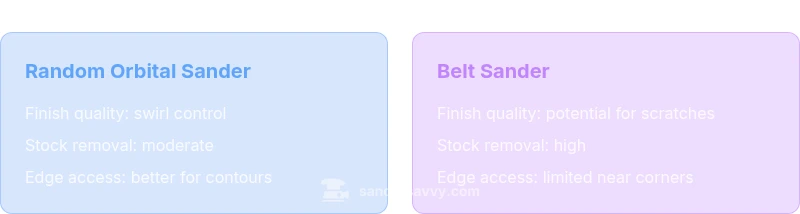
| Finish Quality | Swirl-free, consistent surface | Potential for deeper scratches or gouges if not controlled |
| Stock Removal | Moderate, with better control | High removal speed on flat surfaces |
| Edge Access | Better on curved/contoured areas | Limited edge and corner access |
| Dust Collection | Typically strong with good hood/dust bag | Depends on belt path; can be less contained |
| Vibration/Ergonomics | Lower fatigue; smoother feel over long use | Higher vibration; more hand-arm stress |
| Weight/Size | Lighter and more compact | Heavier and bulkier in many models |
| Best For | Finishing, refinishing, fine surfaces | Quick flattening, rough stock removal |
| Cost/Availability | Widely available; good value | Higher upfront cost; fewer specialized options |
What's Good
- Delivers smooth, swirl-free finishes with less risk of gouges
- Versatile for curved and detailed surfaces
- Strong dust collection with proper setup
- Easy to control and beginner-friendly
Weaknesses
- Slower stock removal compared to belts
- May require finishing passes after belt work
- Can leave slight scratch patterns if technique isn’t refined
- Reliant on proper technique to avoid edge gouging
Orbital sanding is the better overall choice for finishing; belts dominate for bulk removal
For projects where surface finish is critical, the random orbital sander consistently delivers superior results with less risk of gouges. Use a belt sander when you need rapid stock removal on flat surfaces. A combined approach—belt for the heavy work, orbital for refinement—often yields the best outcome and value.
Your Questions Answered
What is the main difference between a random orbital sander and a belt sander?
The random orbital sander uses a small, circular pad that spins while moving in an orbital pattern, which minimizes gouging and produces a smooth finish. A belt sander uses a continuous belt that moves in a straight line for rapid material removal, but it can leave deeper scratches if not controlled.
The orbital is for finish work; the belt is for fast stock removal. Choose based on your goal.
Can I finish with a belt sander?
Finishing with a belt sander is possible but risky; it can gouge edges or create uneven patches. If you start with a belt, follow with an orbital sander and fine-grit passes to even out scratches.
You can, but you’ll likely need to go back over with an orbital sander for a smooth finish.
Is dust collection effective with both tools?
Dust collection depends on the setup. An orbital sander often integrates well with a hood and vacuum, reducing fine dust. A belt sander can be trickier to seal, so a high-quality dust bag or an external vacuum is recommended.
Yes, with good attachments—especially on the orbital sander.
Which tool is best for floor sanding?
For floors, a belt sander is typically used for bulk leveling of large flat planes, followed by an orbital sander for finishing passes to remove scratches and prepare for the finish. The exact approach depends on floor type and coatings.
For floors, start with the belt, finish with the orbital.
What grit progression should I follow for each tool?
Begin with a coarse grit on the belt for stock removal, then move to finer grits. For the orbital, use progressive grits from coarse to very fine, finishing with the finest grit recommended for the coating you’ll apply.
Cross-check the coating’s sanding guidelines and go slow on transitions.
Are belt sanders safe for edges and corners?
Belt sanders can gouge edges if not guided carefully. Use edge guides or perform edge work with an orbital or palm sander to blend edges smoothly.
Be cautious near edges; orbital sanders are safer for corners.
Main Points
- Assess project goals to balance finish quality and removal speed
- Choose random orbital for finishing; belt for aggressive stock removal
- Plan grit progression to minimize rework and maximize efficiency
- Invest in proper dust collection and safety gear for cleaner, safer sanding