Belt Sander vs Random Orbital: A Practical Comparison
Compare belt sanders and random orbital sanders to decide which is best for stock removal, finishing, and edge work. This guide covers performance, surfaces, dust control, and practical workflows for floors, decks, and walls.


In the belt sander vs random orbital comparison, you’ll see two tools designed to smooth wood, but they win on different tasks. A belt sander is unmatched for rapid stock removal on flat surfaces, while a random orbital sander excels at finishing with minimal swirl. Use this guide to map your project needs, plan a workflow, and decide whether you need one tool or a complementary pair.
Belt Sander vs Random Orbital: Core Differences
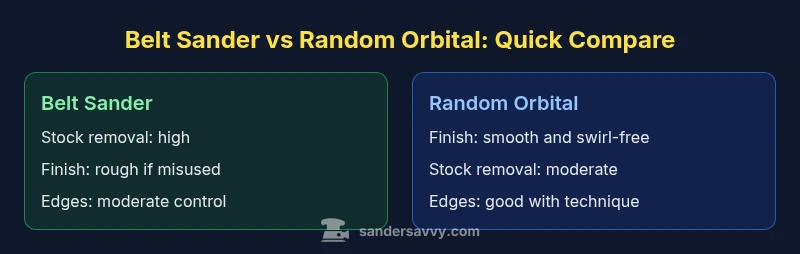
In the belt sander vs random orbital framework, two common tools target the same broad goal of surface smoothing, yet their mechanics and results diverge. A belt sander uses a continuous abrasive belt that runs in a straight line, delivering aggressive stock removal and rapid flattening of flat surfaces. A random orbital sander uses a round pad that both spins and orbits in irregular patterns, producing a finish that is generally smoother and swirl-free. For homeowners and DIY enthusiasts, the practical upshot is clarity: choose the belt sander when you need fast material removal on flat stock, and choose the random orbital when your priority is finish quality and ease of use. SanderSavvy’s team notes that many projects benefit from starting with the belt for rapid leveling, then finishing with a random orbital to achieve a uniform, professional look.
Belt Sander: Mechanism, Capabilities, and Limits
A belt sander mounts a continuous abrasive belt around two drums. The belt’s straight, high-speed motion enables aggressive removal on flat surfaces, making it ideal for flattening rough subfloors or stripping old finishes. The downside is precision: it can gouge if guidance slips or if pressure is excessive, especially near edges. Belt sanders are best when paired with a straight edge guide to keep the belt on course. Use coarse grits for stock removal, then step down to finer grits if finishing directly after removing material. Manage heat by avoiding prolonged runs on a single pass and inspect belts for glazing. Dust collection helps but should not replace proper respiratory protection in poorly ventilated spaces.
Random Orbital Sander: Mechanism, Capabilities, and Limits
The random orbital sander combines a circular pad with a hammering-like orbit. The combined movement minimizes swipe marks and produces a consistently smooth surface with lower risk of gouging. It removes material more slowly than a belt sander, but its versatility shines in finishing work, between coats, and on curved or irregular surfaces. It handles edges and contours better when used with compatible grits and a steady technique. Effective dust control depends on a robust vacuum system and a well-sealed dust port. Pad maintenance and occasional replacement extend tool life and maintain performance.
Performance in Real World Tasks: Stock Removal vs Finishing
For rough stock removal on flat surfaces, the belt sander delivers the best pace per pass, making it the preferred tool for leveling noisy floors or decks where time matters. When your goal is a flawless finish ready for stain or sealant, the random orbital sander delivers a superior surface with minimal visible patterns. In practice, experienced DIYers use both tools in sequence: belt sander to knock down high spots, then random orbital to refine and even out the texture. The critical pacing point is to avoid attempting finishing with a belt sander on a surface still requiring significant leveling. SanderSavvy’s experience underscores the value of a two-stage approach for professional results.
Best Use Cases by Task Type
- Heavy stock removal on flat surfaces: Belt sander excels with coarse grits (e.g., 40–60) to flatten quickly.
- Finishing and sheen control: Random orbital shines with mid to fine grits (e.g., 100–220) for a smooth, uniform look.
- Edges and contours: Orbital sanders handle curves well; belts can be used with care or with a dedicated edge sander.
- Stain preparation: Use the orbital sander for the final smoothing to minimize swirl marks; reserve the belt for initial leveling if necessary.
- Furniture and trim: The random orbital is generally more versatile; use the belt only when you truly need fast removal on large flat areas.
Edge Handling, Contours, and Access
Sanding near edges is a common pitfall. A belt sander can gouge if the belt drifts or pressure is uneven, especially along trim and door frames. For precise edges, a compact palm sander or a smaller orbital sander is often the safer choice, while experienced users can achieve decent results with a belt sander by using guides and maintaining light, even pressure. When working on curved surfaces and radiuses, the orbital’s rounded pad and random motion offer superior control and uniform contact.
Dust Collection, Safety, and Workplace Cleanliness
Dust control is essential for health and visibility. Most sanders offer a dust port compatible with shop vacuums and can be fitted with dust bags. A well-designed dust system minimizes airborne particles and keeps your work area cleaner. Always wear a respirator or dust mask, eye protection, and hearing protection. A robust vacuum with a HEPA filter improves air quality, while frequent bag or canister emptying prevents loss of suction. SanderSavvy emphasizes that better dust control improves both safety and results.
Materials and Surface Considerations
Hardwoods react differently to belt versus orbital sanding. A belt sander can level rough stock quickly on hard woods, but if used improperly, it can leave visible belt marks. A random orbital sander tends to blend irregularities and produce a more uniform surface, especially when switching grits progressively. Softwoods are forgiving but still benefit from proper grit progression. For painted or varnished finishes, orbital sanding often yields a smoother surface with less risk of creating uneven patches. Always test on a scrap piece before applying to the full project.
Maintenance, Consumables, and Costs
Belt and disc consumables are common but vary by brand. Belts wear out and require replacement; availability of belt sizes and grits can influence cost and downtime. Likewise, orbital sanders use discs that must be matched to the pad size. The two tools share maintenance needs such as cleaning vents, checking dust ports, and inspecting the sanding pad or belt for glazing. Quick belt changes improve workflow but require correct tension and alignment. Budget for spare belts and discs to avoid delays during a project.
Practical Workflows for Floors, Decks, and Walls
A typical floor workflow begins with a belt sander to knock down the worst irregularities, followed by a random orbital sander for finishing passes. For deck boards, use the belt to remove old finishes or splinters, then switch to an orbital sander to create a uniform surface ready for staining. Walls and trim call for a lighter touch with an orbital sander, reserving the belt for heavy stock removal on stubborn patches. Always verify the surface on scrap wood and adjust your grit sequence based on the wood species and desired finish. Plan dust management at every step for a cleaner job site.
Common Mistakes and Troubleshooting
Pressure that is too heavy can cause burn marks, gouges, or heat buildup that damages the wood. Starting with too fine a grit on heavy stock removal can slow you down and lead to uneven results. Poor dust collection reduces visibility and finish quality. To fix these issues, back off pressure, switch to appropriate coarser grits for bulk removal, test on scrap areas, and ensure the dust system is functioning properly. If swirl marks appear on finished surfaces, reassess the grit progression and the steadiness of your movements. Regular maintenance and practice reduce most problems over time.
The One Tool Dilemma: Should You Buy One or Both?
If budget restricts you to a single sander, a high quality random orbital sander is the most versatile choice for most DIY tasks. It handles preparation, finishing, and light stock removal with a lower risk of marks. If you frequently work on flat, rough surfaces or need to strip stock quickly, adding a belt sander later makes sense. The optimal workflow for many projects is to start with the belt for level and roughing, then finish with a random orbital for a refined look. The best plan is to own both eventually, but the orbital often delivers the broadest value for a typical home workshop.
Comparison
| Feature | Belt Sander | Random Orbital Sander |
|---|---|---|
| Best for stock removal on flat surfaces | Very high aggressiveness on flat stock | Moderate to high removal depending on model |
| Finish quality and swirl control | Can leave belt marks if not used carefully | Excellent finish with swirl-free patterns |
| Edge and corner access | Challenging near edges without guides | Good edge and corner performance with proper technique |
| Dust collection efficiency | Dust collection varies by belt width and porting | Typically strong with proper vacuum setup |
| Weight and fatigue | Generally heavier and require steadier control | Often lighter and more maneuverable |
| Consumables availability | Belts are widely available and affordable | Discs vary by brand and pad compatibility |
| Best overall workflow suggestion | Ideal for bulk stock removal on flat surfaces | Ideal for finishing and general purpose tasks |
What's Good
- Clarifies when to use each tool for a task
- Highlights finish vs removal tradeoffs
- Helps plan a practical, cost‑efficient workflow
- Encourages safer, cleaner sanding practices
Weaknesses
- Models vary widely; outcomes depend on grit and technique
- Two tools may be needed for optimal results
- Assumes access to both tools or rental options
For most DIYers, start with a random orbital sander and add a belt sander if heavy stock removal becomes a regular need
The random orbital is the versatile, safer first choice for finishing and general prep. A belt sander unlocks fast removal on flat stock. The best long-term approach is to own both, but you can achieve professional results with a strategic two-step workflow and good dust control.
Your Questions Answered
What is the main difference between a belt sander and a random orbital sander?
The belt sander uses a continuous belt for rapid stock removal on flat surfaces, while a random orbital sander uses a circular pad that orbits and spins to deliver a finer, swirl-free finish. The belt is aggressive; the orbital is finishing-focused.
Belt sanders remove material quickly on flat areas, but can gouge. Random orbitals finish smoothly with less risk of marks.
Can a belt sander be used for finishing tasks?
It can, but it’s not ideal for a high-quality finish. Use a belt sander for bulk removal only, then switch to a random orbital for final smoothing to avoid visible belt marks.
Belt sanders are best for removal; finish with an orbital for a top-notch look.
Is a random orbital sander better for edges?
Yes, random orbital sanders handle edges and contours more predictably. Belt sanders can work near edges but require careful technique or an auxiliary edge sander.
Orbits and smooths well at edges; belts need caution near corners.
What grit sequence should I use for belt sanding on hardwood?
Start with coarse grits (40–60) for stock removal, then progress through medium (80–120) to fine (180–220) on finishing passes when appropriate.
Begin coarse, move to finer grits as you flatten then finish.
Can I rent a belt sander if I don’t own one?
Yes, many home improvement stores offer belt sanders for rent. Renting is a cost effective option for one-off projects or to test compatibility with your work before buying.
Renting lets you test the tool before committing.
How do I maintain belts and discs for best results?
Inspect belts for glazing, replace worn belts promptly, and keep discs clean. Use proper tension and alignment to prevent poor performance.
Keep belts clean and replace worn ones to maintain efficiency.
Main Points
- Choose the tool by task: stock removal vs finishing
- Reserve belt sander for aggressive flattening on flat surfaces
- Use random orbital for finishing, edges, and curves
- Pair tools with a solid dust collection plan
- Test on scrap before committing to the project