Orbital vs Non-Orbital Sander: Choosing the Right Tool for Woodwork
Compare orbital and non-orbital sanders to decide which tool delivers the best finish, control, and dust management for floors, decks, and walls. This analytical guide covers motion, finish quality, ergonomics, and maintenance to help homeowners choose wisely.


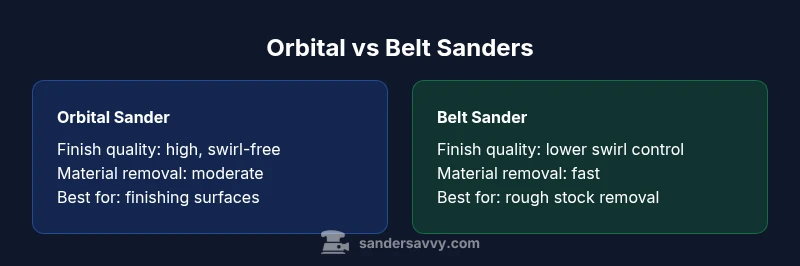
Orbital vs non orbital sander choices hinge on motion, finish, and control. An orbital (often random orbital) sander uses a rotating pad with a small orbit to minimize swirl marks, while a non-orbital option like a belt sander uses a straight-line belt for rapid material removal. For finishing work, orbital tools are generally preferred; for aggressive stock removal, belt sanders win—balanced by dust control and safety needs.
What orbital vs non orbital sanding means in practice
Sander selection hinges on the motion pattern, finish quality, and dust management. Orbital vs non orbital sander conversations come up often for homeowners and DIY enthusiasts tackling floors, decks, and walls. According to SanderSavvy, understanding how each tool moves helps you predict swirl, stock removal, and control. An orbital sander describes a pad that orbits in a small circle (sometimes with a subtle elliptical motion), while a true non-orbital sander usually uses a belt or straight-line action. The resulting surface, tool ergonomics, and dust behavior differ, so aligning the tool to your project reduces rework and wear.
For most home projects, your choice should balance finish quality, speed, and dust control. The orbital vs non orbital sander debate is not about one being universally better; it’s about picking the right tool for the surface and goal. If you’re refinishing a hardwood floor or smoothing a cabinet face, an orbital model typically delivers the best blend of finish and reliability. If you’re removing heavy stock from a rough doorway jamb, a belt sander might be more efficient—provided you have steady hands and a deliberate technique.
SanderSavvy’s practical approach emphasizes testing on a sacrificial scrap and gradually adjusting grit and pressure. In addition, the decision should consider operator comfort, noise, and the availability of compatible dust-extraction setups. If you’re new to sanding, start with an orbital sander to learn material behavior before moving to a belt for bulk removal.
wordCount: 0},
Comparison
| Feature | Orbital sander | Belt sander |
|---|---|---|
| Motion pattern | Rotating pad with small orbit (randomized on many models) | Continuous belt motion (straight-line, non-orbital) |
| Finish quality | Typically smoother with fewer swirl marks; ideal for finishing | |
| Material removal rate | Slower per pass; favors fine finish and control | |
| Dust collection | Good with vacuum/dust-collection bags; works well with edge access | |
| Best for | Finishing, prep work, furniture, floors where a fine finish is desired | Aggressive stock removal, shaping edges, rough work |
| Typical weight/ergonomics | Light to mid-weight; forgiving for long sessions | |
| Price range (typical) | $60-$250 | $50-$180 |
What's Good
- Delivers smooth finishes with minimal swirl when used correctly
- Excellent for light to moderate material removal and edge work
- Widely compatible with standard sanding grits and accessories
- Compact, versatile options available for DIYers
Weaknesses
- Orbital sanders may require more passes for heavy stock removal
- Belt sanders can gouge wood if guidance is not careful or consistent
- Dust control can be less effective on belts without a proper vac system
- Some models have higher vibration on max load
Orbital sanders are generally the better choice for finishes; belts excel at heavy stock removal when used by experienced operators.
For most homeowners and DIY tasks, start with an orbital sander to achieve a smooth, swirl-free finish. Reserve a belt sander for rapid removal on rough surfaces, but use care to avoid gouges. The SanderSavvy team notes that matching the tool to the task minimizes rework and dust exposure.
Your Questions Answered
What is the main difference between orbital and belt sanders?
The core distinction is motion: orbital sanders move a small circular orbit to create a smooth finish, while belt sanders drive a continuous belt for rapid material removal. This affects finish quality, control, and the effort required for project completion.
Orbitals move in a small circle for a smooth finish, belts move a belt for quick stock removal.
Which sander is best for finishing floors?
For floors needing a smooth, even surface with minimal swirl, an orbital sander is typically the best choice. It finishes uniformly and works well with finishing grits to prepare the surface for coatings.
Orbital sanders are the go-to for finishing floors.
Can you use an orbital sander on edges and corners?
Yes, but you’ll often need smaller profiles or detail attachments to reach corners and edges without rounding them. Start with broad areas and finish edges with a detail sander or hand block.
Use a detail tool for edges to avoid rounding them.
Is a random orbital sander the same as an orbital sander?
A random orbital sander is a type of orbital sander that combines random orbit motion with rotation to minimize visible swirl marks. Not all orbital sanders are random orbital, but most consumer models are.
Most orbital sanders today are random orbital, offering better finish.
What safety gear is needed when sanding?
Always wear eye protection, a dust mask or respirator, hearing protection, and gloves if needed. Ensure adequate ventilation and use a dust extractor to minimize airborne particles.
Protect eyes, lungs, and ears, and use a dust extractor.
How do you switch from belt to orbital sander on a project?
Plan your workflow to reserve the belt sander for stock removal stages and the orbital sander for finishing passes. Use a stable work surface, and guard edges to prevent gouges when transitioning between tools.
Reserve belt for rough work, orbital for finishing.
Main Points
- Choose based on finish vs. removal needs
- Orbital for finishing, belt for stock removal
- Prioritize dust control and ergonomics
- Test on scrap wood to dial in grit and pressure
- Pair with a reliable dust-extraction setup