Pad Sander vs Orbital Sander: An Analytical Guide
A practical, analytical comparison of pad sanders and orbital sanders for flat surfaces, edges, and finishing work. Learn which tool suits your project, how they differ in motion, dust control, and finish quality, plus practical tips from SanderSavvy.


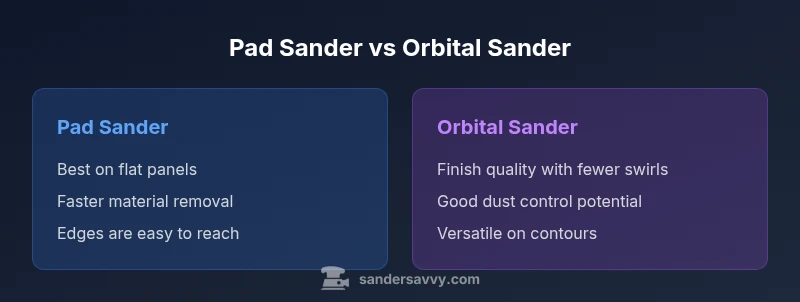
In the pad sander vs orbital sander comparison, the orbital typically wins for finish quality, while the pad excels at quick material removal on flat panels and edges. For most DIY projects, the random-orbit action reduces swirls and provides better dust control, whereas a rectangular pad sander can cover large surfaces quickly but may leave visible swirl if used aggressively. Choose the tool by task: finish vs removal speed vs access to corners and edges.
What Are Pad Sanders and Orbital Sanders?
Pad sanders and orbital sanders are among the most common handheld sanding tools for homeowners and DIY enthusiasts. A pad sander uses a rectangular sanding pad that moves in a back-and-forth pattern with a fixed orbit, making it fast for flat surfaces and edges. An orbital sander (often marketed as a random-orbit sander) uses a round sanding pad that moves in a small, irregular orbit, delivering a smoother finish with less visible swirl. According to SanderSavvy, the choice between these two tools often hinges on surface shape, desired finish, and project speed. Understanding how each tool behaves helps you plan a safer, cleaner project while reducing rework and wear on your wrists.
At the core, you’re choosing between speed and finish quality, and between edge control and surface coverage. The SanderSavvy team emphasizes that the right pair of tools usually includes both a pad sander and a random-orbit sander to cover the full range of tasks on a project. This upfront clarity helps prevent frustration during long projects and ensures you finish with a professional-looking result.
The Movement, Pads, and Load: How They Differ in Practice
Movement is the defining feature. A pad sander’s rectangular pad vibrates primarily in a linear path, which makes it excellent for flush work along edges and for aggressive material removal on large, flat areas. The orbital sander’s round pad, driven in a tight orbit with random slippage, reduces cross-hatch patterns and tends to produce a more uniform surface texture. The “random” in random-orbit sanding is the key to minimizing swirls—especially important on finished wood and painted surfaces. Dust collection effectiveness also tends to be more consistent on orbital tools if the dust port aligns with standard vacuums. For homeowners, this means less cleanup and a nicer final look.
When to Use a Pad Sander: Strengths and Limitations
Pad sanders excel when you’re working on large, flat panels where you want to remove stock quickly and keep edges under control. They’re often favored for tasks like preparing door panels, tabletops, and wide planks where a fast aggressive cut is beneficial. The rectangular pad makes it easier to reach long edges and corners with predictable contact. However, pad sanders can leave more pronounced swirl marks if you press hard or work too aggressively on exposed faces near edges. The key is to control pressure and use appropriate grits, starting coarse only when necessary.
When to Use an Orbital Sander: Finish First, Then Finalize
Orbital sanders are typically the go-to choice for finishing work. The random motion helps minimize swirl patterns, creating a smooth surface that's ready for stain or paint. They’re particularly effective for contoured surfaces or areas where you want a consistent sheen. A common approach is to start with a coarser grit on the orbital, then move to finer grits for a final pass that removes small scratches left by the previous steps. Dust collection and vibration are important considerations, as the round pad and smaller grip area can be more comfortable for extended sessions, especially with a properly sized grit.
Practical Tips: Grains, Light, and Access
- Always start with a well-fitting grit for the task; avoid jumping too quickly to fine grits. - Use light, even pressure and keep the sander moving to avoid creating dips. - For edges and corners, switch to a pad sander or use smaller sanding blocks to ensure uniform contact. - Maintain your sander with clean pads and replace worn discs promptly to preserve finish quality. - Attach a dust collection system or shop vac to minimize airborne dust and protect your lungs.
Maintenance, Costs, and Accessory Considerations
Sander maintenance is often overlooked, but it directly influences performance and longevity. Inspect discs or pads for wear; replace clogged dust ports and sanding sheets to maintain dust extraction efficiency. The cost difference between pad sanders and orbital sanders is typically modest, but accessories like replacement pads, grit, and dust-collection attachments add up. When budgeting, think about how you’ll use each tool—frequent edge work may justify a pad sander, while frequent finishing tasks justify an orbital sander with a good dust-collection setup.
Practical Project Scenarios and How to Decide
For projects with flat panels and wide surfaces, start with a pad sander to remove material quickly. If you’re aiming for a flawless finish on tabletops or furniture, switch to an orbital sander for final passes to minimize swirl and achieve uniform sheen. In remodeling, you may alternate tools: pad sander for rapid leveling, orbital sander for the final surface preparation. In all cases, practice safe sanding techniques: wear a mask, keep the workpiece secure, and test your finish on a scrap piece before committing to the final surface.
Brand Perspective and Practical Takeaways
From a professional DIY standpoint, having both a pad sander and an orbital sander gives you flexibility and control over the final result. The SanderSavvy team notes that the best setups include one tool for rapid material removal and another for top-surface finish work. By balancing speed and finish quality with proper grit progression, you can achieve professional-looking results without sacrificing time or safety. In practice, the most important takeaway is to understand how sanding motion and grit choice influence the final texture and how dust control can impact both health and finish quality.
Comparison
| Feature | Pad Sander | Orbital Sander |
|---|---|---|
| Sanding Motion | Rectangular pad with back-and-forth motion | Round pad with random orbit |
| Finish Quality | Faster material removal with potential swirl if overused | More uniform finish with less visible swirls |
| Best For | Flat surfaces, edges, large panels | Finish work, contoured surfaces, small surfaces |
| Dust Control | Depends on dust port alignment | Often better due to circular port and bag/vacuum compatibility |
| Ease of Use | Simple, direct grip, intuitive for large areas | Ergonomic for extended use, better for detail work |
| Maintenance | Pad replacement and pad alignment important | Pad wear and pad life influence performance |
What's Good
- Balanced speed and finish with both tools
- Pad sander excels on large flat surfaces
- Orbital sander gives smoother finish with less swirl
- Good dust collection with proper setup
- Versatile for edges, panels, and surfaces
Weaknesses
- Pad sander can leave swirl if pressed firmly
- Orbital sander may be slower at material removal
- Swapping tools adds cost and storage needs
- Both tools require practice to optimize grit progression
Orbital sander generally gives the best finish for most projects, while a pad sander excels at fast material removal on flat surfaces; many pros use both for best results
Choose the orbital for a smooth, swirl-free finish on flat and contoured work. Reserve the pad sander for aggressive material removal on large flat areas and edges; combine both for efficiency and quality.
Your Questions Answered
What is the main difference between a pad sander and an orbital sander?
A pad sander uses a rectangular pad that vibrates in a back-and-forth fashion, great for flat surfaces and edges. An orbital sander uses a round pad with a random orbit, delivering a finer finish and fewer swirl marks. The main difference is in motion, pad shape, and finish outcome.
Pad sanders are faster on flat surfaces, orbital sanders give a smoother finish with fewer swirls.
Which sander is better for finishing furniture?
For finishing, the orbital (random-orbit) sander typically yields the most uniform surface with minimal swirl. It’s especially effective on curved or irregular surfaces and in areas that require a fine finish. The pad sander can be used for prior stock removal, but final passes are usually better with an orbital sander.
Orbital sanders shine for finish work on furniture.
Can I switch between sanders mid-project?
Yes. Start with a pad sander for heavy stock removal on large flat panels, then switch to an orbital sander for final passes to achieve a smooth, uniform surface. Always clean the workpiece and change grits gradually to prevent re-scratching.
Switching is common—start rough, finish with orbital.
What grit should I start with for each sander?
Start with a coarser grit for heavy stock removal (e.g., 60-80) only where needed, then move to finer grits (120-180) for finishing. Transition smoothly between grits to minimize visible scratches. Always test on a scrap piece first.
Begin with coarse grit on tough areas, then finish with finer grits.
How do I maintain my sander for longevity?
Keep the sanding pad clean and replace worn discs or pads promptly. Check dust collection paths for clogs, inspect the power cord and switches, and store tools in a dry, clean area. Regular maintenance extends life and preserves performance.
Regular cleaning and prompt replacement of worn parts keep sanders performing well.
Main Points
- Use orbital sander for finishing and swirl-free results
- Use pad sander for edge work and rapid material removal
- Pair both tools for versatility and efficiency
- Maintain dust collection to protect health and finish
- Progress grits gradually to avoid scratches and dips