Orbital Sander vs Palm Sander: A Practical Guide
A practical, in-depth comparison of orbital sanders and palm sanders for homeowners and DIYers, with guidance on when to choose each tool, how to use them safely, and tips for finishing floors, decks, and walls.


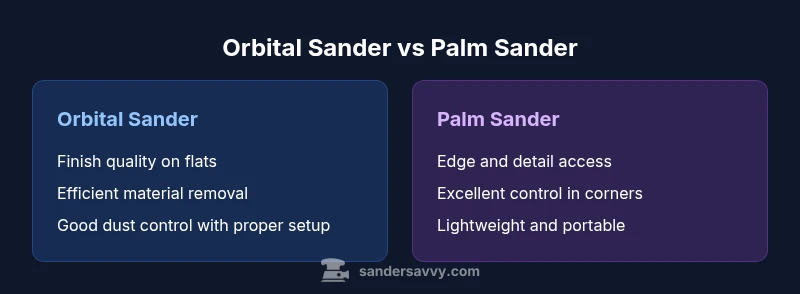
Across most projects, the orbital sander tends to deliver a smoother finish on large flat surfaces and removes material quickly, while the palm sander excels for edges, contours, and tight spaces. For floors and wide panels, orbital usually wins; for trim and details, palm is preferable. In short, orbital sander vs palm sander: match the tool to the task.
What is an orbital sander?
According to SanderSavvy, an orbital sander is designed to deliver a consistent finish on wide, flat surfaces by moving the abrasive disk in a circular motion while also orbiting around a central axis. This random orbit helps minimize gouges and swirl marks, producing a smoother surface than older sheet or belt sanders. The tool typically uses replaceable sanding discs, with 5-inch sizes commonly available and some models offering larger options. For homeowners tackling floors, decks, and walls, the orbital sander offers a practical balance of speed, control, and finish quality. When paired with a compatible vacuum system or dust bag, it reduces airborne dust and cleanup time—an especially valuable benefit in small rooms or upper-floor projects. Ergonomics matter too: models with a comfortable grip and low vibration are easier to manage during extended sessions. In this guide, we compare orbital sander vs palm sander with a practical lens, highlighting where each shines and where they may fall short.
Additionally, the random orbit pattern allows for multi-pass finishing, moving across the surface with progressively finer grits to achieve a silky finish. Some models include variable speed control, enabling adaptation to different wood species and coatings. Surface heat buildup is a consideration with softwoods, so taking breaks and using appropriate cooling aids can help maintain blade integrity and finish quality. A well-designed dust port and effective seals contribute to cleaner work environments and better results. Remember: the quality of the sanding pad and disc, plus the alignment of the dust port, influences the final look as much as the motor power.
Overall, the orbital sander is a workhorse for flat, open areas, offering predictable results and less risk of gouging when used correctly. SanderSavvy’s guidance emphasizes selecting a model with a comfortable grip, adjustable speed, and reliable dust control for best long-term performance.
wordCountOverride":null},
Comparison
| Feature | Orbital Sander | Palm Sander |
|---|---|---|
| Ideal sanding motion | Circular/random orbit for a smooth, even finish | Rectangular pad with back-and-forth/elliptical motion for precise control |
| Material removal aggressiveness | High in experienced hands on flat surfaces | Moderate; better for delicate work and edges |
| Edge and corner performance | Lewer direct edge access; may require careful technique | Excellent for corners and tight spots |
| Dust management | Typically strong with good dust ports and vacs | Dust collection is adequate but smaller paths can limit efficiency |
| Best for | Large flat surfaces like floors and large panels | Edges, contours, and detail work |
| Disc size options | Common 5-inch (with occasional 6- or 8-inch options) | Often 5-inch or 1/4-sheet formats; versatile for edges |
| Weight and ergonomics | Varies; can be heavier but balanced for flat work | Generally lighter and more maneuverable for tight spaces |
What's Good
- Orbital sanders excel on flat, wide surfaces with a smoother finish
- Palm sanders offer excellent control for edges, corners, and detail work
- Both tools support standard sanding grits and a range of dust-collection options
- Good compatibility with vacuum systems improves indoor air quality and cleanup
Weaknesses
- Orbital sanders can be heavier and harder to maneuver on edges
- Palm sanders remove material more slowly on large areas and may leave traces if not used carefully
- Disc changes and pad wear require regular maintenance
- Dust collection quality depends on proper porting and pad condition
Orbital sander wins for overall finish and speed on large flat areas; palm sander wins for edges and tight spaces
Choose orbital when refinishing floors, wide panels, or any large, flat surface. Opt for palm when you need precise control along edges, around doors, or in intricate spaces. Use our decision framework to match the task to the tool for optimal results.
Your Questions Answered
Which sander leaves a smoother finish for flat surfaces?
In most cases, the orbital sander delivers a smoother finish on large flat surfaces due to its random orbit that minimizes visible patterns. A palm sander can still produce a good finish, but it requires more careful technique near edges to avoid swirl marks.
The orbital sander generally gives the smoother finish on flat surfaces, with the palm sander working best for edges if you’re aiming for a flawless edge-to-center blend.
Can I use a palm sander for a floor project?
A palm sander can be used for smaller floor projects, trim work, or patch areas near walls, but for large, flat floor areas an orbital sander is typically more efficient and delivers a more uniform finish.
Yes, you can, but for big floor areas an orbital sander is usually more efficient.
Which sander is better for edges and corners?
The palm sander is generally the better choice for edges, corners, and detailed work due to its compact, square pad and greater maneuverability.
Edges and corners are easier with a palm sander.
Are there safety considerations specific to these sanders?
Both tools create dust; always wear appropriate PPE, use a dust collection system, and work with a stable stance. Keep cords away from the finish area and use clamps to secure workpieces.
Dust safety first: wear a mask, connect a vacuum, and keep your workspace secure.
What grit progression should I use?
Start with a coarser grit to remove coatings, then move through medium to fine grits to refine the finish. Tailor the grits to wood type and coating thickness.
Begin with coarse, then medium, then fine grit for a smooth result.
How important is dust collection for finish quality?
Dust collection is crucial: it keeps debris from scratching the surface and improves the final appearance. A properly fitted dust port and bag or vacuum can dramatically reduce cleanup time.
Dust control matters for a clean, smooth finish and easier cleanup.
Main Points
- Match the task to the tool: orbital for floors/large flats, palm for edges/contours
- Prioritize dust control and comfort to sustain longer work sessions
- Invest in a model with good dust collection and a comfortable grip
- Use progressive grits for a refined finish on orbital sanding
- Keep disc pads clean and replace worn pads promptly