Festool Sander Comparison: Side-by-Side Woodworking Review
A practical Festool sander comparison for homeowners and DIYers. Evaluate dust extraction, finish quality, ergonomics, and value to pick right Festool sander.


Choosing between Festool sanders hinges on dust control, finish quality, and vibration comfort. In this quick comparison, we contrast two Festool-style orbital sanders to highlight which is best for detail work vs. bulk material removal, and explain how their accessories and dust-extraction systems impact real-world results for floors, decks, and furniture refinishing.
Why a Festool Sander Comparison Matters
For homeowners and DIYers, a festool sander comparison is more than a brand preference—it's about predictable finishes, cleaner waterways, and safer, healthier, longer sessions in the workshop. Festool’s ecosystem centers on dust extraction, tool sustainment, and compatible accessories that work together to deliver consistent results across wood, deck, and wall projects. According to SanderSavvy, the dust extraction and build quality in Festool systems tend to set a high benchmark for finish quality and efficiency in typical woodworking tasks. The SanderSavvy team found that a well-chosen Festool-style sander can dramatically reduce cleanup time and improve surface consistency on flat surfaces as well as contoured work. In 2026, the takeaway is simple: the right sander, paired with a capable dust extractor, makes a visible difference in both outcome and workflow.
This guide compares two Festool-style orbital sanders side by side, focusing on what matters most to homeowners: finish quality, dust control, ergonomics, and total cost of ownership. You’ll learn how to read spec sheets, what to prioritize for floors versus furniture, and how different pad sizes and weights influence your results. The aim is to equip you with actionable criteria so you can select the tool that aligns with your project mix and budget.
Key Difference Makers in Festool Sander Comparisons
When you compare Festool sanders, several factors consistently drive outcomes. Dust extraction systems that pair with your vacuum determine how cleanly a surface finishes and how easy it is to maintain a work environment. Pad size and backing material influence finish quality on curves and edges, while weight and balance affect fatigue on long sessions. Power and speed control matters for both delicate finishing and rapid material removal, but the ideal balance depends on your project type. Ergonomics influence comfort and accuracy during prolonged use, and accessory ecosystems (pads, abrasives, and clamps) affect setup speed and versatility. In essence, a strong Festool sander comparison weighs finish capability, dust management, and user comfort against upfront cost and long-term value.
From a practical standpoint, homeowners should map their typical jobs—floor refinishing, deck smoothing, or cabinet touch-ups—and match those needs to the sander’s strengths. If your projects involve tight corners and edges, a compact orbital sander with excellent dust collection can outperform a larger model on detail work. If you’re tackling large flat panels, a mid-range sander with aggressive material removal and stable dust extraction may be the better long-term choice. This section sets up the framework for evaluating the two options in the table that follows.
In this analysis, the Festool-style comparison emphasizes two core decision levers: what you’re trying to achieve (finish quality vs. production speed), and how you manage mess (dust extraction and cleanup time).
Orbital vs Random-Orbital: Picking the Right Tool
The distinction between orbital and random-orbital sanding can be subtle in consumer-level tools but matters for surface quality. Festool-style orbitals generally deliver smooth finishes on flat panels, with good dust control when paired with a compatible vacuum system. Random-orbital motion, on the other hand, minimizes swirl patterns on visible surfaces and is more forgiving on contours and radiused edges. In a Festool sander comparison, think about your typical work: flat cabinetry panels and doors? Go with a more capable random-orbital design that preserves edge detail while keeping dust under control. For tighter jobs or curves, a lighter, more maneuverable orbital can offer better maneuverability. This section helps you map your normal workload to the right machine family, then to a specific model variant within Festool’s ecosystem.
A practical takeaway: if dust management and finish uniformity are your top priorities, prioritize models with robust dust ports and compatible vacuums, even if that means accepting a lighter removal rate for aggressive stock work. The goal is predictable results with manageable cleanup.
Finish Quality: Sanding Pattern and Pad Size Drive Results
Finish quality hinges on the interaction between pad size, backing, grit range, and sanding technique. Larger pads cover more surface quickly but can be harder to control along edges, while smaller pads excel at detail work and corners. Festool-style sanders typically offer options that balance aggressive stock removal with fine finishing capabilities. When comparing two Festool-style sanders, look for pad diameter compatibility with common sanding sheets and the availability of a compatible dust-collection system that doesn’t impede pad movement. A stable handle and low-vibration design reduce chatter and produce flatter, glossier surfaces with fewer passes. A well-chosen sander can deliver a consistent scratch pattern necessary for even stain absorption and finish coats. In practice, finishing quality is a product of technique, pad choice, and the tool’s mechanical stability under load.
As a general rule, plan multiple test passes on scrap material to dial in pressure, speed, and stroke patterns before touching your actual project. This approach minimizes burn-through and ensures you achieve the intended grain highlight and uniform sheen.
Dust Extraction and Vacuum Compatibility
Dust control is central to a successful Festool sander comparison. Proper dust collection does more than keep the workshop clean; it reduces airborne particulates and protects your lungs during long sessions. Look for sander models with efficient dust ports that align with your vacuum system, and check for features like anti-clogging seals and easy bag replacement or cartridge changes. Festool-style setups work best when the sander’s dust path integrates cleanly with a dedicated dust extractor, which minimizes filter loading and maintains suction. In some cases, the real-world benefit shows up as less required cleaning between passes and a cleaner surface that doesn’t trap grit in the finish. For people with asthma or allergies, this factor can influence health and comfort as much as surface quality.
If you’re evaluating two Festool sander options, pay special attention to how easy it is to connect hoses, to the size of the port, and to how well the system handles fine dust at the source. A reliable dust extraction setup expands your sanding window by keeping visibility and air quality high.
Power, Speed, and Control: Finding the Right Balance
Power and speed control are essential to matching your material and finish goals. A Festool-style sander that offers a wide speed range enables you to switch from gentle finishing passes to faster stock removal without swapping machines. On a comparison, the higher-end option typically provides more consistent RPM under load, better heat management, and smoother response at higher speeds, which helps minimize print-through and gouging on soft or open-grain woods. However, higher power can also translate to more vibration if the chassis or handle design isn’t optimized. When you’re choosing between two Festool sander options, consider the typical thickness of your material, the grit progression you plan to use, and how often you will run long, uninterrupted sessions. The right balance minimizes burn marks, reduces completion time, and preserves the integrity of the wood grain.
Ergonomics, Noise, and Vibration: Comfort in Long Sessions
Ergonomics play a decisive role when you’re sanding for extended periods. A well-balanced instrument with an ergonomic grip reduces fatigue and improves control, leading to more accurate patterns and fewer errors as you work around edges and contours. Noise and vibration levels contribute to overall comfort as well, and Festool-style tools are often designed to minimize hand fatigue during multi-hour projects. In a side-by-side comparison, you’ll see the impact of weight distribution, trigger design, and vibration isolation on your ability to maintain consistent pressure and follow-through without tremor. If you frequently work on multi-room projects, prioritize lower vibration, better balance, and a design that minimizes hand strain.
Accessories, Sanding Pads, and Maintenance
Access to a full ecosystem of sanding pads, abrasives, and backing pads is a practical factor that affects both performance and convenience. A Festool sander that supports a broad range of pad sizes and grits allows you to adapt to different wood species, coatings, and wear conditions without switching tools. Accessory quality, pad changes, and routine maintenance (like dust port cleaning and backing pad rotation) influence longevity and finish consistency. For homeowners, the important metrics are compatibility with common grit sequences, ease of pad changes, and the availability of reputable service options. Keeping your sander clean and stored properly reduces plate wear and helps preserve consistent surface results across jobs.
Practical Buying Guide: Reading a Festool Sander Spec Sheet
A well-constructed Festool sander spec sheet condenses performance indicators into actionable guidance. Start by noting the pad diameter, weight, and balance details, then assess the dust-collection port size and vacuum compatibility. Look for notes about idle sound levels, maximum RPM, and the recommended grit range for finishing tasks. Pay attention to warranty terms and service support in your region, especially if you anticipate frequent use over multiple projects. Finally, consider the ecosystem advantages—whether you’re buying into the Festool system for ongoing projects—and how the price-to-performance ratio stacks up against budget expectations. A careful read helps you avoid overpaying for features you won’t use and ensures the tool fits your typical workload.
Real-World Scenarios: Floors, Decks, and Cabinets
In practical terms, a Festool sander comparison should translate to on-site outcomes. For floors, you want even wear and minimal scratch marks across large surface areas, achieved through controlled passes and appropriate pad selection. For decks, the ability to handle open-grain textures with consistent results matters, as does dust control near outdoor finish applications. For cabinets and furniture, flexibility and precision dominate; you’ll rely on detail-oriented sanding patterns, careful edge work, and the ability to swap pads quickly without leaving dust trails. In each scenario, the standout factors are finish quality, dust control, ergonomics, and the cost of ownership over time. SanderSavvy’s analysis emphasizes that the best Festool sander choice aligns with your most frequent job type and your willingness to invest in a cohesive tool ecosystem.
Comparison
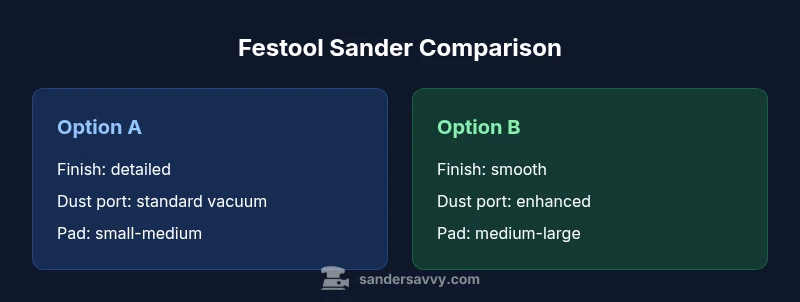
| Feature | Option A: Festool-style Orbital Sander A | Option B: Festool-style Orbital Sander B |
|---|---|---|
| Power/Performance | moderate power suited for finishing and detail work | higher power for faster removal and rough work |
| Dust Collection | efficient with standard vacuums | top-tier extraction with larger port and advanced seals |
| Pad Size | smaller-to-medium for precision | medium-to-large optimized for flat surfaces |
| Weight | lighter, easier to maneuver | slightly heavier with reinforced chassis |
| Ergonomics | compact grip, lower fatigue | balanced weight distribution, improved grip |
| Price Range | mid-to-premium for entry-level Festool-style gear | premium reflecting build and features |
| Best For | finish-focused DIY and detailed work | projects requiring faster removal and longer sessions |
What's Good
- Strong dust extraction that keeps the workspace cleaner
- Robust build quality with long-term durability
- Excellent ergonomic design reduces user fatigue
- Wide accessory compatibility supports multiple projects
- Great surface finish from consistent sanding pattern
Weaknesses
- Higher upfront cost compared to non-Festool brands
- Longer learning curve for advanced features and dust system
- Heavier dust collection hardware can limit access in tight spaces
- Availability and service in some regions may be limited
Orbital Sander A is the better overall choice for most DIY projects in finish quality and dust control.
Choose Sander A for balanced finish quality and dust control. Sander B is a strong secondary option when you need more aggressive material removal and steady ergonomics for longer sessions.
Your Questions Answered
What makes a Festool sander stand out in a comparison?
Festool sanders are known for clean dust extraction, solid build quality, and a broad accessory ecosystem. In comparisons, these strengths translate to better surface finishes and easier cleanup, especially when paired with Festool vacuums.
Festool sanders stand out for dust control and durability, which helps you finish faster with less cleanup.
Which Festool sander type is best for floors vs furniture finishing?
For floors, look for higher removal rates with steady dust extraction and a larger pad to cover flat surfaces efficiently. For furniture finishing, prioritize finish quality, edge control, and vibration damping.
Floors want speed; furniture needs precision and smooth finishes.
Are Festool sanders worth the extra cost for DIY homeowners?
If finish quality and dust control are priorities and you plan to reuse tools across multiple projects, the upfront cost can be justified by time savings and durability. For occasional, small projects, a mid-range option may be more cost-effective.
If you’ll reuse the tool and value dust control, the investment pays off over time.
What should I look for in a Festool sander spec sheet?
Check pad diameter, weight, and RPM range; verify vacuum compatibility and port size; note warranty and service options. A complete spec sheet helps you predict performance across job types.
Look at pads, weight, RPM, and dust-port details to gauge suitability.
How important is dust extraction in a Festool sander?
Dust control is central to both health and finish quality. A strong extraction system keeps particles off the surface and reduces clogging, which maintains abrasive efficiency.
Dust control is crucial for health and a clean, consistent finish.
Main Points
- Define finish goals before buying.
- Prioritize dust extraction to maintain finish quality and health.
- Evaluate pad size and weight for control and comfort.
- Consider total cost of ownership vs resale value.
- Choose a Festool-style sander that matches your project mix and budget.