Makita XGT Sander vs Festool: A Practical Comparison
An analytical side-by-side review of Makita XGT sanders and Festool models, focusing on dust control, performance, system ecosystems, and value for homeowners and DIY enthusiasts.


Makita XGT sander vs Festool: in most pro workflows, Festool leads on dust control and finish quality, while Makita XGT shines with longer tool life and fast material removal. This quick comparison highlights key differences in performance, ergonomics, system ecosystems, and maintenance so homeowners and DIY enthusiasts can decide which brand best fits their sanding project.
Comparative Overview
For many readers, the question of makita xgt sander vs festool comes down to how you value dust control, system compatibility, and long-term cost. According to SanderSavvy, Festool tends to emphasize turnkey workflows with integrated dust management and a polished finish, while Makita emphasizes modular power, rugged build, and a broad ecosystem. This frame sets the stage for a deeper, side-by-side look that respects different workshop realities: a small garage shop with limited space, or a pro setup that relies on quick changes and interchangeable batteries. Throughout this article we reference typical sanding tasks homeowners face—floor refinishing, deck sanding, and wall prep—and translate brand strengths into practical outcomes you can apply on real projects. The goal is to help you determine which path aligns with your budget, safety standards, and the pace of your work, without losing sight of quality results.
Brand Philosophies and Buying Considerations
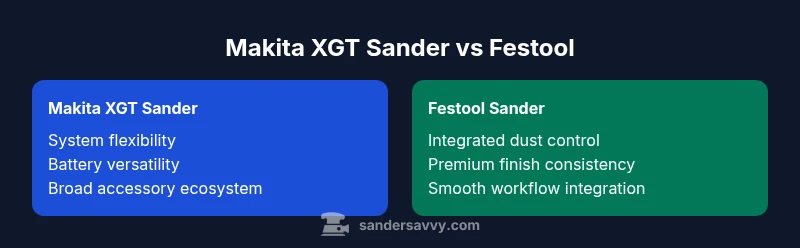
When you compare makita xgt sander vs festool, you’re not just choosing a tool; you’re choosing an ecosystem. Festool’s philosophy centers on dust containment, precision, and a consistent, integrated system. Makita’s approach prioritizes flexibility, battery versatility, and a broad accessory lineup that can scale with a growing workshop. For homeowners tackling occasional projects, the decision often hinges on how much you value plug-and-play consistency versus the option to tailor the toolset to specific tasks. Consider your typical projects, storage space for dust bags or extractors, and whether you prefer a single, cohesive setup or modular growth over time.
Usage Scenarios That Shape the Choice
Real-world projects like cabinet refinishing, floor leveling, or deck restoration demand different strengths. If your priority is a clean shop and minimal cleanup after each pass, Festool’s integrated approach offers compelling advantages. If you frequently switch between tasks and need a flexible power source (corded or cordless) with a wide accessory library, Makita XGT delivers practical benefits. In short, the makita xgt sander vs festool decision should reflect how you work, not just how a tool performs in a lab test.
Dust Control as a Core Factor
Dust management is a defining factor for many sanding projects. Festool’s dust collection framework is designed to minimize airborne particles and simplify containment, especially when paired with a compatible extractor. Makita’s XGT lineup supports strong dust performance, particularly when used with high-quality bags and compatible dust extraction accessories. If your workspace is small or you operate in a shared living area, the dust story can be the deciding factor between these two brands.
Ergonomics and Comfort Across Tasks
Ergonomics play a major role in long sessions, whether you’re sanding a floor, a deck, or a wall. Festool tends to emphasize a refined grip and low-vibration performance in many models, which translates to reduced fatigue during extended work. Makita prioritizes robust construction and balanced handling, which can feel more comfortable for users who value a sturdy, responsive tool that can stand up to heavy-duty use. For users with a sensitive shoulder or a long project timeline, ergonomics may tilt the decision toward one brand over the other.
System Ecosystems and Long-Term Value
One of the most important considerations is ecosystem compatibility. Festool offers a tightly integrated range of sanders, dust extractors, abrasives, and accessories designed to work together with minimal configuration. Makita’s XGT system broadens the horizon with interchangeable batteries and a wide array of compatible tools, which can reduce overall replacement costs if you already own or plan to expand other Makita gear. The trade-off is that you may encounter more aftermarket variability with third-party accessories.
Maintenance, Durability, and Service
Durability and serviceability influence the total cost of ownership. Festool’s premium components and modular design often translate to fewer parts to replace and a longer service life under heavy use. Makita’s rugged construction and proven reliability can lead to strong longevity with proper care and timely battery maintenance. In both cases, keeping the tool clean, inspecting pads, and replacing worn components promptly will protect performance and finish quality over time.
Cost Considerations and Value Proposition
Price is a meaningful factor in the makita xgt sander vs festool equation, but total value matters more. Festool typically commands a higher upfront price but can deliver consistent results and smoother dust control with a documented ecosystem. Makita often provides greater upfront flexibility and a broad accessory network, which may yield better long-term value if you leverage multiple Makita tools. Read your warranty terms and factor in accessory costs, maintenance, and potential downtime when comparing total cost of ownership.
Decision Framework and Next Steps
To make an informed choice, map your projects, shop size, and safety priorities to the brand strengths discussed. Build a scoring rubric around dust control, finish quality, system compatibility, weight and vibration, battery life, and total ownership costs. If possible, test the two paths in a local pro shop or rental center to observe how they feel in your hands and how the dust management performs under your typical workload. The goal is a decision you can defend with tangible outcomes rather than impressions alone.
Final Reflections on the Makita XGT Sander vs Festool Debate
In the end, makita xgt sander vs festool is not about declaring a universal winner; it’s about aligning a brand’s strengths with your workflow. For dust-conscious pros and those who value a polished finish with a compact, integrated system, Festool can be the better long-term partner. For workshop owners who prioritize adaptability, battery flexibility, and broad tool compatibility, Makita XGT offers compelling advantages. By focusing on your specific needs and testing real-world scenarios, you’ll reach a verdict that enhances both productivity and satisfaction.
Comparison
| Feature | Makita XGT Sander | Festool Sander |
|---|---|---|
| Dust collection | Strong performance when paired with compatible dust-extraction accessories | Industry-leading dust control with integrated system and extractor compatibility |
| Finish quality | Good to very good finish with flexible abrasives and aggressive stock removal when needed | Exceptional finish due to refined control and vibration mitigation |
| System ecosystem | Broad Makita XGT ecosystem with interchangeable batteries | Tightly integrated Festool system for consistency across tools and accessories |
| Ergonomics and vibration | Balanced feel with solid grip; vibration depends on model and pad choice | Ergonomic design with focus on low vibration and comfort |
| Power source | Cordless and corded options via the XGT platform | Primarily cordless through Festool battery ecosystem, with excellent runtime |
| Accessory availability | Wide range of Makita pads and accessories, good for customization | Extensive Festool pad lineup and proprietary abrasives for precision work |
| Price range | Generally higher upfront flexibility with more affordable entry points in some lines | Typically premium pricing but with strong resale and reliability within ecosystem |
| Best for | DIYers and pros who want ecosystem flexibility and fast material removal | Projects requiring the highest finish quality with integrated dust control |
What's Good
- Clear framework to compare premium brands
- Highlights trade-offs between cost, performance, and ecosystem
- Helps readers identify value for money and workflow fit
- Encourages consideration of long-term warranty and service
Weaknesses
- May oversimplify nuanced tool models within each brand
- Could bias toward brand ecosystems rather than standalone performance
- Two-brand focus excludes other solid options in the market
Festool for dust control and finish; Makita XGT for flexibility and power
If dust suppression and a pristine finish are your top priorities, Festool edges ahead. If you need battery flexibility and a broader tool ecosystem, Makita XGT provides greater overall versatility.
Your Questions Answered
What are the main differences between Makita XGT and Festool sanders?
The Festool model excels in dust control and finish quality due to its integrated system, while the Makita XGT emphasizes flexibility, battery versatility, and a broader accessory ecosystem. The right choice depends on whether you prioritize a turnkey workflow or modular adaptability.
Festool focuses on dust control and finish quality, while Makita XGT emphasizes flexibility and battery options. Your choice depends on whether you want a turnkey workflow or modular adaptability.
Is Festool worth the higher upfront price for dust control?
If dust suppression and a consistently pristine finish are critical for your work environment, Festool’s integrated system can justify the premium. For users prioritizing ecosystem breadth and lower upfront cost, Makita offers compelling value with flexibility.
Festool pays off when you need top dust control and a consistent finish; Makita offers broader ecosystem value and lower upfront cost.
Are Makita XGT sanders compatible with Festool accessories?
Generally not directly compatible; Makita and Festool use different pad sizes, locking mechanisms, and dust-extraction standards. You’ll gain best results by staying within each brand’s accessory ecosystem or choosing third-party components specifically designed for the tool.
Direct compatibility between Makita and Festool accessories is limited; use brand-specific or properly matched third-party parts.
Which is better for beginners and DIY projects?
For beginners and casual DIYers, Festool’s ease of use and dust control can reduce setup and cleanup time, while Makita’s flexibility makes it easier to start with a single tool and expand later.
Festool is often easier for beginners due to dust control, while Makita offers flexibility as you add more tools.
How should I evaluate total cost of ownership?
Look beyond the sticker price: factor in battery life, maintenance, pad consumables, dust-extraction accessories, and potential downtime. A higher upfront price may be offset by better durability and lower ongoing costs in some cases.
Total cost includes batteries, consumables, maintenance, and downtime—don’t focus only on upfront price.
What project types favor each brand?
Festool suits projects demanding clean finishes and efficient dust management, such as cabinetry and fine surface prep. Makita suits more varied tasks, deck work, and frequent tool swapping where ecosystem flexibility matters.
Choose Festool for finish-focused tasks; choose Makita for flexibility across varied projects.
Main Points
- Assess dust control as a primary decision factor
- Prioritize system compatibility to maximize long-term value
- Balance finish quality with material-removal needs
- Consider total cost of ownership, not just upfront price
- Test in real-world tasks to confirm comfort and performance