Random Orbital Sander vs Sheet Sander: An Analytical Comparison
Compare random orbital sander vs sheet sander to decide which tool fits floors, decks, and walls. Learn finish quality, dust control, ease of use, and best-use scenarios with SanderSavvy.


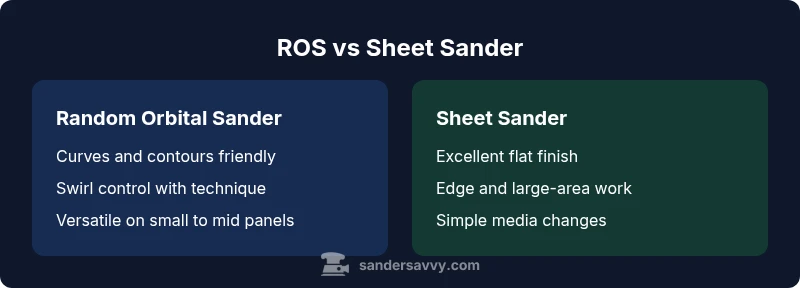
Random orbital sanders and sheet sanders serve distinct roles in wood finishing. A ROS provides versatility for curved surfaces, contours, and efficient material removal with reduced swirl when used correctly, while a sheet sander excels on large flat areas and edges, delivering very smooth, uniform finishes with less risk of gouging. This quick guide helps you pick the right tool for your project.
Core definitions and operating principles
Random orbital sanding combines two actions: a circular orbit plus an irregular orbital motion of the pad. The result is a disc that both spins and wiggles ever so slightly, which minimizes visible swirl patterns when used with care. This makes the random orbital sander a popular choice for projects with curves, profiles, and irregular shapes—think cabinet edges, chair legs, or furniture components where you want an even, refined surface without obvious sanding marks. Sheet sanders, by contrast, use a flat, rectangular pad that accepts a square or rectangular sheet of abrasive. The paper conforms to flat surfaces and can be very effective for large, open areas where you want a consistently smooth planar finish. Technique matters: moving too aggressively with either tool can cause gouges or uneven results. For dust control, both tools typically connect to a dust collection system or shop vac, and hearing protection remains important on longer sessions. (SanderSavvy Analysis, 2026) According to SanderSavvy, the fundamental distinction is how the pad interacts with the work surface: ROS spreads abrasive action across contours, while sheet sanders focus contact on broad flat areas.
startBlockNote():null},
Comparison
| Feature | Random orbital sander | Sheet sander |
|---|---|---|
| Power and speed control | Variable speed typical; broad range of RPM per model | Often fixed or limited speed options; some models offer variable speed |
| Finish quality on hardwood | Swirl-minimizing finish on contoured surfaces when used with proper technique | Very smooth, flat finishes on large surfaces; best for uniform planes |
| Surface versatility | Excellent for curves, edges, and irregular shapes | Best for flat panels and large surface areas; edges can be challenging |
| Dust collection | Strong dust collection with compatible vacuums; port sizes vary by model | Dust bags or dust ports; effectiveness depends on seal and vacuum setup |
| Ease of use and maintenance | Discs with hook-and-loop systems; easy disc changes; moderate learning curve | Sheets are simple but require proper alignment; sheets wear out with use |
| Attachment and media | Discs (abrasive discs) attached to a circular pad | Sheets attached to a rectangular pad; readily available in grits |
| Best for | General finishing, contours, veneer work, and curved components | Large flat areas, doors, tables, and wide floor panels |
| Price range (relative) | Mid-range to higher-end depending on features and motor quality | Typically lower upfront cost; basic models are affordable |
What's Good
- Versatility across shapes and surfaces
- Effective dust control with proper setup and vacuums
- Quality finishes on contoured work when technique is sound
- Wide availability of compatible abrasives and accessories
- Relatively forgiving for beginners when used with care
Weaknesses
- ROS can reveal swirl or gouges if technique is poor
- Sheet sanders may struggle on curved edges and contours
- Sheets wear quickly on heavy stock removal and edges
- High-end ROS tools can be pricier than basic sheet sanders
ROS for versatility and contour work; sheet sanding for flat, large surfaces
Choose a random orbital sander when your project involves curves or varied shapes and you want a balanced finish with reduced swirl. Opt for a sheet sander when the work is predominantly flat and you need a perfectly uniform surface across wide panels. The best choice depends on the surface geometry and finish goals.
Your Questions Answered
What are the main differences between a random orbital sander and a sheet sander?
The random orbital sander uses a circular pad that orbits with a randomized motion, reducing swirl and handling contours well. A sheet sander uses a flat pad with a sheet of abrasive, excelling on flat surfaces for a very uniform finish. Choice depends on surface geometry and finish goals.
ROS is great for curves and swirl-free finishes; sheet sanders are best for flat, wide areas.
Which sander is better for finishing hardwood floors?
For hardwood floors, both can work depending on the job. ROS is versatile for edges and panels; a sheet sander is often preferred for achieving a consistently flat, uniform surface across large floor areas when used carefully.
If you need a flat, even floor, sheet sanding is common; for edges and profiles, ROS shines.
Can you use a random orbital sander to remove finish on a deck?
Yes, a ROS can remove finishes on decks, especially on flat sections and lightly contoured rails. For heavier stock removal or deep finish stripping, a coarser grit and careful technique with the ROS may still be faster, but monitor heat and gouging risk.
You can use ROS for deck finishing, but be mindful of heat and gouges.
Is dust control better with one sander over the other?
Dust control largely depends on the system you connect to rather than the tool itself. Both tools benefit from a tight seal and a good vacuum. ROS may create more fine particles due to its action, but a proper setup mitigates this.
Good dust collection matters more than the tool; connect to a capable vacuum.
How should I choose grit and progression for each sander?
Start with a coarse grit for stock removal, then move to mid-range grits for leveling, and finish with a fine grit for a smooth surface. Always test on a scrap piece to ensure the grit sequence delivers the desired finish for your sander type.
Test first, move through grits, and finish with fine grit.
Are sheet sanders suitable for curved surfaces or edges?
Sheet sanders are less ideal on pronounced curves or irregular edges. They perform best on flat surfaces where pressure stays even. For curved work, ROS or using flexible sanding sponges on edges can help manage contact.
Sheets work best on flat areas; for curves use ROS with care.
Main Points
- Assess project geometry: choose ROS for curves, sheet for flat surfaces
- Use proper grit progression to minimize scratching and swirl
- Maximize dust control with a compatible vacuum and dust port
- Practice technique to avoid gouging with both tools
- Consider ergonomics and maintenance to sustain performance over time