Random vs Non-Random Orbital Sander: A Comparative Guide
A detailed, evidence-based comparison of random vs non-random orbital sanders, covering finish quality, dust control, ease of use, and best-use scenarios for DIY floors and decks.


Random orbital sanders typically deliver smoother finishes and faster stock removal on broad surfaces due to their randomized motion, while non-random (traditional) orbital sanders can be more aggressive for rapid stock removal and work well in tight spaces. For most DIY floors and decks, the random orbital is the safer default, balancing finish quality with dust control.
What distinguishes random vs non-random orbital sanding?
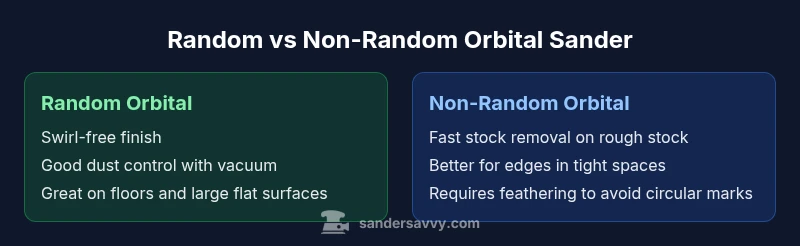
Understanding the random vs non random orbital sander distinction helps homeowners choose the right tool. A random orbital sander combines a rotating orbital motion with a secondary independent random micro-movement. This yields a swirl-free finish at normal speeds, especially on flat panels. In contrast, a non-random orbital sander follows a fixed pattern, typically leaving circular scratches if the operator doesn't feather the edge or varies pressure. The choice influences finish quality, dust control, and how quickly you can approach your target surface. In practice, most DIY projects benefit from the random pattern for general prep and finishing, while the non-random version excels in stock removal and tight spots where control is paramount. Always pair your tool with the correct grit sequence and dust-collection setup for best results.
How the sanding pattern affects finish quality
The sanding pattern matters because it determines how raw wood fibers are abraded and how the resulting micro-scratches align with the final finish. Random orbital action disperses scratches more evenly and hides minor imperfections, producing a surface that can accept finishes like polyurethane with less prep. Non-random orbital sanding relies more on user technique to avoid repeating circular marks. On wide, flat surfaces, this difference is most noticeable when moving from roughing grits to finishing grits.
Noise, vibration, and user fatigue considerations
Sander ergonomics affect your project pace and safety. Random orbital models with balanced housings and larger handles tend to feel smoother at higher speeds, reducing fatigue during long sessions. Non-random orbitals can feel lighter but may transmit more vibration if the pad is worn or if the machine lacks suspension. Wearing gloves and using low-to-medium speeds for extended periods helps manage fatigue in both types.
Stock removal speed and material considerations
Stock removal speed depends on grit, pressure, and surface resistance. Random orbital sanders typically remove material quickly on softwoods while keeping chatter low and finish smooth. Traditional non-random units can be aggressive on dense woods, but the fixed pattern may require more passes to avoid circular scratches. Always match speed and pressure to the wood type and grit level, and avoid forcing the tool.
Dust extraction and sanding pads
Dust collection is a major factor in how comfortable and clean the job stays. Random orbital sanders integrate well with standard vacuum systems, and larger pads spread contact evenly, reducing gouges. Non-random sanders often rely on similar dust ports, but the effectiveness depends on pad size, hook-and-loop compatibility, and the quality of the vacuum hose. For both types, ensure the pad is compatible with your work and that the dust port is sealed when possible.
When to pick random orbital for floors and decks
For wide, flat surfaces such as floorboards or exterior deck treads, the random orbital sander is typically the best first choice. It minimizes swirl marks, handles long sessions well, and provides a forgiving path for beginners. For tasks that demand fast material removal on rough stock or when working in open spaces with limited access, you may opt for the non-random model after planning finishing steps.
When non-random orbital shines (tight spaces, aggressive removal)
Non-random orbital sanders excel in tight corners, edging, and small profiles where a random sander's random motion would be awkward or slow. They can be more controllable for aggressive stock removal when you need to flatten high spots quickly. In these scenarios, work with light pressure and multiple passes to avoid creating circular patterns.
Tool specifications that matter (pad size, dust port, weight)
Key specs to compare include the maximum pad size and the pad attachment system, the machine weight, and the dust-port compatibility. A larger pad helps cover more area with a uniform finish, while a smaller pad is better for edges and contours. The dust port quality and hose compatibility determine how much dust stays out of your lungs and how clean the workspace remains.
Grains and sanding sequence for typical wood surfaces
The recommended sequence typically starts with a coarse surface prep, followed by medium, then fine grits for finishing. Random orbital sanders tend to perform best when you begin with coarser grits on flat stock and then move toward finer grits for finishing. With non-random sanders, pay attention to the direction of the move to avoid repeating circular patterns and to reduce the need for extra passes.
Practical step-by-step: how to test finishes on scrap
Always test any milling and finish approach on a scrap piece before committing to the project. Start with a sample of the wood type and a representative edge area. Run a few passes with the random orbital sander at a moderate speed, then try a non-random sander to compare results. Assess the finish by staining or applying polyurethane to see how the surface accepts it.
Common mistakes and troubleshooting
Common mistakes include using too high a speed, pressing hard, and neglecting dust extraction. These habits lead to swirl marks, gouges, and dusty workspaces. To troubleshoot, slow down, maintain a light touch, use appropriate grit sequences, and switch between random and non-random patterns depending on the task and stage.
Maintenance and long-term care of orbital sanders
Regular maintenance extends tool life and performance. Clean the vents, inspect the pad for wear, replace worn discs, and lubricate moving parts as recommended by the manufacturer guidelines within your region.
Comparison
| Feature | Random orbital sander | Non-random orbital sander |
|---|---|---|
| Pattern | Randomized motion to reduce swirl marks | Fixed circular pattern with potential swirls if not feathered |
| Finish quality | Typically smoother and more uniform | Finish depends on technique; may show circular marks |
| Dust control | Excellent when paired with a good vacuum and port | Generally good but highly dependent on port and pad setup |
| Stock removal speed | Balanced efficiency on softwoods; good for finishing | Often faster on rough stock but may require additional finishing passes |
| Best for | Flat surfaces and finishing work | Edging, tight spots, and aggressive stock removal |
| Weight/ergonomics | Light to mid-weight with balanced design | Light-to-mid-weight; comfortable but may transmit more vibration |
| Price range | Mid-range to affordable for DIYers | Mid-range to affordable with varying brand quality |
What's Good
- Random sanding reduces visible swirl marks on flats
- Versatile across finishes and stock types
- Better dust control when paired with a good vacuum
- Wide availability of pads and accessories
Weaknesses
- Learning curve to optimize technique
- Non-random can remove stock faster but may require extra finishing passes
- Both require proper technique to avoid gouges or burns
- Noise and vibration can be tiring on long jobs
Random orbital sanding is the safer default for most DIY tasks; non-random orbital remains valuable for specific jobs
For floors and decks where finish quality matters, choose random orbital for swirl-free results and dust control. Reserve non-random orbital for aggressive stock removal in tight spaces, using disciplined technique.
Your Questions Answered
Which sander leaves fewer swirl marks, random orbital or non-random orbital?
In most cases, random orbital sanders produce fewer visible swirl marks due to the randomized motion. Proper technique and appropriate grit sequences further reduce patterns.
Random orbital sanders generally leave fewer swirl marks; use the right grit and light pressure for best results.
Can I switch between patterns mid-project without re-prepping the surface?
Yes, you can switch patterns, but you should inspect and re-prep the surface to ensure consistent finish and avoid embedding patterns.
You can switch patterns, but check the surface and consider re-prepping for consistency.
What is the best practice for hardwood floors sanding sequence?
Typically start with a coarse grit for initial leveling, then move through medium to fine grits, keeping consistent motion and feathering passes to avoid visible marks.
Begin with a coarse grit, then medium, then finish with a fine grit, using feathered passes.
Is dust collection essential for both sander types?
Dust collection is highly recommended for both types to keep lungs safe and workspace clean; use a compatible vacuum and a clean filter.
Yes—dust collection helps both sanders, protecting you and your space.
What maintenance steps extend the life of an orbital sander?
Regularly clean vents, inspect and replace worn pads, check cords or triggers, and store in a dry place; follow manufacturer guidance.
Keep it clean, replace worn pads, and store properly to extend life.
Are there budget-friendly options for random vs non-random orbital sanders?
Yes, there are affordable models for both types, often with interchangeable pads and basic dust collection; compare warranty and support.
There are budget-friendly options for both, with trade-offs on durability and dust control.
Main Points
- Start with random orbital for most tasks to minimize swirl marks
- Switch to non-random only for aggressive stock removal in tight spots
- Invest in reliable dust collection and appropriately sized pads
- Progress through grits gradually for the best finish
- Practice on scraps to tune technique before applying to the project