Which Sander for Floorboards: A Comprehensive Comparison
Explore a practical, analytical comparison of belt, random orbital, and finish sanders for floorboards. Learn which sander fits heavy stock removal, even finishes, edge work, and safe DIY sanding with dust control and grit progression guides.


For most floorboard projects, a random orbital sander is the best all‑around choice, balancing material removal, finish quality, and control. Belt sanders excel for heavy stock removal but require careful handling to avoid gouges, while finish and detail sanders shine on edges and intricate corners. This guide weighs the trade‑offs and gives practical scenarios to help you pick the right tool.
Why the right sander matters for floorboards
Choosing the right sander for floorboards is more than picking a popular model. The sander you select determines how quickly you level raised grain, how smoothly you finish the surface, and how safely you work around edges and existing trim. According to SanderSavvy, the typical home DIYer benefits from a single, versatile machine for bulk removal and a dedicated edge/finish approach for tight spots. The goal is to minimize gouges, create a uniform substrate, and maintain dust control throughout the project. A well‑chosen sander also reduces fatigue because it fits your grip, weight, and maneuvering style. Consider your floor type (softwood vs hardwood), the finish you want, and your tolerance for noise and dust when comparing options.
In this guide we analyze the three core classes—belt, random orbital, and finish sanders—and how they perform on common floorboard scenarios. This approach aligns with the SanderSavvy methodology of practical, safety‑mocused guidance that homeowners can apply on a weekend project. Remember that no single tool is perfect for every task; the best outcome comes from pairing a primary, versatile sander with a specialized attachment or technique for edges and corners.
bold emphasis is used to highlight key ideas throughout the section.
Feature Comparison
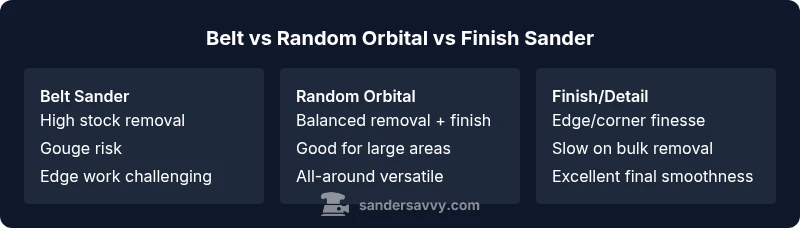
| Feature | belt sander | random orbital sander | finish sander (orbital/detail) |
|---|---|---|---|
| Stock removal speed | High for rapid material removal on open floors | Medium with balanced stock removal and surface control | Low, best for finishing and smoothing rather than bulk removal |
| Finish quality | Aggressive finish unless used with care and light pressure | Excellent finish quality when used with the right grit progression | Very good to excellent finish, particularly on edges and tight spots |
| Grit progression compatibility | Coarse to medium progression needed for initial leveling | Sequential progression from coarse to fine is ideal | Fine to ultra‑fine finishing for final coats |
| Edge access | Challenging near walls without edge guards | Good edge access with standard attachments | Best for edges and corners with dedicated detail heads |
| Dust control | Depends on vacuum setup and bag design | Strong suction with attached vacuums and dust ports | Moderate dust control; best with edge guards and full containment |
| Best for | Heavy stock removal on open floor runs | General floor leveling and even surfaces | Edge work, corners, and fine finishing |
| Price range (rental/buy context) | Low to mid | Mid to high | Mid |
What's Good
- Versatile across stock removal and finishing tasks
- Modern dust extraction makes cleanup easier
- Good balance of cost, capability, and control for DIYers
- Fits a wide range of floorboard types and finishes
Weaknesses
- Belt sanders can gouge floors if misused
- Finish sanders are slower on large areas
- Edge work requires additional attachments and care
Random orbital sander is the recommended default for floorboards; reserve a belt sander for deliberate stock removal and use a finish/detail sander for edges.
Choose the random orbital for everyday floorboard work due to its balance of speed and finish. Use a belt sander only when you must remove substantial material, with careful technique and protective edging. Reserve a finish/detail sander for precise edges, corners, and final smoothing to achieve a professional result.
Your Questions Answered
What is the best sander for floorboards overall?
For most floorboard projects, a random orbital sander provides the best balance of removal, control, and finish quality. It’s the workhorse tool for bulk leveling while preserving the wood’s character. Use a belt sander only when you need significant stock removal and proceed cautiously.
The random orbital is the go‑to for most floorboard jobs; belt sanders are for heavy stock removal with care, and finish sanders handle edges and final smoothing.
Can I use a belt sander on floorboards without damaging them?
Yes, but only with careful technique: use light pressure, keep the tool flat, and stay parallel to the grain. Belt sanders remove material quickly and can gouge if guidance is lost or if you stay in one place too long.
Belt sanders can work, but they demand steady technique and edge protection to avoid gouges.
Do I need a dedicated dust extraction system for sanding floors?
Yes. Floor sanding creates a lot of fine dust. A sealed system with a quality vacuum or dedicated dust extractor helps protect your lungs and keeps the work area cleaner, especially when you’re working with hardwoods.
Definitely use a good dust extractor to keep dust down and protect your breathing.
What grit progression should I follow on floorboards?
Start with a coarse grit to level the surface, move to a mid grit for smoothing, and finish with a fine grit for a smooth, ready-to-finish surface. Avoid jumping steps to prevent ridges and uneven texture.
Begin with coarse, move to medium, then finish with fine grits for a smooth floor.
Can I sand curved edges or radiused corners with a random orbital sander?
Yes, you can handle curved edges using the sander with a flexible pad or by concentrating your strokes along the curve, but you’ll still need a detail sander for tight corners and very curved transitions.
For curves, use the right attachment and plan to switch to a detail sander for tight spots.
Renting vs buying a sander for a DIY project
If you only have a single project or a short time frame, renting makes sense. For frequent projects or ongoing hardwood work, owning a sander with compatible attachments is more cost-effective and convenient.
Rent if it’s a one‑off; buy if you sand regularly.
Main Points
- Start with a versatile random orbital sander for most floorboard work
- Use a belt sander sparingly and with edge guards to avoid gouges
- Attach a good dust extraction system to minimize airborne dust
- Finish and detail sanders excel for edges, corners, and final smoothing
- Plan grit progression from coarse to fine for an even finish