Drywall Sander Comparison: Choose the Right Tool for Finishing Drywall Walls and Ceilings
A thorough drywall sander comparison for homeowners and DIY enthusiasts. Learn how to balance dust control, reach, power, and price to pick the right tool for a smooth finish with minimal mess.


Choosing the right drywall sander requires a true drywall sander comparison. This guide compares a dedicated drywall sander with integrated dust collection, a general-purpose random-orbital sander, and a pole sander for ceilings. We evaluate power, weight, dust control, noise, and price to help homeowners pick confidently and finish with less mess.
What matters in a drywall sander comparison
Drywall finishing hinges on the tool you pick, because the right sander reduces dust, saves time, and delivers a smooth final surface for paint. A thorough drywall sander comparison weighs dust control, reach, power, ergonomics, and price. Dust control is the first and most visible win: models with integrated vacuums or dust ports keep particles off the room and on the filter. Weight and balance matter for long sessions, while noise and vibration impact comfort. Access to corners and ceilings is a frequent pain point that shapes the choice between a short-head random orbital model and a pole sander. SanderSavvy’s testing across common room sizes shows the best overall outcomes come from balancing dust removal with manageable weight and predictable finish. In this drywall sander comparison, we’ll look at three representative approaches and explain when each excels, including practical tips on setup and maintenance. This is designed for homeowners and DIY enthusiasts who want practical, real-world guidance rather than hype.
According to SanderSavvy, a thorough drywall sander comparison helps homeowners avoid overpaying for underpowered tools and ensures you buy tools that fit the job size and cadence of your project. The following sections lay out criteria, test methods, and concrete scenarios to help you decide with confidence.
formatOverrideNeededForSEOAnnotationOnlyForInternalUseUnlessOtherFieldsAreUsedForThisPurpose
Feature Comparison
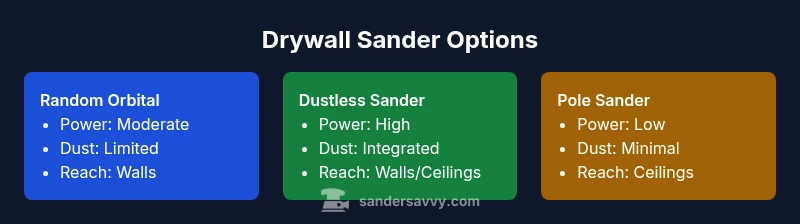
| Feature | Random Orbital Drywall Sander | Dustless Drywall Sander with Vacuum | Pole Sander (Ceiling Reach) |
|---|---|---|---|
| Power & speed | Moderate to high power with variable speed for feathering and rapid material removal | High power with integrated dust collection and stable speed | Manual operation with limited power; best for light touch-ups or ceiling reach |
| Dust management | Basic dust port or bag; requires external extraction | Integrated dust collection with HEPA filtration; cleaner job sites | No integrated dust system; relies on manual removal and masks |
| Weight & ergonomics | Medium weight with balanced grip; good for walls | Heavier due to vacuum system; designed for dust control | Lightweight and extendable; best for overhead work but fatigue may creep in on long sessions |
| Reach & access | Effective on walls and lower ceilings; shorter head | Excellent dust control on projects with floor protection; mid-range reach | Best for ceilings and high walls; lacks built-in dust collection |
| Noise & vibration | Moderate noise; vibration managed by design | Higher noise due to vacuum motor; robust isolation features | Lower power output; less vibration but limited surface versatility |
| Price range (general) | Mid-range to mid-high; depending on model and attachments | Higher upfront for integrated dust systems, but savings on cleanup can offset it | Lower upfront; add-ons increase long-term costs if you need frequent use |
| Best for | Wall finishing and patch work where finish quality matters | Dust-sensitive spaces and larger drywall projects with cleanup in mind | Ceiling work with reach; light sanding where surfaces are flat |
What's Good
- Dust management reduces cleanup time and exposure
- Multiple options cover walls, ceilings, and corners
- Ergonomic and balance-focused designs minimize fatigue
- Wide availability and model variety enable budget choices
Weaknesses
- Dustless or vacuum-equipped models cost more upfront
- Pole and reach-focused sanders may be slower on flat walls
- Integrated vacuums require maintenance and filter changes
- Higher-end options can feel overkill for small patches
Dedicated drywall sander with integrated dust collection is the best all-around choice for most DIYers.
For most drywall finish projects, a dust-collection-equipped sander delivers cleaner air and a smoother finish. If you rarely sand ceilings, a pole sander may suffice, but expect longer sessions and more effort on walls. The advantage goes to the tool that balances power, reach, and dust control.
Your Questions Answered
What is the best sander for drywall finishing?
For most DIY projects, a dedicated drywall sander with integrated dust collection offers the best balance of finish quality and cleanup. It handles walls and ceilings well and keeps dust down during long sessions.
For most DIY projects, a dust-collection drywall sander is the best all-around choice.
Can I use a regular random orbital sander for drywall?
Yes, you can, but you’ll sacrifice dust control and potentially finish quality. An orbital without dust collection tends to create more dust and may require more passes to achieve a smooth finish.
Yes, but you’ll have more dust and possibly more work to get a smooth finish.
Is it worth paying more for a dustless drywall sander?
If you work in a small space or care about cleanup time, a dustless model often pays for itself through reduced cleanup and better air quality. For occasional projects, a basic model may suffice.
Dustless models usually pay off in less cleanup time, especially in tighter spaces.
What grit should I start with for drywall sanding?
Start with a coarser grit for initial smoothing (around 60–80) and move to finer grits (120–180) for the finish coat. Always test on a small area before proceeding.
Start with a coarser grit, then move to a finer one for the finish coat.
Do I need a separate dust extraction system beyond the sander?
A built-in dust port or vacuum is typically sufficient for most residential projects, but you may want a larger dust extractor for very dusty environments or frequent sanding.
Often the sander’s dust port is enough, but a dedicated extractor helps in very dusty spaces.
How should I maintain a drywall sander?
Regularly clean the sanding pads, inspect the vacuum filters, and store the tool in a dry area. Replace worn discs and check cords for damage to keep performance steady.
Keep it clean, replace worn discs, and check the power cord and filters.
Main Points
- Prioritize dust collection to reduce cleanup and improve air quality
- Choose based on project scope: walls and mid-ceilings vs ceilings-only
- Balance weight and ergonomics to minimize fatigue
- Expect higher upfront costs for integrated dust systems but lower cleanup costs
- Test reach and handle vibration before committing to a purchase