Drum Sander Comparison: A Practical Guide for Floors
In this drum sander comparison, homeowners and pros learn how drum sanders differ from belts and orbitals, safety practices, maintenance, and when to rent or buy for floor refinishing projects.


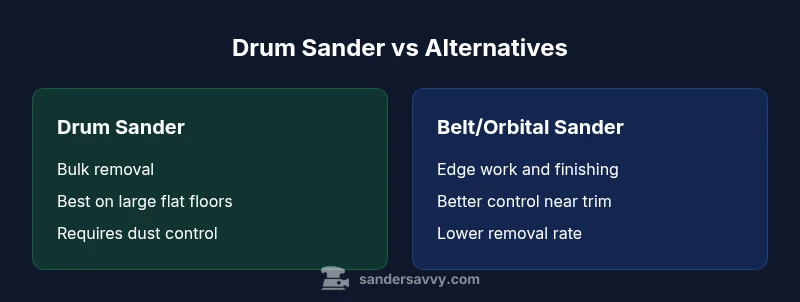
drum sander comparison typically shows aggressive stock removal on large, flat floors, but with a steeper learning curve and dust-control needs. For small projects or edges, a belt or random orbital sander is safer and easier to control. The drum sander shines where speed and flatness matter most, especially on wide hardwood surfaces.
What is a drum sander and how it works
A drum sander uses a powered rotating drum wrapped with an abrasive belt to remove material from wood floors. The drum spins at a controlled speed while the abrasive belt grinds away high spots and finishes. Because of its aggressive stock removal, it is best suited for large, flat areas where you need to level and remove old coatings quickly. Proper technique, a steady pace, and consistent overlapping passes matter just as much as choosing the right grit and belt type. In the context of a drum sander comparison, understanding the core mechanics helps you estimate dust output, surface flatness, and the risk of gouges. For DIYers, renting or borrowing a drum sander can be a smart move if you plan to refinish multiple rooms; for a single small area, a belt or random orbital sander may be more economical.
Why the drum sander comparison matters for floor refinishing
When you look at a drum sander comparison, you’re weighing bulk removal against finish quality, edge access, and dust control. The drum’s power comes from a robust motor and wide sanding belt, which allows rapid material removal on wide, flat surfaces. Yet, the same power can cause gouges or burn marks if technique isn’t precise. That’s why the drum sander comparison should consider room size, coating thickness, and the presence of baseboards or trim. For DIYers tackling a whole-rooms project, the drum sander can be a time saver when used correctly, especially in conjunction with a finishing sander for edges and corners.
Edge work and shape considerations in the drum sander comparison
Edges and corners are where the drum sander often reveals its limits. Near walls and trim, you’ll typically switch to a belt sander or orbital sander for delicate finishing. The drum sander excels on open, unbroken floor areas and is less forgiving in tight spaces. In a comprehensive drum sander comparison, this distinction helps you map out a plan: bulk removal with the drum, refined finishing with a belt or orbital sander, and final polish with a palm sander or hand tools where needed.
Planning grit progression and pass strategy
A successful drum sander comparison hinges on grit planning. Start with coarse grits to remove old finishes and level resin or uneven patches, then step down to finer grits for smoothing. Maintain even pressure and steady motion to prevent burnishing. Overlapping passes and consistent belt tension help minimize ridges and snipe. The drum sander comparison should also include test patches on scrap sections to calibrate pressure, speed, and dust control before moving to the main floor.
Feature Comparison
| Feature | Drum Sander | Belt Sander | Random Orbital Sander |
|---|---|---|---|
| Best use | Bulk removal on large, flat floors | Edge work and aggressive material removal with more control near edges | Finishing and light smoothing with minimal swirl |
| Material removal rate | high (aggressive stock removal) | medium | low |
| Edge accessibility | Limited near edges; requires care or secondary tool | Good edge control with appropriate belt options | Excellent for edges and corners with proper technique |
| Finish quality | Flat and level when used with proper technique | Moderate finish; often needs more passes | Smooth finish with minimal marks when used correctly |
| Dust control | High dust output; requires robust extraction | Moderate dust; requires dust bag or small collector | Lower dust with efficient small-area sanding |
| Skill required | high | medium | low |
| Cost to operate | varies by model/rental; higher upfront/maintenance | moderate | low |
What's Good
- Fast material removal on large, flat floors
- Can produce an excellent base flatness when used with care
- Useful for multi-room refinishing projects when rented
- Versatile with belts and drums for different coatings
Weaknesses
- High risk of gouges or burn marks if misused
- Requires strong dust collection and space management
- Heavy and less forgiving for beginners
- Maintenance and consumables add ongoing costs
Drum sander is the right choice for bulk removal on wide, flat floors when you have the skill to manage finish quality.
Choose a drum sander for fast leveling of large areas. Use finishing tools for edges and detailed work to achieve a uniform surface.
Your Questions Answered
What is a drum sander best used for?
Drum sanders excel at bulk material removal on large, flat hardwood floors with thick finishes. They speed up leveling and remove deep coatings efficiently. In a drum sander comparison, you’ll plan to use it for the initial pass and then switch to finishing tools for edges and details.
Best used for bulk removal on large flat floors; switch to finishing tools for edges.
Can a drum sander be used on curved edges or intricate moldings?
Drum sanders are not ideal for curves or tight contours. Near edges and molding, you should use a belt sander or orbital sander for better control. In a drum sander comparison, reserve the drum for open floor areas and follow with detail tools.
Not ideal for curves; use belt or orbital for edges.
What safety steps are essential when using a drum sander?
Always wear PPE, ensure robust dust extraction, and test on scrap before starting. Keep a clear workspace, unplug during belt changes, and follow the manufacturer’s guidelines. This is a core part of any drum sander comparison for safe operation.
Wear PPE, use dust extraction, and test on scrap.
What is the difference between a drum sander and a belt sander?
A drum sander removes material in bulk on flat surfaces and can be aggressive, while a belt sander is more versatile for edges and faster finishing but risks gouging if misused. In a drum sander comparison, the belt sander is often the safer finishing companion near edges.
Drum sander removes more at once; belt sander is safer near edges.
Should I rent or buy a drum sander?
Renting is economical for occasional refinishing, while buying pays off if you refinish floors regularly and will reuse the tool. In a drum sander comparison, consider your project frequency and belt life before deciding.
Rent if you’re rare; buy if you refinish often.
Is a drum sander suitable for hardwood floors in homes?
Yes, for many hardwood floors. Test on scrap first, use the correct grit progression, and monitor heat to avoid scorching. A careful drum sander comparison will guide you to the safest approach for your floor type.
Yes, but test first and proceed carefully.
Main Points
- Assess floor size before choosing a tool
- Plan grit progression and pass strategy
- Prioritize dust control and PPE
- Rent for irregular or infrequent jobs to reduce upfront costs