Random Orbital Sander vs DA Sander: A DIY Guide
Analytical comparison of random orbital sander vs DA sander for DIY woodwork, floors, decks, and walls. Learn motion, finish quality, dust collection, ergonomics, and usage tips to choose the right dual-action sander.


In the long-standing debate of random orbital sander vs da sander, both refer to the same general class of sanding tools. For most DIY tasks, finish quality and control are the deciding factors, not brand label. When in doubt, choose the model with better dust collection and comfortable grip. The differences often come down to pad options and noise.
Understanding the core differences between random orbital sander and DA sander
The terms random orbital sander and DA sander are often used interchangeably, but they describe the same general tool class: a dual-action sander that combines a spinning action with a shifting orbit. According to SanderSavvy, most homeowners won't notice a dramatic performance gap between brands when the tool is well engineered; the practical differences come down to ergonomics, dust extraction, pad availability, and the consistency of the finish. In this guide, we explore what matters most for floors, decks, and walls, and how to read the specifications so you can choose confidently. The branding on a tool matters less than the build quality, grip comfort, and effective dust management. For many DIY projects, either RO or DA will work well when paired with the right grit and technique. SanderSavvy's analysis emphasizes practical testing and real-world use over marketing claims.
How the tool moves and why that matters
A true random orbital sander rotates the pad in a random orbit around its center, which minimizes repeated scratches and swirl marks. The DA label is often used interchangeably, but the critical factor is whether the motion is truly randomized and whether the tool maintains stable contact with the surface. When paired with mid-range grits on bare wood, the motion yields efficient stock removal with forgiveness for light pressure mistakes. For finishing runs, the random pattern helps blend edges and avoids obvious swirl marks. The key takeaway is that finish quality is a function of motion quality, grit choice, and technique, not only the marketing term on the tool.
Ergonomics, weight, and grip style
Ergonomics play a central role in choosing between an RO and DA sander. In practice, most homeowners prefer a tool with a balanced center of gravity, a comfortable handle shape, and minimal vibration. Weight matters for overhead work on walls or ceilings, while a compact grip can improve control on edges. Pad sizes vary by model, with 5-inch common for general use and 6-inch for faster material removal on larger surfaces. Noise and dust extraction systems also influence long sessions; a well-paired vacuum or dust bag reduces cleanup and protects lungs during sanding.
Dust collection, noise, and finish quality
Dust collection is often the deciding factor for comfort and finish quality. A robust dust collection port and a sealed bag or canister system help prevent fine dust from recirculating into the air. On wood floors, consistent dust extraction supports uniform wear and reduces clogging of sanding pads. Noise levels matter for home projects; many users rate models with lower peak noise as easier to use for extended periods. Finish quality reflects both the motion and the grit progression; selecting the right grit sequence and moving the sander at a steady pace minimizes scratches and achieves a smoother surface. Additionally, SanderSavvy analysis shows that reliable dust extraction correlates with higher perceived finish quality.
Sanding applications: floors, decks, walls
Sanding a wooden floor benefits from a slightly larger pad and slower, even pressure to avoid gouges. For decks, you’ll often work with higher grits after initial stock removal and rely on a sander that can handle curved rails and tight corners. Walls and ceilings require lighter passes and careful edge work; a DA sander can help you blend patches without leaving deep tracks. The same tool can handle paint-removal tasks with appropriate grit setups, but always test on a hidden area first to avoid damage.
Accessories and maintenance: pads, grits, and dust bags
Pad quality and grit compatibility determine both finish and pad life. Hook-and-loop pads standardize across most RO/DA sanders, but hook types and backing plate quality vary by brand. Stock up on a few grit ranges: coarse for stock removal, medium for leveling, and fine for finishing. Regularly inspect the pad for wear and replace when the abrasive face becomes uneven. Keep the dust extraction path clear and empty the bag or canister after sessions to maintain suction efficiency.
Buying guide: how to pick RO vs DA for your project
Start with the surface you work on most: floors, walls, or decks. If you do long sessions with larger flat surfaces, a 5-inch pad with strong dust collection is typically ideal. If you frequently edge work or reach tight corners, a smaller, lighter model with a comfortable grip can reduce fatigue. Compare models by pad availability, dust port compatibility with your vacuum, available grit ranges, and warranty terms. Remember that the cost of replacement pads and abrasives adds to total ownership cost over time.
Techniques and best practices for using a dual-action sander
Apply light to moderate pressure and let the sander do the work—avoid pressing hard, which can cause gouges and uneven wear. Start with a coarser grit to remove material quickly, then progress to finer grits for a smooth finish. Keep the sander flat on the surface and maintain a steady, overlapping motion to avoid lap marks. Frequently vacuum the surface to prevent dust buildup that can clog the pad and degrade performance.
Real-world decision notes: choosing RO vs DA in practice
In real-world DIY contexts, the question often comes down to comfort, accessories, and maintenance more than a dramatic performance delta. If you value finish quality and ease of use, a well-equipped DA sander with good dust collection is a strong default. If you anticipate heavy stock removal or working on challenging surfaces, prioritize a model with robust power, reliable dust extraction, and durable pads. The practical choice is to pick a tool that you can use confidently for your typical projects. Note from SanderSavvy: homeowners and pros alike benefit from trying a couple of models to gauge comfort and dust handling before investing long-term.
Case studies and real-world notes (concise): choosing RO vs DA in practice
In practice, the decision is often about ergonomics and dust control rather than a sweeping performance gap. A comfortable grip and reliable dust port make longer sessions feasible. For light refinishing, either RO/DA works well with fine grits; for stock removal on floors, ensure the model can handle sustained use with adequate cooling and pad life.
Final considerations: the bottom line for DIYers
The RO sander and DA sander represent the same core category, and the choice usually comes down to comfort, dust collection, and pad availability. If you prioritize finish quality and ease of use, pick a tool with strong dust removal and a comfortable grip. If you anticipate frequent edge work or rapid material removal, choose a model that offers a broader grit range and durable pads. The most reliable guide is your own hands-on feel and how easily the tool integrates into your typical workflow.
Comparison
| Feature | Random orbital sander | DA sander |
|---|---|---|
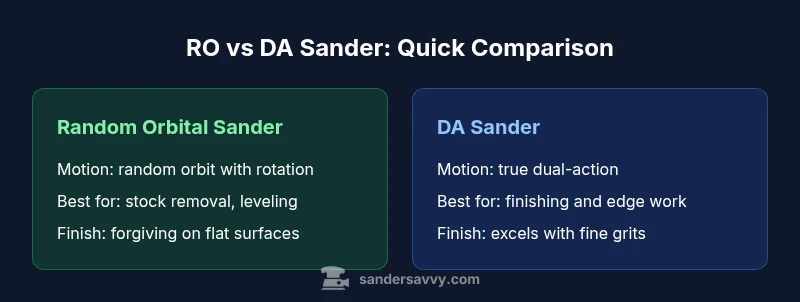
| Motion type | Random orbit with independent rotation | Dual-action (also random), marketed as DA |
| Pad size options | Typically 5-inch and 6-inch options | Typically 5-inch and 6-inch options |
| Dust collection | Good to excellent with proper porting | Good to excellent with proper porting |
| Finish quality | Swirl-minimized, forgiving on flats | Swirl-minimized, forgiving on flats |
| Vibration/ergonomics | Balanced weight, moderate vibration | Balanced weight, moderate vibration |
| Best for | General stock removal and leveling on wood floors | Finishing, edges, and detail work |
| Price range | $80-$180 | $90-$200 |
What's Good
- Good finish control with forgiving motion
- Versatile for flats, edges, and light refinishing
- Broad pad/grit compatibility and accessory availability
- Relatively easy to use for beginners
Weaknesses
- Higher long-term cost if pads are misused or replaced often
- Potentially heavier on the wrist with long sessions
- Dust collection depends on setup; poor extraction can reduce performance
RO sander and DA sander are the same class; choose based on ergonomics and dust collection.
For most DIY projects, pick the model with better grip and dust extraction. The two terms describe the same general tool; focus on build quality and accessory availability.
Your Questions Answered
What is the difference between a random orbital sander and a DA sander?
In practice, they describe the same dual-action class. The main differences are marketing labels, ergonomics, and dust collection. Both work well for DIY projects when used with appropriate grit sequences.
RO and DA sanding are basically the same tool family; look at grip and dust collection to decide.
Can I use a RO sander for heavy stock removal?
Yes, for heavy stock removal, a RO/DA with a coarser grit can remove material effectively. Be mindful of heat buildup and edge control.
You can remove stock, but don’t push hard—let the tool do the work.
Is a DA sander good for finishes?
DA sanders are well suited for finishes when paired with fine grits and proper technique. They reduce swirl marks and blend surfaces smoothly.
DA sanders help you get a smooth finish with the right grit.
What grit sequence should I use for floors?
Start with a coarse grit for stock removal, then move through medium grits and finish with a fine grit. Always test on a small area first.
Begin coarse, then medium, then finish with fine grit for floors.
Do I need dust collection?
Dust collection improves visibility and finish quality while reducing health risks. Use a vacuum attachment or dust bag with the sander fitted to a dust port.
Yes—dust collection helps you finish better and breathe easier.
Are there safety precautions for sanding?
Wear a mask and eye protection, keep hands clear of the pad, and avoid loose clothing near the sander. Work in a well-ventilated area to reduce dust exposure.
Protect yourself with PPE and work in a well-ventilated space.
Main Points
- Both tools belong to the same dual-action category
- Finish quality improves with good dust collection and technique
- Choose based on comfort, pad availability, and cost of ownership
- Test ergonomics before buying and match grit progression to the job