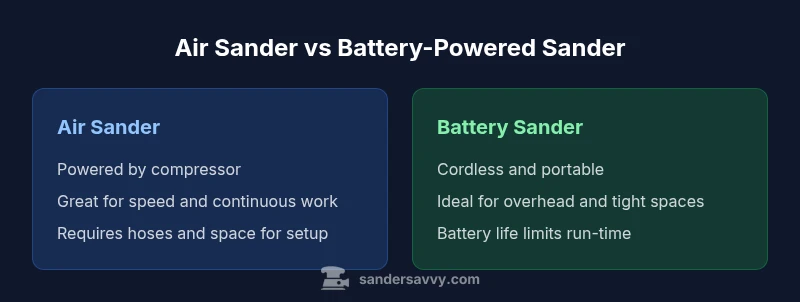
Air Sander vs Battery: A Practical Guide for DIY Sanding
In-depth, objective comparison of air-powered vs battery-powered sanders for homeowners and DIY enthusiasts. Learn how power, portability, dust control, and maintenance affect performance on floors, decks, and walls.


Air sander vs battery power is a fundamental trade-off for DIY floors, decks, and walls. In a well-equipped shop, pneumatic (air) sanders deliver steady speed and strong feathering with minimal downtime. Cordless battery sanders win for portability and overhead work, freeing you from hoses. The right choice depends on space, task length, and how much you value mobility vs speed.
Introduction to the air sander vs battery debate
According to SanderSavvy, choosing between an air-powered sander and a battery-powered model is not just about horsepower; it's about how you work. The air sander vs battery decision shapes performance on floors, decks, and walls by influencing speed stability, portability, and dust control. The SanderSavvy team found that many DIY homeowners underestimate the impact of a workspace setup on tool effectiveness: a well-equipped shop with a reliable compressor can unlock greater productivity with pneumatic sanders, while cordless options excel when mobility matters. This guide breaks down the core differences, common use cases, and practical tests you can perform to decide which path aligns with your goals, budget, and safety preferences. Throughout, we’ll keep terminology accessible and illustrate decisions with real-world scenarios you’re likely to encounter in home improvement projects. You’ll finish with a clear recommendation tailored to your space and project timeline.
How pneumatic air sanders work
Air sanders rely on compressed air delivered by a pump connected through hoses to a tool head that drives a random-orbital or finish sanding action. The advantages start with speed consistency: the regulator in a good air system maintains a steady oscillation and constant contact pressure, which translates to smooth finishes on wide, flat surfaces like wood floors and deck planks. A key practical factor is the compressor: its duty cycle, tank size, and moisture trap determine how long you can work before overheating or pressure dips occur. Dust management often relies on external vacuum systems or cyclone filtration paired with a compatible dust shroud. Maintenance is straightforward but requires keeping hoses clear, moisture out, and the regulator clean to prevent erratic spurts of speed.
How battery-powered sanders work
Battery-powered sanders depend on a rechargeable cell pack (usually Li-ion) and an electric motor that drives a sanding pad in an orbital motion. The standout benefits are portability and decluttered work environments: you can move around furniture, work on ceilings, or sand outdoors without dragging hoses or finding outlets. Speed control is often electronic, with soft-start features that reduce kickback and dust-free start-ups. Battery runtime varies with voltage, plate size, grit, and the density of the material; for most DIY tasks, a couple of short sessions on a single charge with a mid-range pack is typical, followed by a recharge. The dust system may be integrated or add-on; many cordless sanders rely on an attachable vacuum or vacuum-less shroud for best results.
Key performance factors when comparing air vs battery sanders
When evaluating air sander vs battery options, consider these dimensions: power delivery and consistency, surface finish quality, ergonomics and vibration, noise levels, and practical constraints like workspace infrastructure. Pneumatic sanders tend to deliver strong, consistent removal with excellent control for long sanding sessions, provided the compressor can sustain pressure. Battery sanders shine in overhead access, tight spaces, and outdoor environments where mobility matters more than raw speed. The choice often hinges on task duration and whether you have a reliable air line or a portable power source. For DIYers tackling floors, decks, and walls, running a quick test swap—use both tools on a scrap piece—can reveal how each feels under your typical workload.
Noise, dust, and ergonomics in real-world use
Air sanders can produce noticeable compressor noise and the clatter of hoses, which is a consideration for home workshops near living spaces. Dust control is workable but depends heavily on powered extraction and a properly sealed shroud. Battery-powered sanders are quieter in operation and free you from hoses, but some users notice more frequent battery swaps for extended projects. Ergonomics plays a central role: longer sessions with a heavier pneumatic tool may require anti-fatigue grips and straps, while lighter cordless units can reduce shoulder strain during overhead work. For many DIY homeowners, the decision comes down to whether the task is stationary and continuous or mobile and variable in angle.
Cost of ownership and ongoing maintenance
Cost of ownership for air vs battery sanding hinges on upfront equipment and ongoing running costs. Air systems require an air compressor, hoses, filters, and moisture traps, which can be a larger initial investment but may be economical per hour for heavy, repeated work. Battery sanders typically have a lower upfront price for the bare tool but incur battery replacement costs and occasional motor servicing as the packs age. In a typical home shop, the air approach can be cost-effective when you perform frequent, long sanding tasks, while cordless sanders are appealing for cleanup jobs, quick touch-ups, and locations without ready power.
Best use cases for air sanders in DIY projects
Air sanders excel on large, flat surfaces in a controlled workshop setting where you can rely on a stable air line and a robust extraction system. If you’re refinishing a wood floor or deglossing a large deck area, the steady power and feathering capability of pneumatic units help you achieve even removal and a smooth base for finishing. They also pair well with heavier grit pads for rapid material removal without sacrificing control. Polling real-world DIYers, air sanders are favored when you need consistent RPM, predictable performance, and minimal downtime between passes, provided your compressor won’t bog down.
Best use cases for battery-powered sanders for DIY projects
Battery-powered sanders are unbeatable for overhead work, furniture finishing, and wall prep when you don’t want to drag a compressor into tight spaces. They shine in deck and porch projects where you must move around corners and under eaves. Cordless tools offer quick changeovers and quick setup times, which is invaluable for freelancers or homeowners with limited space. The portability also helps when you want fine-tuning in small areas where the air line would be awkward or impractical. When you value agility and flexibility over the longest possible run, battery-powered sanders are often the smarter pick for DIYers.
Safety and maintenance routines you should adopt
Regardless of the tool, always wear eye protection, a dust mask or respirator, and hearing protection as appropriate. Air sanders demand a careful hose management system to avoid tripping hazards, along with moisture traps and regular filter checks to prevent water-laden debris from clogging the tool. Battery sanders require careful battery maintenance: avoid deep discharges when possible, store at room temperature, and follow manufacturer guidelines for charging cycles. Routine pad changes, grit selection based on the task, and cleaning of the sanding head after each session help extend life and maintain consistent results.
How to choose between air and battery in practical projects
To decide between air sander vs battery, start by mapping your workspace: Is there a reliable compressor, hoses, and a dust extraction system, or is mobility the priority? For large, repetitive tasks in a fixed shop with ample ventilation, air sanders tend to deliver faster, uniform results. If you frequently work in awkward spaces, outdoors, or away from power outlets, cordless models offer unmatched freedom. Consider a hybrid approach: a pneumatic main tool for bulk material removal and a compact cordless sander for touchups or hard-to-reach areas. Your decision should reflect how these factors align with your project mix and schedule.
Practical techniques to maximize sanding results with either tool
No matter which tool you choose, technique matters. Start with appropriate grit progression to avoid scorched or fuzzy surfaces, and maintain even pressure to prevent gouging. For air sanders, use a light touch near edges and corners, and keep the pad moving to avoid burn marks. For battery sanders, take advantage of soft-start features and vary speeds to accommodate thickness changes in the material. Always keep a spare pad and a blade or backing pad-compatible with your model. Regularly inspect dust collection components for blockages and ensure the exhaust is directed away from you and your workspace.
Common misconceptions about air vs battery sanding
One common myth is that air sanders always remove material faster than cordless models. In reality, performance depends on air supply quality, regulator settings, and the pad type. Another misconception is that cordless tools are always weaker; modern batteries deliver surprisingly strong torque for many DIY tasks, especially when quick setup and versatility are key. Finally, many assume louder equals more effective; noise levels vary with setup, but efficiency and results depend on technique and tool condition, not just volume. Understanding these nuances helps you pick the right tool for the job.
Comparison
| Feature | air sander | battery-powered sander |
|---|---|---|
| Power source | Pneumatic via air compressor | Lithium-ion battery (cordless) |
| Portability/setup | Requires hoses and a compressor; typically less portable | Cordless and hose-free; highly portable |
| Run time / endurance | Limited by compressor duty cycle; continuous use possible with air supply | Limited by battery charge; swap or recharge as needed |
| Dust management | External extraction with shroud and vacuum; depends on setup | Integrated or add-on dust collection; depends on model |
| Maintenance | Compressor maintenance, hoses, moisture traps | Battery care, chargers, occasional motor service |
| Best for | Large shop tasks with steady power and long runs | Overhead, tight spots, outdoor work; mobility matters |
| Cost implications | Higher upfront when building a compressor-based system; running costs depend on air usage | Moderate upfront tool cost with ongoing battery replacements |
What's Good
- Strong, consistent sanding power with regulated air supply
- Good for long, continuous sessions in a shop setting
- Dust control can be highly effective with proper extraction
- Cordless option provides mobility and overhead access
- Wide range of pad options and grit compatibility
Weaknesses
- Requires air compressor, hoses, and space for setup
- Compressor noise and maintenance can add to the workshop footprint
- Battery packs require replacement over time for cordless models
- Dust management relies on external systems and technique
Air sander is generally preferred for shop-based, continuous sanding; battery sanders win for portable, overhead, and remote tasks
Choose air if your workflow is stationary with reliable air supply and heavy, repeated passes. Choose battery if you need mobility and clean-up without hoses, especially for overhead or exterior work.
Your Questions Answered
Which is faster for large surface areas: air sander or battery-powered sander?
In a well-equipped shop, an air sander often completes bulk removal faster due to steady pneumatic power. Battery tools can keep up on shorter sessions or when you’re moving around, but may need more pauses to recharge. Your actual speed depends on grit, pad type, and how you regulate pressure.
Air sanders usually finish large areas faster in a shop, but cordless models are great for portability. Your setup and pad choice matter as much as the tool.
Can I run a dust extraction system with both tools?
Yes. Both air and battery sanders pair best with an effective dust extraction setup. For pneumatic tools, connect to a shop vacuum or cyclone system; for cordless tools, rely on a compatible dust shroud and vacuum. Good dust control improves finish quality and air quality in the workshop.
Use a dust extraction system with either tool for better finish and air quality.
Is noise a major issue with air sanders?
Air sanders can be noisy due to the compressor and hose system, particularly in small spaces. Cordless sanders are typically quieter during operation. If noise is a concern, invest in a quiet compressor or use a ducted exhaust setup and hearing protection.
Air tools can be loud; cordless ones are quieter. Protect your hearing with appropriate PPE.
What maintenance tasks are common to both tools?
Regular blade and pad inspections, keeping blades clean, and replacing worn pads are common to both. For air tools, service the regulator, moisture traps, and hoses. For battery tools, monitor battery health, store properly, and follow charging guidelines to maximize life.
Check pads and cleaners frequently; service air parts and care for batteries to extend tool life.
Are there hybrid or combo options that mix advantages?
Hybrid approaches exist where a shop uses air tools for bulk removal and a cordless sander for finish work or hard-to-reach angles. This setup minimizes downtime and maximizes flexibility, though it requires managing two tool ecosystems and possibly two dust control strategies.
A hybrid setup can give you the best of both worlds, but adds management overhead.
Main Points
- Assess workspace infrastructure before buying
- Pick air for speed and consistency in a fixed shop
- Choose battery for portability and overhead access
- Combine tools strategically for best results
- Invest in good dust extraction regardless of tool choice