Drum Sander vs Thicknesser: Pros, Cons, and How to Decide
A practical, objective comparison of drum sander and thicknesser—when to use each, how they differ, and a clear decision guide for woodworkers.


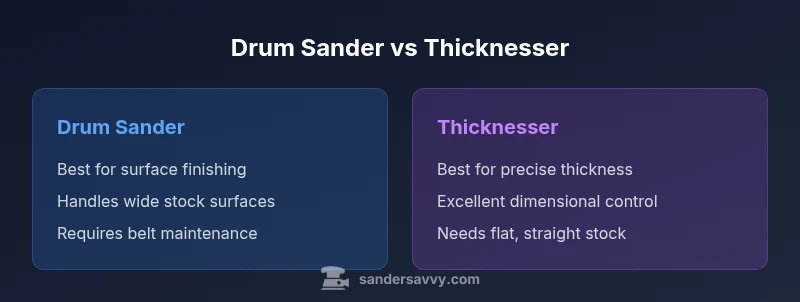
Drum sander vs thicknesser: If you need boards to a precise thickness, a thicknesser is the workhorse; if you want a perfectly flat, sanded face after milling, a drum sander is typically better. For most projects, you’ll pair both: plan stock with a thicknesser, then finish surfaces with a drum sander.
What are drum sanders and thicknessers?
According to SanderSavvy, the choice between a drum sander vs thicknesser hinges on workflow and final appearance requirements. A drum sander uses a rotating belt around a drum to abrade the board’s surface, producing a smooth, even finish across wide sheets. A thicknesser (also called a planer) employs a cutterhead to shave material from the board to bring it to a uniform thickness along its length. Understanding these basics helps you plan a workflow that minimizes waste and time. In most shops, you’ll eventually use both, but your priority guides the order of operations. The drum sander excels at producing an immaculate surface after milling or flattening, while the thicknesser is the workhorse for achieving precise thickness across boards. This distinction matters for save time, reduce waste, and improve final appearance.
Preparedness and the broader workflow
A sound woodworking workflow treats stock preparation as a sequence rather than a single step. Planes and planers establish uniform thickness; sanders then refine the surface to remove tool marks and levels irregularities. The drum sander is less about thickness control and more about surface perfection, while the thicknesser is optimized for dimensional accuracy. For DIYers and professionals alike, combining both tools offers a robust approach to high-quality boards. Remember that each tool operates best on stock prepared and cleaned beforehand: jointed edges, flat faces, and stable stock support minimize tear-out and snipe.
Core design differences you should know
The core difference between these machines lies in their primary function and how they interact with stock. A thicknesser cuts off a thin layer from the board’s face to reach target thickness, usually with two feed rollers and a cutterhead. A drum sander removes material from the surface using abrasive strips mounted on drums, with sanding belts or drums rotating against the stock. This creates a flat, smooth face but does not guarantee exact thickness across boards. The two tools complement each other in most workshops, enabling precise thickness followed by a pristine surface.
How to evaluate finish quality and dimensional control
Finish quality and dimensional control are the two key axes you should measure when choosing between a drum sander and a thicknesser. A thicknesser provides predictable thickness and is essential when boards must be uniform in height, width, and planed faces. A drum sander, by contrast, excels at leveling surface texture, removing machine marks, and creating a final, uniform face across wide boards. For projects like cabinet panels, tabletops, or floors, many woodworkers prefer to thickness stock first, then finish with a drum sander to achieve a flawless surface. Sander quality, belt condition, and proper feed speed all influence outcomes.
Practical performance considerations for real-world use
In practice, the drum sander’s belt speed, drum size, and belt width determine how aggressively it removes material and how flat a surface it produces. The thicknesser’s feed rate, infeed/outfeed tables, and blade sharpness govern how evenly material is removed and how well the boards stay square. Both tools require careful setup: edge jointing to reduce tear-out, correct stock supports to prevent drift, and consistent feed rates to avoid gouging or snipe. Dust collection and personal protective equipment are essential for both machines, especially when sanding wide stock or hardwoods.
Use-case scenarios: when each tool shines
If you are building kitchen cabinets and want fast, uniform thickness across multiple boards, a thicknesser is your best friend. If you are sanding panel surfaces, flattening bowls, or leveling a live edge, a drum sander will deliver superior surface quality. For reclaimed lumber with uneven faces, the drum sander can take down high spots after initial planing, while the thicknesser can bring rough stock to precise dimensions before finishing. In many shops, the reliable path is to plan stock with a thicknesser and then finish surfaces with a drum sander.
Safety, setup, and dust management considerations
Both machines generate substantial dust and pose pinch points and kickback risks if misused. Ensure a solid dust collection system and adjust the machine to minimize dwell time on any one area of stock. Use zero-clearance tables or sacrificial boards to reduce tear-out on the thicknesser, and always keep blades sharp and belts intact on the drum sander. Safety gear such as eye protection, hearing protection, and a respirator suitable for wood dust will enhance your comfort during longer sessions. Regular maintenance creates safer, more accurate results.
Cost considerations and maintenance realities
Costs for drum sanders and thicknessers vary by size, power, and available features. In a typical shop, the drum sander requires ongoing belt or disc renewals, dust extraction, and motor maintenance. A thicknesser involves blade changes, alignment checks, and occasional head adjustments. If you’re budgeting for a small shop, consider the total cost of ownership, including blades, belts, and the maintenance intervals. In some cases, a mid-range drum sander plus a compact thicknesser covers a broad spectrum of tasks without overspending. Sander quality and brand reliability influence both upfront cost and long-term performance.
How to integrate both tools into a practical workflow
A common, practical workflow is to start by bringing stock to a consistent thickness with a thicknesser, then move to a drum sander for final finish and flatness. This sequence keeps material waste low and reduces the risk of over-sanding. Check boards individually for warping or cupping; process the ones that hold flat faces first. For panels, start with a thicknesser and then run through a drum sander in multiple passes with careful belt tension and minimal contact time to avoid heat build-up. Regular checks of blade sharpness and belt wear help maintain consistent results.
Tips to avoid common pitfalls
Avoid common pitfalls by maintaining proper alignment and consistent feed speed. A dull blade in a thicknesser or a worn belt on a drum sander can create gouges or waves that require rework. Always plane or sand with the grain when possible, or cross-grain only with light passes to reduce tear-out. Keep stock flat and supported to prevent snipe and ensure uniform results across longer boards. Finally, keep safety guards in place and never remove dust extraction during operation.
Comparison
| Feature | Drum sander | Thicknesser |
|---|---|---|
| Primary function | Surface finishing and planing marks removal on large surfaces | Thicknessing stock to a target final dimension |
| Best use case | Final surface finish, flattening after milling or reclaiming stock | Dimensional accuracy and uniform thickness across boards |
| Finish quality potential | Excellent surface finish with proper technique | Predictable thickness with high dimensional consistency |
| Stock size handling | Wide boards and panels; edge-to-edge finishing | Typically limited by board width but very effective for standard sizes |
| Operational costs | Consumables (belts), dust extraction, periodic motor maintenance | Blades, cutting head maintenance, alignment, dust management |
| Setup and maintenance | Belt tension, drum alignment, dust extraction efficiency | Blade sharpness, cutterhead alignment, dust removal |
| Safety considerations | Dust management and kickback risk; maintain guards | Dust and blade contact hazards; use proper PPE |
| Best for | Surface finalization and leveling | Thickness control and milling stock to spec |
What's Good
- Delivers a superior final surface finish for exposed faces
- Excellent for leveling and flattening wide panels
- Flexible for reclaiming warped or cupped stock after milling
- Useful as a finishing step after initial planing or milling
Weaknesses
- Less precise for thickness control across multiple boards
- Requires careful setup to avoid gouges or burn marks
- Higher ongoing consumables and maintenance compared to some planers
- Dust production can be substantial without extraction
For most woodworkers, the best approach is to use both tools in sequence: thickness stock with a thicknesser, then finish with a drum sander for a flawless surface.
The thicknesser provides the critical thickness control, while the drum sander delivers a superior surface finish. Using them in tandem minimizes waste and maximizes both dimensional accuracy and surface quality.
Your Questions Answered
Can I replace a thicknesser with a drum sander for all projects?
No. A drum sander cannot reliably achieve precise board thickness across multiple pieces. Use a thicknesser when final thickness tolerance matters, and reserve the drum sander for surface finishing and flattening. In many shops, both tools are used in sequence for best results.
No. A drum sander isn’t a substitute for precise thickness control; use a thicknesser for thicknessing, and a drum sander for finishing. Often, both together give the best results.
Which tool is faster for finishing large boards?
For finishing large boards, a drum sander can be faster to achieve a uniform surface, but its effectiveness depends on belt wear and heat management. A thicknesser will not finish large surface textures as efficiently. Consider a two-step approach for large surface prep.
A drum sander is usually faster for large surfaces, assuming the belt is in good condition and you manage heat well.
What safety concerns should I be aware of with drum sanders?
Drum sanders generate a lot of dust and can cause kickback if fed too aggressively. Always use dust collection, wear PPE, and keep workpieces flat and supported. Check belt wear and avoid overheating the belt.
Dust collection and PPE are essential. Keep the board flat, feed steadily, and replace worn belts to avoid hazards.
Can thicknessers handle rough or warped stock?
Thicknessers work best on stock that can be fed straight and with consistent thickness. Warped or cupped boards may require flattening or flattening along edges first, or processing in smaller steps. Always joint and plane in a controlled sequence.
Thick stock can be tricky if warped; flatten edges first and plane in controlled passes.
Is a drum sander suitable for final edge finishing?
A drum sander excels at face finishing but edge finishing depends on the machine and setup. Some models support edge sanding, but for most edges, you may need a different tool or a narrower belt. Plan accordingly.
Edge finishing with a drum sander is possible but consider dedicated edge tools for best results.
What maintenance does a thicknesser require?
Regularly check and sharpen knives, align the cutterhead, and inspect infeed/outfeed tables. Clean debris after use and ensure proper lubrication for moving parts. Routine alignment checks help maintain accuracy.
Keep blades sharp, check alignment, and clean after use.
Main Points
- Plan stock to a target thickness first, then finish with a drum sander
- Prioritize surface finish quality for panels and wide boards
- Maintain dust extraction and safety gear to protect health
- Check blades and belts regularly to prevent defects
- Consider a two-tool workflow for best results