Is a Grinder the Same as a Cut Off Tool? A Practical Comparison
A detailed, analytical comparison clarifies the differences between grinders and cut-off tools, their ideal uses, safety considerations, and how to choose the right tool for metal, wood, or masonry projects.


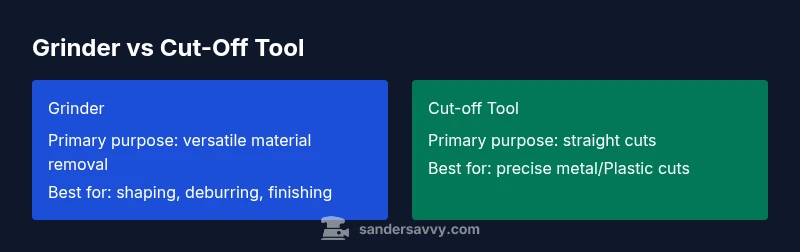
Is a grinder the same as a cut off tool? In short, no—grinders are versatile multi-taskers, while cut-off tools are specialized for clean, straight cuts. This comparison helps you identify which tool fits a given job, material, and workspace, reducing mistakes and improving results.
Defining grinders and cut-off tools
According to SanderSavvy, a grinder is a versatile power tool that uses attached discs for removing material, smoothing edges, and shaping surfaces. A cut-off tool is more narrowly focused on making straight, narrow cuts with a cut-off wheel or thin blade. The question is a grinder the same as a cut off tool is common among homeowners and DIYers, and the short answer is no: while a grinder can perform many tasks, a dedicated cut-off tool excels at precise, clean cuts and better control for certain materials. In practice, you will encounter both tools in metal fabrication, woodworking, and home maintenance, where choosing the right attachment and guard configuration matters for safety and results.
This section lays the groundwork with precise definitions and typical configurations so you can tell them apart in catalogs, on the shop floor, or during a project planning session in 2026.
Key differences in design and operation
The most visible differences are in intent and ergonomics. A grinder tends to be heavier and designed for sustained material removal, with a broad range of discs—from grinding wheels to flap discs and sanding pads. A cut-off tool, by contrast, is often slimmer and optimized for making narrow, straight cuts with thin cut-off wheels. Speed is a factor, but the real distinction lies in control and intended task: grinders favor material removal and shaping, while cut-off tools emphasize precision cutting with minimal material removal. Knowing this helps you anticipate vibration, balance, and guard requirements, which in turn influences your technique and safety.
For everyday projects, you’ll often see “grinder” labeled for multi-disc configurations, while “cut-off tool” or “cut-off wheel” denotes the cutting-focused option. This distinction remains important when you read manufacturer documentation or choose between cordless and corded variants.
Attachments and discs explained
Attachments drive the capabilities of both tool types. Grinders support a wide spectrum of discs, including aggressive grinding wheels for metal, flap discs for deburring and finishing, sanding discs for wood, and polishing pads for a final shine. A cut-off tool uses cut-off wheels designed to slice through metal, plastic, or wood with minimal debris. Some grinders can accept cut-off wheels, and some cut-off tools can take narrow grinding discs, but compatibility depends on arbor size and guard clearance. When selecting tools, verify arbor diameter, wheel width, and maximum disc thickness to ensure safe operation. Always use the correct guard for the disc type and material for both categories to reduce the risk of wheel shattering or kickback.
For beginners, a practical rule is to start with project-specific discs and upgrade as you gain experience and confidence.
Material suitability and performance across substrates
Material choice heavily influences tool selection. Metal fabrication often benefits from a grinder’s versatility, especially for rust removal, edge shaping, and deburring when paired with appropriate discs. Woodworking tasks such as rough shaping or stripping finish may be tackled with a grinder using sanding discs or flap wheels, but precise rip-cutting or slotting is typically better handled with a cut-off tool or a dedicated saw. Masonry projects usually require specialized grinding or cutting attachments and dust control, as grinding concrete can generate a lot of fine particles that affect air quality. The key takeaway is to match the tool to the primary task: bulk material removal and shaping vs. precise, straight-cut operations. In all cases, plan your workflow to minimize tool changes and maximize surface quality.
Practical usage scenarios
Consider how you approach common tasks. If your job involves removing corrosion from a steel surface, a grinder with a flap disc or a gritty sanding pad speeds material removal and gives a consistent finish. When you need to pass a metal sheet or trim a stud with a clean face, a cut-off wheel on a compatible tool delivers the straight, narrow cut required for a tight fit. For DIY projects that mix cutting and shaping, invest in a versatile grinder and reserve a dedicated cut-off tool for critical straight cuts, especially in metal and PVC installations where exact tolerances matter. The takeaway is to build a small toolkit that balances versatility with precision, aligning with your typical project mix.
Safety and PPE considerations
Both tool types demand rigorous safety practices. Eye protection is essential, as is hearing protection due to high-speed operation. Volatile dust and fumes may require respiratory protection in enclosed spaces, particularly when cutting metal or masonry. Ensure guards are in place and undamaged, and always secure the workpiece to prevent kickback. The correct use of PPE—safety glasses, face shield when grinding, respirator or dust mask for dusty materials, gloves, and protective footwear—greatly reduces the risk of injury. Training and reading the operator’s manual for your specific model are critical steps toward safe and effective use.
As you gain experience, you should also monitor tool vibration and take breaks to prevent hand-arm fatigue. These practices help maintain control and reduce long-term strain.
Maintenance and care
Regular maintenance extends tool life and ensures consistent performance. Keep ventilation pathways clean, inspect guards and alignment before use, and replace worn discs promptly. Clean the arbor and ensure discs seat evenly without wobble. For metal tasks, check for heat buildup and allow cooling periods to avoid warping or glazing of the disc. Store tools in a dry place, and replace damaged accessories rather than attempting to operate with compromised discs. Performing simple maintenance tasks after each project minimizes downtime and keeps performance predictable across jobs.
Cost, availability, and market context
Prices for grinders and cut-off tools vary by brand, power rating, and included accessories. The best value often comes from a tool that matches your most common tasks and offers a robust selection of compatible discs and wheels. When budgeting for a project, consider the total cost of ownership, including replacement discs, guards, and dust-management accessories. For homeowners, a mid-range grinder with a solid safety guard and a starter set of discs can cover a wide range of tasks without frequent upgrades. For professionals, investing in higher-quality discs and reliable guarding can reduce downtime and improve results over time.
Common myths and misconceptions
A frequent misconception is that grinders are interchangeable with cut-off tools in every scenario. The reality is nuanced: while some grinders can accept cut-off wheels, they don’t always deliver the precision or control needed for narrow cuts in tight spaces. Another myth is that cutting is inherently faster than grinding. In practice, the best approach depends on material, thickness, and required finish. Proper tool selection reduces the risk of waste, poor cuts, or damaged material. Debunking these myths helps you make wiser decisions at the point of purchase.
How to choose the right tool for a project
Start by defining the primary task: are you removing material, shaping a edge, or making precise cuts? If you need versatility across metal and wood, a grinder with a balanced set of discs is a sensible investment. If your work repeatedly requires straight, narrow cuts with a narrow kerf, a dedicated cut-off tool becomes indispensable. Consider work space, weight, balance, and guard design. Finally, read local regulations and dust-control requirements for your workspace, and prioritize tools with good guards and reliable safety features.
Quick-start checklist for new users
- Identify project tasks: grinding, cutting, deburring, or finishing.
- Check material type and required precision.
- Verify disc compatibility and guard availability.
- Plan dust-control and PPE needs.
- Start with a safe, conservative approach and test on scrap material first.
- Maintain discs and guards, replacing worn components promptly.
Real-world project examples
A homeowner refurbishes a steel railing by removing rust with a grinder and then deburring edges with a flap disc. A garage remodel uses a cut-off tool to trim metal studs and door frames for a precise fit, followed by a grinder to smooth any rough edges. In a wood shop, a grinder with a sanding attachment handles surface prep on rough boards, while a cut-off tool is reserved for trimming off-cut pieces with clean lines.
Comparison
| Feature | Grinder | Cut-off tool |
|---|---|---|
| Primary purpose | Versatile material removal, grinding, cutting, and finishing with various discs | Specialized for clean, straight cuts with narrow wheels or blades |
| Attachments/discs | Grinding wheels, flap discs, sanding discs, polishing pads | Cut-off wheels, narrow blades; some models accept light grinding discs |
| Best use cases | Metal fabrication, deburring, surface finishing, shaping | Precise straight cuts in metal, wood, and plastic |
| Control and maneuverability | Heavier with broader motion; requires practice | Slimmer profile with focused control for straight cuts |
| Safety considerations | Guard requirements; kickback risk with grinding discs; dust generation | Higher risk with high-speed wheels; keep guards in place and inspect wheels |
What's Good
- Grinders offer versatile, all-in-one capability with a broad accessory ecosystem
- Wide availability of discs and attachments across brands
- Good value for mixed tasks when storage or tool count is limited
Weaknesses
- Cut-off tools excel at precise, straight cuts but lack grinding versatility
- Grinders can be heavier and harder to control for beginners; higher kickback potential
- Using the wrong disc type can damage material or cause safety issues if guards are not used properly
Choose based on task needs: use a grinder for versatility and general prep; use a dedicated cut-off tool when you need clean, precise cuts in metal or plastics.
Grinders cover a wider range of tasks, making them a practical first tool for homeowners. Cut-off tools shine in control and precision for straight cuts, particularly in restricted spaces. For a balanced setup, pair a grinder with a separate cut-off tool for best results.
Your Questions Answered
Is a grinder the same as a cut-off tool?
No. Grinders are versatile tools designed for grinding, cutting, and finishing with various discs. Cut-off tools specialize in making straight, narrow cuts with cut-off wheels. The right choice depends on the task and material.
No—grinders are multi-taskers, while cut-off tools focus on straight cuts with narrow wheels.
Can I use cut-off wheels on a grinder?
Often yes, but it depends on arbor size and guard clearance. Check the manufacturer’s compatibility chart for your model before attempting to mix wheels and tools.
You can, but verify compatibility first to avoid safety issues.
What safety gear should I wear?
Wear eye protection, hearing protection, gloves, and a dust mask or respirator when dust is generated. Ensure guards are in place and that you work in a well-ventilated area.
Always wear eye, ear, and respiratory protection and keep guards on.
Best use cases for each tool?
Grinders are ideal for material removal and finishing across metals and wood. Cut-off tools excel at clean, precise straight cuts, especially in metal and PVC work.
Use grinders for shaping and finishing; use cut-off tools for precise cuts.
Are there tools that combine both tasks?
Some models offer motorized oscillation or allow swapping discs for light grinding and light-cutting tasks, but true precision cutting usually requires a dedicated tool.
There are combo tools, but for best cuts, dedicated tools win.
How do you prevent kickback and maintain discs?
Use the correct disc for the task, maintain a firm grip, avoid pinching the wheel, and replace worn discs promptly. Keep a safe stance and stop if you notice excessive vibration.
Grip firmly, replace worn discs, and keep guards in place to stay safe.
Main Points
- Grinders are versatile but heavier and less precise for cuts
- Cut-off tools specialize in straight cuts with better control in tight spaces
- Choose based on task: universal grinding vs. precise cutting
- Always use the correct guard and PPE for safety