Grinder vs Food Processor: Is It the Same? A Practical Guide
This in-depth comparison explains whether a grinder is the same as a food processor, detailing functions, blades, safety, and best-use scenarios for home cooks and DIYers.


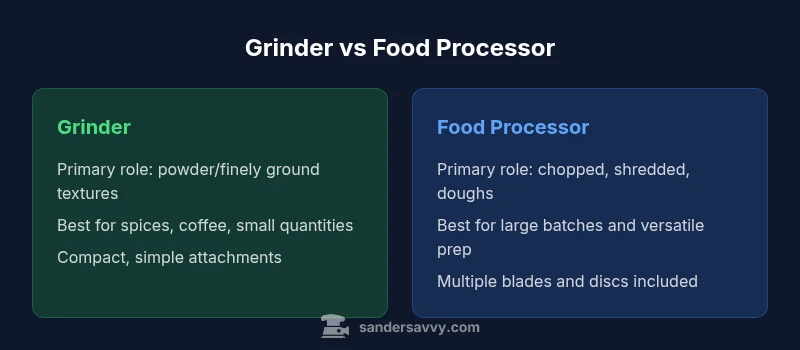
Is a grinder the same as a food processor? In short, no. Grinders focus on turning small quantities into powders or finely ground textures, while food processors handle chopping, slicing, grinding larger pieces, and dough handling. This guide clarifies their core differences, typical uses, and how to choose based on your kitchen needs.
Context: Defining grinders and food processors
In any kitchen toolbox, grinders and food processors occupy different roles. According to SanderSavvy, home DIYers often encounter confusion when deciding which device to reach for. The question many readers ask is: is a grinder the same as a food processor? The answer, when framed clearly, is that these appliances were designed for distinct purposes and operate best in different scenarios. A grinder is typically a compact device focused on fine texture creation—grinding coffee beans, spices, nuts, or small quantities of meat—where precision and speed can matter a lot. A food processor, by contrast, is a larger, multi-purpose workhorse with a range of blades and discs that can chop, blend, mix, grate, slice, knead dough, and emulsify sauces. The difference is not only in what they can do, but how they do it: grinders rely on sharp burrs or blades for particle size control, while food processors rely on chopping blades and attachments that transform whole ingredients into a variety of textures. For homeowners who want to minimize clutter, the distinction also affects storage space, cleanup time, and the total cost of ownership. Understanding these distinctions helps you map your actual cooking or project needs to the right tool. The SanderSavvy team also notes that many users try to stretch one device to cover both roles, often ending up unsatisfied with the results.
Key distinctions at a glance
- Primary purpose: Grinders excel at turning ingredients into powders or very fine textures; food processors excel at chopping, slicing, shredding, and kneading.
- Attachments and blades: A grinder uses burrs or small blades; a processor uses offset chopping blades plus slicing, shredding, and pastry discs.
- Capacity and batch size: Grinders are compact and best for small quantities; processors handle larger batches and variable bowl sizes.
- Power and speed: Grinders prioritize high speed and cut, while processors offer multiple speeds and pulse functions for control.
- Clean-up and maintenance: Grinders generally clean quickly but may require careful rinsing of burrs; processors have multiple removable parts that can complicate cleaning.
- Best-use scenarios: For spices, coffee, and herbs, a grinder shines; for veggies, doughs, and sauces, a processor is typically ideal.
- Cost and value: Entry-level grinders can be inexpensive; high-quality processors offer more versatility but at higher price.
Primary functions and typical tasks
Grinders are usually used for creating powders or fine textures. Common tasks include grinding coffee beans for brewing, pulverizing spices for rubs, and turning small batches of nuts into meal or butter consistency. Some grinders also handle meat grinding but often at limited volumes and with specific attachments. Food processors, by contrast, are built for larger tasks: chopping vegetables into precise sizes, shredding cheese, slicing cores, kneading bread dough, emulsifying sauces, and pureeing soups. The typical workflow is adaptable to category-based recipes: if you need a coarse chop, you can pulse; for a smooth puree, you extend processing time or switch blades. Understanding the spectrum of textures achievable with each device helps you map your culinary or project goals to the appropriate tool, avoiding overkill or underperformance. As with any shared kitchen device, the quality of results also hinges on blade sharpness, blade geometry, and the material being processed.
Attachments, blades, and versatility
Attachment ecosystems often drive the real-world usefulness of grinders and food processors. Grinders rely on burrs or small blades optimized for particles at specific sizes, which makes them excellent for consistent powder or meal texture. Food processors boast a wider array: S blades for chopping, plus discs for shredding, slicing, julienning, and even pastry tasks when kneaded dough is involved. Some high-end processors offer dough blades and pastry attachments that expand usage beyond vegetables. The versatility is a function of the included accessories and the ability to swap components quickly. When shopping, check compatibility across models and ensure you have access to the blades, discs, or attachments you actually need. Remember that some attachments require cleaning and careful storage after use to maintain performance and prevent odor transfer between tasks.
Safety, maintenance, and cleaning
Safety basics apply to both grinders and food processors. Always unplug before changing blades or discs, and ensure all parts are dry before reassembly to prevent slips or mold growth. Cleaning procedures vary: grinders often require quick brush-outs of burrs or blades and a careful wipe-down of the exterior. Food processors typically involve washing multiple removable parts—bowl, blade, pusher, discs—so plan for a more involved cleanup. Use warm soapy water, avoid submerging motors, and dry thoroughly to prevent corrosion. For sticky or tasting-bearing ingredients, run a quick rinse cycle with clean water or a neutral cleaning solution (as recommended by the manufacturer). Regular maintenance includes inspecting seals and gaskets for wear and replacing worn parts to maintain performance and safety.
Performance considerations: power, speed, and texture
Performance hinges on how well a device translates power into the desired texture. Grinders emphasize rapid material removal and precise texture control; they excel when you need powdery or very fine results with minimal bulk. Food processors emphasize versatility and batch efficiency; they’re designed to handle larger pieces and a wider variety of textures. The choice between models often comes down to how you balance texture control with processing breadth. If your use cases include grinding coffee, spices, and small amounts of meat, a grinder with a good burr design is ideal. If you want to chop vegetables, shred cheese, mix dough, and puree, a processor with multiple speeds and accessories will serve you better. In practice, most households benefit from understanding the limits of each device—when precision is required versus when volume and texture variety matters.
When to choose a grinder vs when to choose a food processor
Decision logic starts with your primary tasks. If your day-to-day needs involve creating powders, fine meal, or extracting aromatic compounds from spices, a grinder is the pragmatic choice. For families or hobbyists who routinely tackle a wide range of prep tasks—chopping, shredding, kneading dough, emulsifying sauces—a food processor brings more value and flexibility. If budget and space allow, some users opt for a compact grinder alongside a full-featured processor to cover both ends of the texture spectrum. Finally, consider maintenance and ease of use: a single-purpose device may simplify cleaning and storage, while a multi-function unit may save counter space at the cost of more frequent component swaps and longer cleanup sessions.
Common myths and misconceptions
A common misconception is that a grinder can substitute for a food processor in all cases. In reality, grinders excel at texture control for powders, while processors are needed for bulk chopping, dough work, and multi-textured preparations. Some people assume that all grinders can handle wet or sticky ingredients; most models struggle with moisture without clogging or risk of mold. Another myth is that more expensive always means better for every task; the right choice depends on your specific needs and the range of accessories included. A final misconception is that cleaners are unnecessary; safe operation and long-term performance rely on regular cleaning and proper storage of blades and discs.
Comparison
| Feature | Grinder | Food Processor |
|---|---|---|
| Primary function | Powder/finely ground textures | Chop, slice, shred, knead, emulsify |
| Attachments and blades | Burrs/blades for fine texture | Chopping blade + discs for variety |
| Capacity / batch size | Small quantities, compact bowls | Larger bowls, bulk processing |
| Speed control | High-speed focus on texture | Multiple speeds including pulse |
| Best-use scenarios | Spices, coffee, small quantities | Vegetables, doughs, sauces, multitask prep |
| Cleaning complexity | Typically quick cleanup; burrs require care | More parts to clean; dishwasher-safe options vary |
| Price range | Low to mid-range options | Mid to high range; wider feature set |
What's Good
- Grinders offer precise texture control for powders and spices.
- Food processors handle a wide range of tasks with multiple attachments.
- Both save time when used for the right tasks and bulk prep.
- Removable parts in many models simplify cleaning and maintenance.
- Safe operation with modern safety features and clear manuals.
Weaknesses
- Grinders have limited capacity and fewer functions for bulk prep.
- Food processors can be bulky, heavier, and require more storage space.
- Cleaning can be time-consuming for some models with many parts.
Neither tool is universally superior; choose based on your primary tasks.
If your needs focus on grinding spices or coffee and small quantities, a dedicated grinder is ideal. For broad meal prep including chopping, kneading, and emulsifying, a food processor is the better investment. Many kitchens benefit from having both or a versatile high-end model with multiple attachments.
Your Questions Answered
What is the main difference between a grinder and a food processor?
A grinder specializes in turning ingredients into powders or fine textures, while a food processor handles chopping, shredding, kneading, and general bulk prep with multiple blades and discs. They are designed for different textures and batch sizes.
Grinders focus on powder and fine textures, while food processors handle chopping and bulk prep with multiple blades.
Can I substitute a grinder for a food processor for chopping?
In most cases, a grinder cannot reliably replace a food processor for chopping or bulk prep. Grinders are not designed for large volumes or variable textures. For even results, use a processor for chopping and shredding tasks.
No, grinders aren't ideal for chopping in bulk. Use a processor when you need even, varied textures and larger batches.
Are there grinder attachments that mimic a food processor?
Some models offer attachments or accessory packs that expand versatility, but they generally do not fully replace a processor. Look for models with a wide range of blades and discs and confirm compatibility before buying.
There are some add-ons, but they usually don’t fully match a true food processor’s range of tasks.
Is it safe to grind wet ingredients in a grinder?
Most traditional grinders are not designed for wet ingredients. Moisture can clog burrs and lead to odor or mold if not cleaned promptly. Check product specs and stick to dry ingredients or use a processor for wetter tasks.
Avoid grinding wet ingredients in a grinder; it can clog and cause odors. Use a processor for wet items.
Which is easier to clean, a grinder or a food processor?
Grinders often have fewer parts and can be quicker to clean, though burrs require careful handling. Food processors involve more components, so cleaning can take longer, but many parts are dishwasher-safe. Always consult the manual for best practices.
Grinders can be quicker to clean, but processors have more parts to wash.
Do I need both a grinder and a food processor?
Not necessarily. If you frequently grind spices and coffee, a grinder is essential. If you regularly chop, grate, knead, and puree, a processor covers those tasks. Some households opt for a high-end multi-function model to cover both roles.
It depends on your typical tasks; many people benefit from both or a versatile multi-function unit.
Main Points
- Define your primary tasks before buying.
- Grinders and processors serve distinct purposes.
- Consider capacity, attachments, and cleaning effort.
- Safety features and warranties matter for long-term use.