Is a Grinder the Same as a Polisher? A Practical Comparison for Sanding Tasks
Explore whether a grinder is the same as a polisher, how each tool works, and when to use them on floors, decks, and walls. Clear guidance from SanderSavvy to help DIYers choose the right tool and finish.


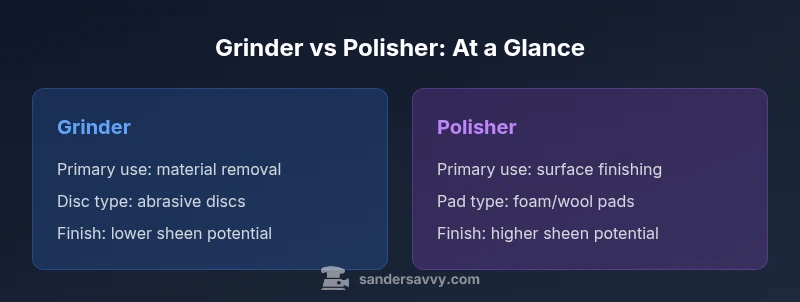
Is a grinder the same as a polisher? Not exactly. In woodworking and flooring, grinders are heavy-duty material-removal tools, while polishers refine surfaces to a high gloss. Grinders use grits and abrasive discs for shaping or stripping, whereas polishers employ soft pads and polishing compounds for finishing. The distinction matters for outcomes on floors, decks, and walls, and helps prevent gouges or dulling.
Tool Fundamentals: Definitions and Core Differences
In the world of sanding, the terms grinder and polisher describe two distinct tool families with different goals. A grinder is designed to remove material quickly, shape edges, or strip finishes. It typically uses hard abrasive discs or wheels that bite into the surface. A polisher, by contrast, works toward refinement and shine, relying on soft pads and polishing compounds to blend scratches and produce a smooth, lustrous finish. According to SanderSavvy, understanding these core differences is the first step toward selecting the right tool for any job. This knowledge sets expectations for performance, surface quality, and the kind of dust management you’ll need. For homeowners and DIY enthusiasts, recognizing when to switch from material removal to surface finishing can save time and prevent costly mistakes on floors, decks, and walls.
Is a grinder the same as a polisher? Clarifying the terms
The phrase is a common source of confusion on job sites. A grinder is not a polisher, even though some machines can accept interchangeable attachments. The key distinction lies in intended outcome: material removal versus surface refinement. A grinder, especially an angle grinder, uses coarse abrasive discs to aggressively remove material and flatten rough areas. A polisher uses a range of pads—from foam to wool—paired with polishing compounds to eliminate micro-scratch patterns and bring out a uniform sheen. If you search for a “grinder versus polisher” on wood, concrete, or metal tasks, you’ll see both tool families described with different accessories and safety requirements. For DIYers tackling floors or decks, misusing a grinder as a polisher can burnish rather than brighten the surface, leaving uneven results.
How grinders work: mechanics, discs, and common accessories
Grinders rely on high torque and robust abrasives to remove stock quickly. Common configurations include angle grinders and straight grinders, each compatible with a variety of discs such as silicon carbide, aluminum oxide, or diamond-coated options for tough materials. For sanding, you’ll typically attach grinding discs that grind away material, level high spots, or remove old coatings. Accessories like guard plates, dust collection shrouds, and vacuum adapters improve control and capture dust at the source. When selecting a grinder for sanding, pay attention to arbor size, wheel compatibility, and intended surface—coarse discs for rough shaping versus finer discs for blending. Because grinders operate aggressively, PPE and precise technique are essential to avoid gouges or fire hazards from overheating.
How polishers work: pads, compounds, and finishing formats
Polishers focus on surface refinement. They use soft pads—foam, microfiber, or wool—paired with polishing compounds or waxes to remove fine scratches and bring out a consistent finish. In floor and deck work, you’ll see orbital or rotational polishers used with finishing pads to achieve a uniform sheen without cutting deeper into the wood. Polishing compounds vary in grit, cut, and color, designed to address distinct stages of finishing from coarser blends to high-gloss finishes. Safety and dust control remain important, but the goal shifts from material removal to controlled smoothing and depth perception. For DIYers, matching pad density and compound type to the wood species and finish desired will yield better results than brute-force grinding.
Performance metrics: speed, torque, and material removal rate
When comparing grinders and polishers, look at performance in terms of torque, RPM range, and pad or disc compatibility. Grinders typically deliver high torque and can operate at a range of speeds, enabling rapid material removal on stubborn coatings or rough surfaces. Polishing tools emphasize steadier, smoother operation with less aggressive contact. The finish quality often improves with higher-quality pads and carefully chosen compounds. For decks and floors, consider a workflow that uses a grinder for initial stock removal and leveling, followed by a polisher for final smoothing and gloss. This two-step approach tends to yield more consistent results than attempting both tasks with a single tool.
Typical applications by task: floors, decks, walls
Floors: A grinder handles old finish removal from hardwood, tile, or concrete, preparing a level base for sanding. Polishing is then used to refine the surface and achieve the desired sheen. Decks: Heavy material removal may be needed to strip finishes or cut back uneven areas, after which polishing can refine the surface before sealing. Walls: Sanding walls often requires a specialized orbit or detail sander, but the same principles apply—grinder-like tools for bulk work and polishers for fine finishing. Across tasks, choose the tool based on required material removal versus final appearance, and always consider the surface’s delicate or hard components.
Dust, safety, and work conditions
Dust control is essential with both grinders and polishers. Grinders can generate significant dust and heat, so use fixed or portable dust collection, minimize exposure, and wear appropriate PPE. Polishers also create fine dust, especially on dusty finishes, so a respirator or dust mask, eye protection, and hearing protection are recommended. Work in a well-ventilated space and consider a dedicated dust-collection setup to reduce cleanup time. SanderSavvy emphasizes planning dust management as part of the prep phase to protect indoor air quality and occupant safety.
Choosing between a grinder and a polisher: decision criteria
Start with your end goal: stock removal or finish refinement. For rough shaping, uneven surfaces, or heavy coatings, a grinder is often more efficient. For smoothing, blending, and achieving a consistent sheen, a polisher is the better choice. Budget, surface type (wood, concrete, metal), and the required level of finish drive the decision. If the job requires both depth and depth-lightening, plan a two-step workflow that uses both tools in sequence. Remember that some machines are designed to accept different pads or discs; verify compatibility before purchasing to avoid downtime.
How to use each tool safely: setup, PPE, ventilation
Safety starts before you turn the tool on. Attach guards and dust shrouds, secure the workpiece, and ensure proper grounding. Wear eye protection, hearing protection, gloves, and a dust mask or respirator appropriate for the material being worked. For grinders, maintain a controlled stance and avoid excessive pressure; let the tool do the work. For polishers, use smooth, even passes and avoid overheating the surface. Ventilation helps, particularly with solvent-based finishes or resinous woods. If you’re uncertain about the correct pad or disc for a material, test on a small inconspicuous area first before committing to the full surface.
Maintenance and care: keeping blades, pads, and discs in good condition
Regular maintenance extends tool life and ensures consistent results. Clean dust from vents and moving parts after use. Inspect pads and discs for wear; replace missing or torn elements promptly to avoid marring the surface. Store attachments in a dry, protected area to prevent pad deformation. For polishers, replace pads as they lose their elasticity; for grinders, check guards and guards to ensure they do not rub or overheat the surface. A simple routine—inspect, clean, replace—keeps sanding equipment performing at its best and reduces the risk of accidents on future projects.
Common pitfalls and troubleshooting
A common mistake is using excessive pressure, which can gouge the surface or overheat the material. Another pitfall is selecting an incompatible pad or disc for the surface; always verify grit, pad type, and compound compatibility. If you notice uneven results, re-evaluate feed rate and technique, and consider a different pad or disc to even out the finish. For dust issues, ensure the dust collection system is properly sealed and the filter is clean. By following a planned approach and testing a small area first, you’ll mitigate most issues before they affect a large portion of the project.
Practical workflow: projects that require both tools
Many DIY projects benefit from a two-step approach. Start with a grinder to remove old coatings, level high spots, or strip finishes. After achieving the desired roughness, switch to a polisher with finishing pads and a compatible polishing compound to refine the surface. This sequence yields a better final appearance with fewer visible scratches and a more uniform sheen. Plan for adequate time and dust control at each stage, and document your pad and disc choices for future reference. A well-structured workflow reduces rework and helps you achieve professional-looking results.
Comparison
| Feature | Grinder | Polisher |
|---|---|---|
| Power/Speed emphasis | High torque with aggressive material removal | Moderate torque with emphasis on finishing and control |
| Disc/Pad options | Abrasive discs or wheels for stock removal | Soft pads (foam, microfiber, wool) for finish work |
| Best for | Shaping, stripping finishes, smoothing rough surfaces | Smoothing, blending, and bringing out sheen |
| Finish quality | Coarser, less consistent finish possible | Smoother, more uniform finish with shine |
| Dust control | Dust suppression possible with shrouds and vacuums | Dust control depends on pad choice and technique |
| Typical price range | Lower upfront cost with interchangeable attachments | Higher upfront cost for complete finishing kits |
| Safety considerations | Greater risk of gouges if misused | Lower risk of deep gouges but heat build-up if not managed |
What's Good
- Clear separation of duties: removal vs finish
- Flexibility with many attachments and surfaces
- Can achieve professional finishes with proper technique
- Two-step workflow reduces rework
Weaknesses
- Partial tool overlap can cause confusion
- Higher upfront cost for finishing setups
- Improper use speeds wear and damages surfaces
- Dust and heat management require careful planning
Grinder vs polisher: use the grinder for stock removal and the polisher for finishing, then combine as needed for best results
For most sanding projects, start with a grinder to strip or level surfaces, then switch to a polisher for refinement and sheen. The SanderSavvy approach emphasizes a two-step workflow to optimize both material removal and surface quality, minimizing gouges and uneven finishes.
Your Questions Answered
What is the main difference between a grinder and a polisher?
The main difference is purpose: grinders remove material quickly with abrasive discs, while polishers refine and brighten surfaces with soft pads and polishing compounds. This affects safety, finish quality, and required attachments.
Grinders remove material; polishers finish surfaces. Pick the tool based on whether you need to strip away material or bring out a smooth sheen.
Can a grinder be used for polishing tasks?
A grinder can be used for light blending on large, flat surfaces, but it is not ideal for achieving a uniform finish. It risks gouging or burnishing. Use a dedicated polisher for best results and save the grinder for initial material removal.
Grinders aren’t ideal for polishing, but they can do light blending if you’re careful.
What pads or discs should I use for sanding vs polishing?
For sanding, use abrasive discs or wheels designed for stock removal. For polishing, switch to soft pads (foam or wool) and appropriate polishing compounds. Compatibility with your tool and surface is key.
Choose abrasive discs for removal, soft pads with compounds for polish.
Is dust control important when using these tools?
Yes. Both tools generate dust; use dust collection, appropriate respirators, and protect surrounding areas. Proper containment reduces cleanup and health risks.
Dust control matters for safety and cleanup—don’t skip it.
What safety gear should I wear when sanding floors or decks?
Wear eye protection, hearing protection, a dust mask or respirator, and gloves. Ensure proper ventilation and avoid loose clothing near rotating parts.
Protect your eyes and lungs, and keep clothing clear of the workspace.
How do I troubleshoot uneven results from polishing?
Check pad condition, surface preparation, and even feed rate. Worn pads or improper compound can cause streaks; replace pads and recalibrate your technique.
Uneven results usually mean a worn pad or wrong technique—try a fresh pad and adjust speed.
Main Points
- Define your goal: removal vs finish first
- Plan a two-step workflow when appropriate
- Choose pads and discs matched to surface and finish
- Prioritize dust control and PPE throughout
- Test a small area before full-scale work