Difference Between a Grinder and a Polisher: Practical Guide
Explore the key differences between grinders and polishers, their uses, safety tips, and how to choose the right tool for sanding floors, decks, and walls. Practical guidance for DIY homeowners and pros.


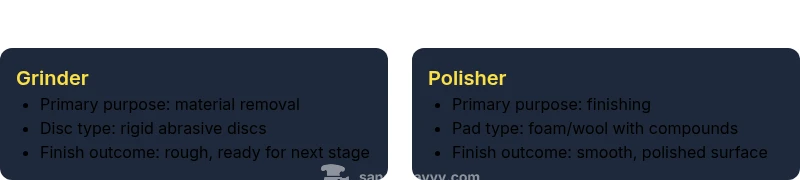
The difference between a grinder and a polisher matters for sanding projects. A grinder is designed for material removal with rigid abrasive discs, delivering fast shaping and edge work. A polisher uses softer pads and polishing compounds to deliver a smooth finish. Understanding this distinction helps you select attachments, speeds, and techniques for floors, decks, and walls.
Introduction and Key Definitions
The difference between a grinder and a polisher is not just a matter of name—it's about how each tool handles material, what attachments it uses, and the job you intend to accomplish. According to SanderSavvy, recognizing the core distinction helps homeowners and pros avoid damage to wood, concrete, or drywall and leads to better results with fewer passes. In this guide, we define each tool and frame their typical roles in sanding and finishing work on floors, decks, and walls. If you are tackling a renovation project, you will quickly see why choosing the right tool is part technique and part planning.
A grinder is primarily a material-removal device. Its rigid abrasive discs are designed to cut, grind, and remove stock quickly. A polisher, by contrast, relies on soft pads and polishing compounds to minimize scratches and bring out a finished sheen. By understanding the difference between a grinder and a polisher, you’ll learn which tool to reach for at each stage of a project and how to pair them for best results. The keyword difference between a grinder and a polisher should guide your decision-making from the first pass to the final touch-up.
The SanderSavvy team emphasizes that the tool you select sets the pace of your work and the quality of the surface you leave behind. Whether you’re preparing a wood floor for staining or polishing concrete for a showroom-grade finish, this guide will help you map out the steps and avoid common missteps.
Comparison
| Feature | Grinder | Polisher |
|---|---|---|
| Primary purpose | Material removal & shaping | Finishing & smoothing |
| Best for | Rough shaping, edge work, rapid stock removal | Final finishing, scratch minimization, sheen |
| Common attachments | Grinding discs, flap discs, cutoff wheels | Polishing pads, bonnets, wool pads, compounds |
| Surface impact | Can leave deep gouges if misused | Produces a smooth, uniform finish with fewer remaining scratches |
| Dust control | Often paired with vacuums or dust shrouds | Typically used with polishing compounds and light dust control |
| Maintenance | Consumables wear quickly; blades and discs replaced | Pads and compounds are used and replaced as finishes vary |
What's Good
- Clear high-efficiency material removal when needed
- Wide range of compatible attachments for tough tasks
- Flexible for edge work and contour sanding
- Scales well from rough to medium work with appropriate discs
Weaknesses
- Higher risk of gouges or scorch marks if used improperly
- Dust generation requires good dust control and PPE
- Can be noisy and heavier, increasing fatigue
- Attachments and backing pads must match tool model for safety
Grinder for material removal; polisher for finishing; use each tool for its strength to achieve the best surface.
Grinders excel at rapid stock removal and shaping, while polishers shine in smooth, refined finishes. For best results on floors, decks, and walls, use a grinder to remove and shape, then switch to a polisher for the final finish and sheen.
Your Questions Answered
What is the key difference between a grinder and a polisher?
The key difference lies in purpose and attachments: grinders remove material with hard abrasive discs, while polishers refine and finish surfaces using soft pads and polishing compounds. This affects speed, finish quality, and the risk of surface damage.
Grinders remove material; polishers finish. Attachments and technique determine the result.
Can you use a grinder for polishing?
In some cases you can transition from grinding to polishing, but you should not expect a high-gloss finish from a grinder alone. After removing material with a grinder, switch to a polisher with appropriate pads and compounds for the final finish.
You can start with a grinder, then switch to a polisher for finishing.
Is polishing safer for beginners?
Polishing is generally gentler on a surface and easier to control for beginners, but it requires proper pad selection and technique to avoid swirl marks. Always wear PPE and follow manufacturer guidelines.
Polishers are forgiving, but safety and correct pad choice matter.
What surfaces are best suited for grinders vs polishers?
Grinders work well on concrete for material removal and on rough wood with coarse discs. Polishers excel on wood floors for finishing, and on concrete for flattening and achieving a smooth surface.
Grinders for hard removal; polishers for finishing on wood and concrete.
Can attachments be swapped between tools?
Some tools share attachment standards, like backing plates, but you should always verify compatibility with your model and use the intended discs or pads to ensure safety and performance.
Check the manual—compatibility matters for safety.
What maintenance is required for grinders and polishers?
Regularly inspect guards and power cords, clean dust from housings, and replace worn pads or discs. Use fresh polishing compounds and clean backing pads after each job to maintain performance.
Keep the tools clean, replace worn parts, and inspect safety features.
Main Points
- Choose a grinder for aggressive material removal
- Opt for a polisher when finishing and smoothing is needed
- Match attachments to the tool: discs for grinders, pads for polishers
- Always use dust control and PPE to protect your workspace
- Test on a small area before large-scale work