Most Common Grinder Size for Sanding: How to Pick the Right Pad
Discover the most common grinder size for sanding projects, how size affects performance, and how to choose the right pad size for floors, decks, and walls. Practical tips from SanderSavvy (2026).


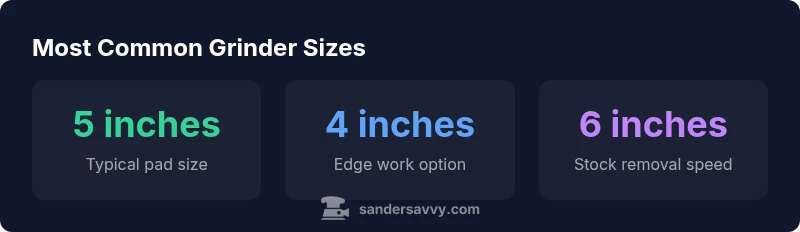
For handheld sanding, the most common grinder size is five inches. A five-inch pad balances stock removal, control, and dust management, making it the go-to choice for most DIY and pro projects. Use four inches for edges and tight spots, and six inches when you need faster removal on large, flat areas. Detail work can rely on two-to-three inch pads.
What the phrase 'most common grinder size' means for sanding
In sanding contexts, a grinder’s size usually refers to the sanding pad diameter for orbital and random-orbital machines, or belt width for belt sanders. The phrase "most common grinder size" points to the pad size that balances efficiency with finish quality for general projects. According to SanderSavvy, the five-inch pad is the default starting point for many homeowners and professionals because it handles most floors, decks, and walls with predictable results. That said, the right size varies by job, workflow, and workspace constraints, so it’s helpful to know when smaller or larger sizes are advantageous.
Sizes you’ll encounter: from palm detail to floor refinishing
- Handheld random orbital sanders: 5-inch pads are the industry workhorse for most finishes. A 5-inch size provides a forgiving balance between control and material removal.
- Edge and corner work: 4-inch pads offer better access to tight spaces along walls, door frames, and trim without sacrificing too much removal speed.
- Large flat surfaces: 6-inch pads remove stock faster on expansive areas like board-floors and decks, reducing project time while maintaining an even finish.
- Detail work: 2-3 inch pads and small palm sanders excel at irregular shapes, spindles, and around fixtures where larger pads can’t reach.
- Belts vs. discs: belt sanders typically use belt widths (commonly 3 inches by length) and are not interchangeable with disk pads; size decisions should align with your tool family and project type.
How size affects performance: stock removal, finish quality, weight, and dust
Pad size directly impacts material removal rate, surface finish, control, and fatigue. Larger pads cover more surface area, delivering faster stock removal but can feel less precise near edges. Smaller pads offer tighter control at corners but remove material more slowly. Heavier machines with larger pads also demand better dust collection and posture discipline to avoid rider fatigue over long sessions. The goal is to pick a size that matches the surface, edges, and your pace—while keeping vibration and dust under control.
Choosing the right size for your project
Choosing pad size begins with surface characteristics. Flat, wide areas like a floor or deck boards benefit from 5- or 6-inch pads for speed, provided you can manage edges. Edges, corners, and tight spots are best served by 4-inch or smaller pads. For intricate profiles or detailed trim, you’ll reach for 2- to 3-inch detail sanders. When in doubt, start with 5 inches, and switch to a smaller pad as you approach edges or irregular features. Always consider the tool’s weight and your posture: larger pads require steadier handling and a dust collection strategy.
Accessories and compatibility: abrasives, discs, and dust collection
Your pad size determines which abrasives you can use and how effectively they cut. Use those designed for the corresponding pad diameter; mixing sizes can cause excessive vibration, poor finish, or gouging. Dust collection compatibility matters too: larger pads can generate more airborne dust during rapid stock removal, so a capable dust extractor or shop vac is essential. Also, check for hook-and-loop (Velcro) compatibility and the correct grit sequence to avoid under- or over-smoothing.
Real-world scenarios: when to choose which size
- Finishing a living-room floor: start with a 6-inch pad for bulk removal if the surface is relatively flat, then reduce to 5- or 4-inch for finishing passes near walls and transitions.
- Deck boards with gaps: a 5-inch pad balances removal and control across boards with mild irregularities.
- Tight corner work around baseboards: a 4-inch or smaller pad is your friend to avoid scuffing adjacent surfaces.
- Detailed wooden trim: a 2-3 inch detail sander can reach profiles without creating gouges.
Common mistakes to avoid with grinder sizes
- Assuming a single size fits all projects; size should be matched to surface and edge demands.
- Skipping dust collection or using a poor vacuum setup, especially with larger pads.
- Mixing abrasive grits inconsistently; follow a logical progression from rough to fine to minimize texture shifts.
- Overworking edges with large pads, which can gouge or scribe into adjacent walls.
Maintenance to keep grinders sized right
Regularly inspect pads for wear and glazing; replace worn pads to maintain consistent contact with the surface. Clean the backing plate and check the hook-and-loop surface; a damaged interface reduces abrasive performance and can cause heat buildup. Keep belts aligned and tensioned for belt-sander work, and store tools in a dry, low-dust environment to prevent corrosion or pad delamination. A good maintenance routine prolongs pad life and preserves finish quality.
Comparison of common grinder sizes and their best uses
| Tool Type | Typical Pad Size | Best Use | Notes |
|---|---|---|---|
| Orbital/Ros | 5 inches | General finishing and light stock removal on flat surfaces | Most versatile for DIY projects |
| Belt Sander | 3x18 inches | Aggressive material removal | Requires steady control and posture |
| Detail Sander | 2-3 inches | Edges and corners | Ideal for tight spots and trim work |
Your Questions Answered
What is the most common grinder size for sanding projects?
For handheld sanding, the 5-inch pad is the most common choice. It balances speed, control, and dust management. For edges and corners, consider 4 inches or smaller, and reserve 2-3 inch pads for detail work.
The 5-inch pad is the go-to for most projects; smaller sizes help in edges.
Can I use a 6-inch grinder for small areas?
Yes, but it’s less maneuverable and can gouge if used in tight spaces. Use 6-inch on large flat surfaces and switch to 5-inch or smaller for edges.
6-inch works for big spaces, but go smaller for tight spots.
What’s the difference between belt sanders and orbital grinders in terms of size?
Belt sanders are measured by belt width (commonly 3 inches) and are separate from pad sizes on orbital sanders. Size affects removal rate and control; belts remove faster but are harder to control near edges.
Belt sanders are different from orbital pads; the size matters across both types.
What is the best practice for choosing pad size?
Match pad size to surface area and edges. Use 5-inch pads for open areas, 4 inches for edges, and 2-3 inches for detail work. Consider project scope and personal comfort.
Pick size based on surface area and edge work.
How do I know if I should upgrade to a larger size?
If you’re spending excessive time on large flat areas or fighting edges, a larger pad (6 inches) or a belt sander can speed things up. If control or dust is an issue, try a smaller size.
If projects feel slow or rough, upgrading can help.
What accessories matter most with a given size?
Ensure abrasives, dust collection, and replacement pads match the grinder size. Using the wrong pad size reduces effectiveness and increases fatigue.
Always pair the pad with the right discs and dust collection.
“A well-chosen grinder size can dramatically improve finish quality and reduce fatigue during sanding.”
Main Points
- Start with a 5-inch pad for most projects to balance speed and control
- Use 4-inch pads for edges and tight spaces
- Reserve 6-inch pads for large flat areas when you need faster removal
- Pair pad size with the right abrasives and dust collection
- Consider belt sanders (3x18) for heavy stock removal on open surfaces