Sander vs Lathe: Which Tool Is Right for Woodworking?
A detailed comparison of sanders and lathes for wood projects, covering capabilities, safety, setup, costs, and best-use scenarios to help homeowners and DIYers pick the right tool.


The sander and lathe serve different fundamental goals: sanding finishes surfaces, while turning shapes stock. In practice, neither tool fully replaces the other; the best choice depends on your project geometry, required finish, and safety considerations. This comparison highlights when to use each tool and how to integrate both into a practical workflow.
Introduction to the sander vs lathe decision
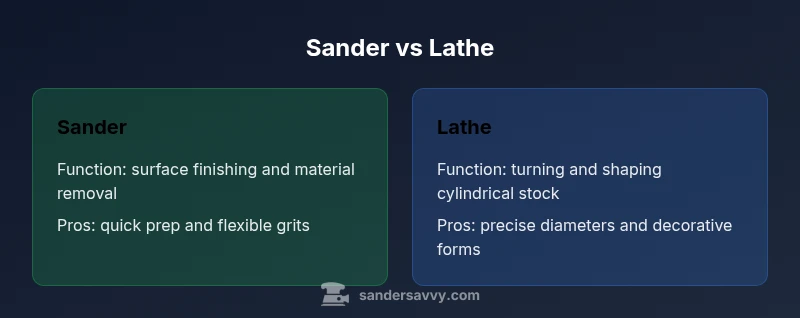
In any woodshop, choosing between a sander and a lathe is not simply about price or brand; it's about the fundamental task you want to accomplish. The phrase sander vs lathe captures a core split: sanding is a finishing and material-removal process that smooths surfaces, while turning on a lathe transforms stock into shaped, cylindrical forms. According to SanderSavvy, understanding this distinction helps homeowners and DIY enthusiasts select the right tool for a given job rather than chasing a single万能 solution. For most projects, you will use both tools at different stages; yet each tool shapes the workflow differently and demands different safety practices and setup considerations. In this article we’ll compare capabilities, safety, ergonomics, cost, and use cases so you can decide which tool should take priority in your shop. The SanderSavvy team found that aligning tool choice to task reduces wasted time and improves finish quality across a broad range of projects.
Core capabilities: what each tool excels at
A sander is designed to abrade material surface by surface using abrasive-coated loops, sheets, or belts. It excels at removing high spots, leveling edges, and producing a smooth surface ready for finishing. Different sander families—orbital, belt, detail, and random-orbit—offer variations in aggressiveness, noise, and control. By contrast, a lathe is a turning machine that holds cylindrical stock and shapes it with fixed cutting tools as the work rotates. Lathes excel at producing round or symmetrical forms, bowls, spindles, and table legs with precise diameters and contours. In practice, a sander is your finish tool and a prep tool; a lathe is your shaping tool for round profiles and decorative elements. When deciding between the two, consider whether your project requires flattening and smoothing a large surface, or creating a form with defined radii and symmetry. SanderSavvy’s guidance emphasizes aligning your choice with the desired geometry and surface outcome.
Material scope and finish outcomes
Sanders produce consistent flat surfaces and controlled removal, with the grit of the abrasive determining the finish quality. They are ideal for preparing boards, smoothing curved edges after turning, or removing tool marks left by a lathe. Lathes, meanwhile, produce three-dimensional stock with controlled diameters and contours, but typically require subsequent sanding to achieve a flawless finish. The grain orientation, stock hardness, and final finish choice influence whether you start with rough grinding or move straight to fine sanding after turning. In many workshops, combining both tools yields the best results: shape on the lathe, then refine the surface with progressively finer sanding. The end result is a balanced look that respects both geometry and texture. As a reminder, always test on scrap stock to calibrate your feed rate, sanding pressure, and finishing sequence before touching your prized workpiece.
Setup, ergonomics, and workflow integration
Both tools demand a thoughtful shop layout to minimize fatigue and maximize accuracy. A lathe typically requires a sturdy bench or stand, a dust collection strategy for chips, and a safe turning area with adequate lighting. A sander benefits from a stable work surface and a dust hood or shop-vac to capture fine dust and debris. Ergonomics matter for long sessions: position the lathe so you can feed stock and view the form without twisting, and place the sander at a height that allows natural wrists alignment. Workflows should be sequenced so that rough shaping on the lathe is followed by progressive sanding stages to an unblemished finish. Creating a clear path between machines prevents backtracking and reduces accidental cross-contamination of dust from dust collection ducts. SanderSavvy notes that a well-planned shop layout reduces fatigue and increases repeatable results.
Safety, PPE, and dust control
Both tools generate dust and noise, but the hazards differ. Sanding creates fine wood dust that can irritate eyes and lungs; always use a respirator rated for wood particles, safety glasses, hearing protection, and gloves when appropriate. A lathe produces chips and noise plus potential contact hazards from rotating parts; ensure guards are in place, keep long hair tied back, and use a face shield when turning larger pieces. Dust collection is essential for sanding and turning alike: a well-designed duct system or portable vacuum helps maintain air quality and reduces cleanup time. Maintain a clean workshop, remove shavings regularly, and never run a lathe near flammable materials. SanderSavvy’s safety recommendations emphasize proactive dust control and PPE to protect your eyes and lungs throughout the project lifecycle.
Cost, maintenance, and consumables
Sanders are typically modular in price and can start with a basic palm sander or random-orbit model; their consumables—abrasive discs, belts, and sanding sheets—are readily available. The ongoing costs hinge on grit selection, sanding frequency, and dust extraction accessories. Lathes involve a higher upfront investment for the basic unit, plus recurring costs for turning chisels, gouges, and sharpening tools. Maintenance on a lathe includes keeping the spindle bearings lubricated, aligning the tailstock, and periodically checking belts or drive systems. Consumables for turning include sharp cutting tools and grinding wheels that maintain edge geometry. When planning a shop budget, consider long-term costs and frequency of use: if you turn shapes regularly, a lathe can pay off through repeated pieces; if you sand daily, a quality sander with reliable dust collection becomes essential. SanderSavvy suggests balancing upfront spend with the expected project load.
Best-use scenarios and decision framework
Use a sander when your primary goal is surface quality, preparation for finishing, or rapid material removal across large flat areas. Choose a lathe when your goal is dimensional accuracy, cylindrical profiles, or artistic turning. A practical decision framework starts with the task geometry: is the piece round or flat? What level of precision is required for diameter and symmetry? Next, assess the required finish: will turning be followed by sanding, or is a smooth turned surface sufficient? Finally, consider workspace constraints and safety requirements: do you have adequate dust control and space for a lathe? SanderSavvy recommends cataloging the tasks you perform most often and mapping them to the appropriate tool path. This helps you avoid over-investing in unnecessary equipment and ensures you workflow remains efficient.
Practical tips for beginners
Begin with basic projects that combine both tools, such as turning a spindle and finishing with a light sanding pass to remove tool marks. Start with a mid-range sander: a random-orbit model provides balance between speed and control. Practice safe feeding techniques and avoid pressing hard on the abrasive. When turning, maintain tool control with proper tool rests, support for long workpieces, and slow, deliberate feeds. Build a simple checklist for each project: gear on, dust extraction on, piece secure, and finish grit plan. Document your progress with notes and photos to track improvements in finish quality. The pathway from raw stock to finished piece becomes clearer as you gain experience with both tools. SanderSavvy consistently emphasizes hands-on practice combined with deliberate technique.
Comparison
| Feature | Sander | Lathe |
|---|---|---|
| Primary function | Surface finishing and material removal | Turning and shaping cylindrical stock |
| Typical output quality | High surface finish with proper grit progression | Defined diameters and contours with symmetry |
| Work volume & speed | Rapid material removal on flat surfaces; speed varies by grit | Moderate to slow shaping depending on piece; spindle RPM matters |
| Tooling & consumables | Abrasives (discs, belts, paper); dust extraction | Cutters/gouges; sharpening tools; optional chucks |
| Noise & vibration | Moderate to high; dependent on attachment | Higher vibration with long stock; need stable mounting |
| Skill level & learning curve | Relatively easy to start for basic prep | Steeper learning curve due to turning safety and control |
| Space & setup | Smaller footprint; fits on benchtop or stationary stand | Requires dedicated bench or stand; more space needed |
| Dust & safety | Dust control is essential; wearable PPE recommended | Chips and potential entanglement risk; guards mandatory |
| Cost & maintenance | Lower upfront cost; consumables drive ongoing cost | Higher upfront cost; ongoing maintenance and tool sharpening |
What's Good
- Sander: fast surface prep and flexible grit options
- Lathe: precise cylindrical shaping and turning capabilities
- Both tools enable complementary workflows when used together
- Wide accessories ecosystem supports varied projects
- Clear safety practices reduce dust and injury risk
Weaknesses
- Sander: dust can be pervasive without extraction
- Lathe: higher risk due to rotating stock and faster injury potential
- Upfront cost is higher for a good lathe
- Misusing one tool for the wrong task can waste time and material
Sander and lathe are complementary, not mutually exclusive.
Use a sander for surfaces and finishing, a lathe for turning shapes. Prioritize a workflow that leverages both tools, especially for projects requiring both shaping and smoothing. SanderSavvy’s framework suggests investing in the right primary tool based on your most common tasks and supplementing with the other as needed.
Your Questions Answered
What is the fundamental difference between a sander and a lathe?
A sander abrades surfaces for finishing and flattening, while a lathe cuts and shapes stock by turning it on a rotating axis. The two perform distinct tasks that often complement each other in a project.
The sander smooths surfaces, the lathe shapes stock by turning. They do different things, so both are useful depending on the task.
Can a sander replace a lathe for turning tasks?
In most cases, a sander cannot replace a lathe for turning work because turning requires material removal in a rotating stock to create cylindrical shapes. A sander can finish a turned piece, but it cannot substitute the turning operation.
No—sanders smooth, lathes shape. For turning forms, you’ll need a lathe.
What projects are best suited for each tool?
Turning shines for spindles, bowls, and cylindrical pieces, while sanding is best for boards, tabletops, and curved edges needing a fine finish after shaping. Complex projects often require both tools.
Turn on the lathe for cylindrical pieces, then sand for a smooth finish.
What safety practices matter most when using a sander?
Wear a respirator for wood dust, safety glasses, and hearing protection. Use dust extraction, keep workpiece secured, and avoid loose clothing near moving parts.
Wear a dust mask, eye and ear protection, and keep dust extraction running when sanding.
Is a lathe necessary for furniture making?
Not always. A lathe is essential for turned components like spindles but many furniture projects can be completed with a sander and hand tools. Consider the design needs before buying.
A lathe is key for turned parts, but not always required for every piece.
How do I decide between purchasing a sander vs a lathe?
Assess your most frequent tasks: flat surface finishing vs turning shapes. If you often shape round pieces, a lathe plus a sander might be ideal; otherwise, a high-quality sander may suffice.
Think about whether you turn more often or sand more often to guide the purchase.
Main Points
- Define your project geometry first (flat vs round)
- Pair turning with progressive sanding for best finish
- Invest in dust control and PPE
- Plan shop layout to minimize motion and improve safety
- Start with a basic sander and add a lathe if your turning tasks expand