Linisher vs Belt Sander: A Practical Woodworking Guide
Explore the differences between a linisher and a belt sander, with practical guidance on use, setup, safety, and choosing the right tool for flat surfaces and finishing tasks.


When you ask what is a linisher vs belt sander, the short answer is that both use sanding belts, but a linisher is a stationary belt sander with a large table for flattening and finishing wide surfaces, while a handheld belt sander offers portability for curved or detailed work. Understanding their design, use cases, and safety helps you pick the right tool for woodworking projects.
What is a linisher vs belt sander?
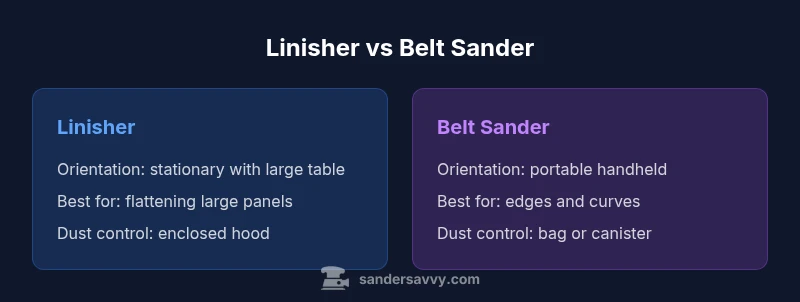
In woodworking, a linisher and a belt sander share a common mechanism—an endless sanding belt. The critical distinction is how the belt presents itself to the stock. A linisher, often a stationary linishing machine, features a large, flat table and a guided platen. It excels at flattening and evening broad panels and producing uniform finishes on straight edges. A handheld belt sander is designed for mobility and access to irregular shapes, curved surfaces, and tight corners. Answering what is a linisher vs belt sander means recognizing the linisher as a workshop fixture for broad, flat stock, while the belt sander is the versatile tool for portable stock removal and shaping.
For most shop setups, you’ll find that the linisher shines on cabinet panels and door components, whereas the handheld belt sander handles edge work and shaping tasks. As with any sanding tool, proper belt selection, dust control, and protective equipment are essential to avoid scorching or gouging material.
The distinction also affects how you configure workpieces, the types of jigs you can use, and the finish quality you can achieve. In many shops, both tools are part of the same workflow: the linisher establishes a flat foundation, and the handheld sander handles edges, curves, and refinements. This synergy is a hallmark of effective woodworking.
Comparison
| Feature | Linisher (stationary belt sander) | Handheld belt sander |
|---|---|---|
| Orientation & mounting | Stationary with a fixed table | Portable handheld |
| Best use | Flattening and finishing wide stock | Edge work, curves, and detail work |
| Work surface capacity | Large flat table supports wide panels | Limited contact area; relies on user control |
| Dust control | Often enclosed with a hood or cabinet for better capture | Bag or canister dust collection; needs external control |
| Portability | Low; requires bench or stand space | High; designed for mobility between sites |
| Belt replacement/maintenance | Belts tensioned on a supported track; maintenance linked to table alignment | Belts changed frequently; quick swaps common |
What's Good
- Excellent for flat, wide-panel finishing and consistent stock removal
- Large work surface enables straight-edge accuracy on long boards
- Stable workflows when combined with jigs and fixtures
- Good dust collection potential with proper enclosure
Weaknesses
- Requires dedicated space and a solid stand or bench
- Lower portability limits use to the workshop environment
- Belt changes and alignment can interrupt workflow
- Higher initial investment for a quality stationary unit
Linisher is the go-to for flat-panel finishing in a fixed shop, while a belt sander remains essential for mobility and edge work.
If your projects involve large, flat panels and consistent finishes, the linisher is the best tool to own. If you need to move between sites or tackle curved edges and profiles, a handheld belt sander covers that gap. In many shops, the smart setup uses both tools in tandem to optimize efficiency.
Your Questions Answered
What is the main difference between a linisher and a belt sander?
The linisher is a stationary belt sander with a large table for flat stock, ideal for flattening and finishing panels. A belt sander is handheld, portable, and better for edges, curves, and detailed work.
The linisher is stationary with a big work surface, while a belt sander is portable for edges and curves.
Can I use a handheld belt sander as a linisher?
You can approximate some linisher tasks with a handheld belt sander using jigs and a flat surface, but you won’t get the same consistent flatness or large-panel support as a true linisher.
A handheld sander isn’t a perfect substitute, but you can mimic flat-work with careful setup.
Which tool is better for flattening large panels?
For large panels, a linisher provides superior flatness and uniformity due to its fixed table and guided platen. A belt sander can do the job but requires more manual control and may result in uneven areas.
Linisher wins for large flat panels; belt sander needs more control.
What safety gear should I wear when sanding?
Always wear eye protection, a dust mask or respirator, hearing protection, and gloves as needed. Ensure dust collection is active and that you work in a well-ventilated area to manage fine dust.
Safety first: eye protection, a mask, hearing protection, and good dust control.
How do I choose the right grit for each tool?
Start with coarser grits (e.g., 40–60) for rapid material removal, then move to medium (80–120) and finish with fine grits (150–240) for a smooth surface. Always test on scrap and adjust based on stock hardness.
Begin with coarse grit for rough work, then fine-tune with finer grits.
Are there maintenance tips to extend belt life?
Keep belts clean and free of debris, check tension regularly, and replace worn belts promptly. Proper dust extraction and cooling during use help prevent belt glazing and premature wear.
Keep belts clean, check tension, and replace worn belts early.
Main Points
- Choose linisher for flat-panel finishing in a dedicated workspace
- Use a belt sander for portability and edge work
- Match belt grit to task and test on scrap first
- Invest in solid dust control and PPE for safety