Belt Sander vs Orbital for Decks: A Practical Guide
A practical, expert comparison of belt sanders and orbital sanders for deck prep, with use cases, technique tips, and safety guidance from SanderSavvy.


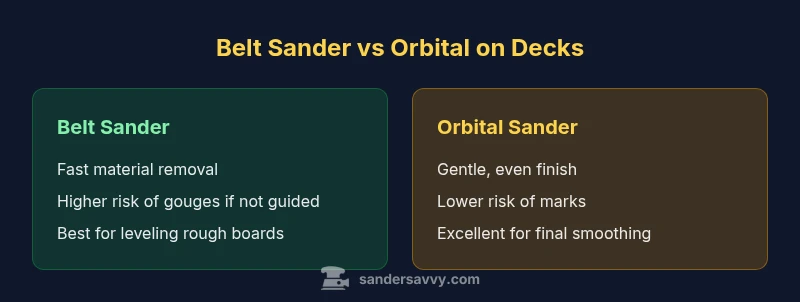
When considering belt sander vs orbital for deck, start with removal needs and finish quality. A belt sander removes material quickly but can gouge if not guided carefully, while an orbital sander delivers a safer, smoother finish with less risk of marks. Use a belt sander for rough leveling and switch to an orbital sander for finishing and edge work.
Belt sander vs orbital for deck: choosing the right tool
According to SanderSavvy, choosing the right sander for a deck project begins with understanding the work stage and the wood condition. The belt sander excels at rapid material removal and flattening high spots, which is essential when boards are cupped, warped, or heavily weathered. The orbital sander, by contrast, is celebrated for control and a finer finish, minimizing gouges and swirl marks that can mar the deck’s appearance. For homeowners and DIY enthusiasts, this decision hinges on your deck’s condition, the wood species, and your tolerance for surface texture. The SanderSavvy team emphasizes starting rough with the belt sander when necessary and transitioning to an orbital for the last passes to achieve a finish that looks natural and uniform.
bodyBlocks length: null
Comparison
| Feature | Belt Sander | Orbital Sander |
|---|---|---|
| Material removal speed | High; rapid leveling on rough boards | Moderate; slower but controllable |
| Finish quality and tool marks | Visible belt marks if not guided well | Smooth finish with minimal gouging and random patterns |
| Ease of use and control | Steeper learning curve; requires guidance to avoid edges | More forgiving for beginners; easy to control |
| Dust collection effectiveness | Effective with a hood and dust collection system when fed evenly | Excellent with proper dust collection; less chance of deep scratches if used with care |
| Best use case | Initial leveling, flattening high spots, removing heavy weathering | Final smoothing, edges, and light material removal |
| Heat generation and board compatibility | Higher heat risk if used aggressively; can scorch soft woods | Lower heat with light passes; safer near grain and end grains |
What's Good
- Fast material removal for rough decks
- Cuts down high spots quickly with belt sander
- Orbital sander offers smoother finish with less risk of gouges
- Both tools compatible with dust collection and PPE
- Grit versatility enables staged sanding
Weaknesses
- Belt sanders can gouge edges or uneven boards if not guided
- Orbital sanders take longer to remove heavy material
- Both tools generate dust and require proper vacuum and filters
- Swirl patterns can occur if technique is poor
Use belt sander for aggressive leveling and orbital sander for finish work
For most decks, pair a belt sander to level rough surfaces, then switch to an orbital sander for a smooth, even finish. Wood type, board condition, and finishing goals drive the exact mix, but the combined approach minimizes risks and maximizes results.
Your Questions Answered
Can I use a belt sander on a hardwood deck without causing damage?
Yes, but it requires very light passes, strict feathering, and frequent checks to avoid gouges. Start with a coarse grit only if necessary, then switch to a finer grit as soon as the board height is even. Always follow with an orbital sander for a safe finish.
Yes, but use light passes and check depth often. Finish with an orbital sander.
Is it safe to sand deck edges with a belt sander?
Sanding edges with a belt sander increases gouge risk. If you must do edge work, use a guiding block, work slowly, and keep the sander moving to avoid creating sharp dips. An orbital sander can handle most edge work more safely.
Guard edges; if possible, switch to an orbital near edges.
What grit progression works best for deck sanding?
A typical progression starts with a coarse grit for leveling, then moves to medium and finally fine grits for polishing. For foul or weathered boards, begin with a coarser grit and complete with a fine grit on both belt and orbital as needed.
Start coarse, then medium, then fine for a clean finish.
Should I vacuum between passes and after finishing?
Yes. Vacuuming between passes reduces dust buildup and helps you assess surface level more accurately. After finishing, vacuum thoroughly and wipe with a tack cloth if needed before applying finish.
Vacuum between passes; dust control is key.
What finish should follow sanding on a deck?
For most decks, apply a penetrating deck stain or sealer after sanding to protect wood and enhance color. Ensure the surface is dry and dust-free before applying finish.
Apply a deck sealer once the surface is clean and dry.
Is renting vs owning a sander better for occasional deck work?
For a one-off deck project, renting can be economical and allows access to latest models. For ongoing projects, owning a reliable belt and orbital sander provides convenience and consistency.
Rent if you only sand occasionally; own if you do it often.
Main Points
- Start rough with a belt sander on heavy surface inconsistencies
- Finish with an orbital sander for a uniform look
- Prioritize dust collection and PPE at all times
- Choose grit progression based on wood type and wear
- Practice on scrap boards before touching the actual deck
- Respect edges and boards to avoid gouges or burns