Is a belt sander better than an orbital sander? Practical comparison for DIYers
Explore when a belt sander outperforms an orbital sander and when the finish comes from an orbital tool. Practical guidance for homeowners, covering floors, decks, and walls with safe sanding practices.


According to SanderSavvy, is a belt sander better than an orbital sander for most home projects? In practice, belt sanders excel at rapid stock removal on large flat surfaces, while orbital sanders deliver finer finishes with less risk of gouging. The right choice depends on the job stage and finish quality; for many projects, you’ll pair both tools to maximize speed and control.
Belt vs Orbital: Core differences for sanding projects
The belt sander and orbital sander occupy different places in a woodworker's toolkit. A belt sander uses a continuous abrasive belt that spins at high speed, delivering aggressive material removal on flat, open surfaces. An orbital sander (often called a finish sander) uses a square or round pad that moves in small ellipses, producing a smoother finish with far less risk of gouging. When considering is a belt sander better than an orbital sander, you must account for the project stage, the material, and the desired final texture. According to SanderSavvy, the smart approach is to begin rough work with a belt sander on large flat stock and transition to an orbital sander for finishing passes. The SanderSavvy team found that this paired approach often yields faster leveling and a more even, ready-for-finish surface.
Performance criteria that matter in the belt vs orbital debate
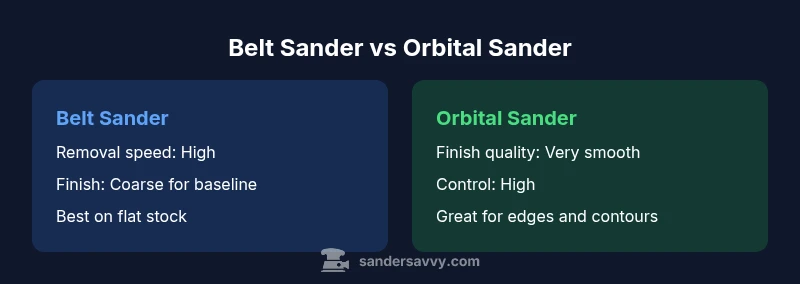
To compare the two tools fairly, focus on a consistent set of criteria: material removal rate, finish quality, control and maneuverability, dust collection, vibration and comfort, and versatility with various grits and accessories. In general, a belt sander offers a higher removal rate on flat surfaces—great for quickly knocking down high spots and removing old coatings. An orbital sander shines in finish quality, delivering a smooth surface with less risk of visible scratches. For beginners and hobbyists, the orbital option often feels more controllable and easier to manage, reducing fatigue during longer sessions. The choice becomes a matter of project phase: roughing or pre-smoothing vs fine finishing and edge work.
Best use cases: when to pick each tool
- Rough stock removal on floors, tabletops, and door panels favors a belt sander for speed and efficiency.
- Flattening large slabs or removing heavy coatings is often best tackled with a belt sander, followed by touch-up with an orbital sander.
- Finishing work, edges, and contoured areas benefit from the orbital sander’s finer grit range and gentler touch.
- For curved or irregular surfaces, orbital sanders can reach corners and radii more easily, while a belt sander may require extra care or alternative tools.
- In a typical workflow, you might begin with a belt sander to establish an even plane and then switch to an orbital sander for the final smoothing pass to achieve a flawless surface.
Dust management and ergonomics
Dust collection is crucial with both tools, but the belt sander generates more debris due to higher material removal. Use a properly sized dust collector with a hood or bag, and consider a vacuum-equipped sander to minimize airborne particles. Ergonomics matter: belt sanders are heavier and bulkier, which can strain the wrist and shoulder on long jobs. Orbital sanders are lighter and more balanced, making them more comfortable for long finishing sessions. A quality breathing mask and eye protection are essential regardless of tool choice; the wrong choice for a given job can turn sanding into a longer, more frustrating process.
How to choose between them for floors, decks, and walls
For large, flat floor areas with rough coatings, a belt sander is often the best starting point. If your plan includes removing old varnish or finishing coats before refinishing, the belt sander can speed up the process, but you’ll want to finish with an orbital sander to even out texture and remove swirl marks. On decks and walls, consider the surface’s hardness and grain orientation. Floors generally tolerate belt sanders in the initial stage; walls may require a lighter touch with an orbital sander to avoid uneven gouges. A practical approach is to map your project into a roughing phase (belt) and a refining phase (orbital), then adjust grit progression to minimize scratches while preserving wood fibers.
Maintenance and troubleshooting
Belt sanders rely on a belt that can wear quickly under heavy use; inspect the belt for frayed edges and replace when needed. Ensure the belt tension is correct—too loose and it slips; too tight and it can wear bearings. Orbital sanders use discs or pads; replace pads promptly if the trailing edge shows wear. Clean up dust frequently to prevent clogging of the motor vents. If you notice vibration or unusual noise, check the belt alignment, pad lock, and screw tightness. Regular maintenance saves motor life and improves finish quality, which directly ties back to the central question of is a belt sander better than an orbital sander for your specific task.
Practical setup: getting started with both tools
Start with a clear plan and appropriate safety gear. Pick belt sander belts in coarse, medium, and fine grits appropriate for your wood type. Set a consistent angle and maintain even pressure to avoid gouges; remember, belt sanders remove more material quickly, so control is crucial. For orbital sanding, begin with a mid-range grit and move toward finer grits for a glassy finish. Use a dust collection system and work in a well-ventilated area. Keep the sanding lines consistent and avoid lingering in one spot to prevent burn marks and gouges. A test patch on scrap wood can help calibrate pressure and technique before tackling the main surface.
Real-world cost and rental considerations
Budget is a practical factor when deciding between belt and orbital sanders. In many DIY projects, renting a belt sander for roughing stages followed by an orbital sander for finishing can be cost-effective, especially for one-off refinishing tasks. If you plan multiple projects in a season, investing in both tools makes sense to cover rough work and fine finishing. Consider the accessory ecosystem—dust bags, belts, sanding discs, and replacement pads—as part of the total cost of ownership. Regardless of choice, proper maintenance and safe operation extend tool life and improve outcomes.
Common mistakes to avoid with belt vs orbital sanding
A few frequent missteps can derail a project: starting a belt sander on pretty soft wood without a plan, using the wrong grit and leaving swirl marks, or neglecting dust control which clogs the filter and reduces effectiveness. Another pitfall is attempting finish work with a belt sander, which can gouge and roughen the surface. Conversely, using an orbital sander for heavy material removal is slow and can create an uneven texture. By planning phases, using the correct grit sequence, and maintaining consistent pressure, you can prevent these errors and keep the project moving efficiently.
Material-specific guidance: hardwoods vs softwoods
Hardwoods respond well to belt sanding for rapid flattening, but you must be mindful of grain rise and potential burn marks. For softwoods, a belt sander can still be effective for removing coatings quickly, but you’ll need to start with a coarser grit and move to finer grits sooner to avoid overly aggressive material removal. Always test on a scrap piece to calibrate speed, pressure, and grit progression. An orbital sander will help you reduce surface irregularities and ensure the final finish remains smooth and uniform across different wood types.
Comparison
| Feature | Belt Sander | Orbital Sander |
|---|---|---|
| Material removal rate | High on flat stock; rapid stock removal | Moderate to high with the right grit; fast finishing on large surfaces |
| Finish quality | Coarser, visible scratch patterns if not followed by finishing | Very smooth finish with consistent movement and fine grit |
| Control and maneuverability | Bulkier; needs more stance and planning | Lighter, easier to maneuver, great for corners |
| Dust management | Produces a lot of debris; best with strong dust collection | Cleaner dust profile, especially with good vacuum setup |
| Best for | Rough stock removal on large flat areas | Finishing, edges, and detailed work |
| Price range (relative) | Higher initial cost; belt belts and maintenance | Usually lower upfront cost; widely available |
What's Good
- Fast material removal on large flat surfaces
- Excellent for establishing a base level on rough stock
- Works well with the right grit progression when paired with an orbital
- Broad compatibility with standard sanding belts and accessories
- Useful for floor prep and heavy stock leveling
Weaknesses
- Higher risk of gouging if misused
- Bulkier and heavier to handle in tight spaces
- Requires belt changes and more setup time
- Can abrade wood fibers if not used carefully
Belt sander benefits are greatest for roughing large flat areas; orbital sanders excel at finishing and detail work
Choose a belt sander for fast bulk removal on flat stock, then switch to an orbital sander for a smooth, even finish. This two-tool approach typically delivers both speed and quality in DIY projects.
Your Questions Answered
Is a belt sander better than an orbital sander for hardwood floors?
For hardwood floors, a belt sander is advantageous for the initial leveling and removing old coatings quickly. However, you should switch to an orbital sander for the final smoothing to avoid deep scratches and ensure an even finish. This combination is often the fastest route to a professional-looking floor.
For floors, start rough with a belt sander, then finish with an orbital sander for a smooth, even surface.
Can I use a belt sander for furniture?
Yes, you can use a belt sander for furniture when removing thick coatings or leveling raised grain on flat surfaces. Be mindful of tighter curves and edges where the tool can gouge. Finish with an orbital sander or hand-sanding to maintain detail and deliver a refined surface.
Use the belt sander for rough spots on flat furniture parts; switch to a finish sander for edges and details.
Which sander should I rent for deck refinishing?
For decks, renting a belt sander for heavy stock removal and coating stripping can save time, but you’ll likely want an orbital sander for the final smoothing and stain-ready surface. Always wear appropriate safety gear and protect surrounding areas from dust.
Rent a belt sander for rough work, then finish with an orbital sander for a clean deck finish.
What grits should I start with for belt vs orbital sanding?
Begin with coarse grits (60–80) on the belt sander for initial flattening, then move to medium (120–150). For finishing with an orbital sander, start at medium (120–150) and progress to fine (180–220). Always test on scrap and adjust to wood type and coating.
Start rough with coarse grits on the belt, then finish with fine grits on the orbital.
Is it safe to switch between sanders mid-project?
Yes, switching between tools mid-project is common and recommended. Plan a clean phase transition: belt sander for roughing, orbital sander for finish. Keep the workspace organized and monitor dust collection and belt wear during the switch.
Absolutely—use belt for roughing, orbital for finishing, with a clear transition plan.
How do I prevent gouges when using a belt sander?
Keep the sander moving at a steady pace, do not apply excessive pressure, and use a guide or straightedge on long, flat areas. Start with a belt in a coarse grit and gradually move to finer grits, checking for consistency after each pass.
Keep it moving, don’t press hard, and test on scrap first.
Main Points
- Start with a plan to separate roughing from finishing tasks
- Use a belt sander for fast removal on large flat surfaces
- Finish with an orbital sander to achieve a smooth texture
- Invest in a good dust-management setup
- Practice on scrap to dial in grit progression
- Rent or own both tools to cover diverse projects