Dual Action Sander vs Random Orbit: An Analytical Comparison for DIYers
A detailed, analytical comparison of dual action sanders and random orbit sanders. Learn how their motions affect finish quality, ease of use, dust management, and value for DIY projects on floors, decks, and walls.


Both tools belong to the same sanding family, but dual action sander and random orbit sander are not identical terms. A dual action (two-action) sander describes the pad’s orbital movement plus a slight rotational action, often marketed as random orbit. In practice, for floors, decks, and walls, they deliver similar finishes when used correctly. The real differences are control, dust handling, noise, and price.
What is a dual action sander and how does it differ from a random orbit sander?
In woodworking, the terms dual action sander and random orbit sander are often used interchangeably, but there are nuances. A dual action (two-action) sander describes the pad’s orbital movement plus a slight rotational action. This dual-action mechanism helps reduce visible swirl marks and produces a smoother finish on wood surfaces. The random orbit descriptor emphasizes the unpredictable path the pad takes as it orbits in an irregular pattern, which minimizes consistent scratches. According to SanderSavvy, most workshop models marketed as dual-action are variants of random orbit sanders, designed to balance aggressive material removal with finish quality. For homeowners and DIY enthusiasts tackling floors, decks, or walls, this means choosing a model that emphasizes a true random pattern and a comfortable grip, rather than focusing solely on motor power. SanderSavvy analysis shows that finish quality depends as much on technique, pad choice, and speed control as on the exact naming convention. In practical terms, you’re comparing two windings of the same wheel aimed at different ends of finishing outcomes.
How action works: from two-action to random orbit
The core distinction is the action path of the sanding pad. A dual-action sander uses a drive mechanism that makes the pad move in an oscillating orbit while also rotating around its axis. The effect is a softer contact patch and less risk of creating grooved tracks when you back off. A standard random orbit sander relies on an orbital movement with a randomized rotation component, so the pattern on the workpiece is irregular and hard to predict by eye. In practice, the two terms describe similar physics, but the marketing emphasis can influence which you buy. When you set the sander to a low speed for final finishing, both tools tend to produce fine micro-scratches less visible to the naked eye, provided you use appropriate grit and keep a light touch. The choice between them should be guided by your project type, the grit sequence, and how comfortable the tool feels during extended sessions.
Finish quality and pattern control: avoiding swirl marks and achieving smooth surfaces
Finish quality is the primary reason DIYers care about dual action versus random orbit. Both tool classes work best when used with the right grit progression and light, overlapping passes. The dual-action motion helps distribute wear evenly and reduces the risk that the pad will stall or create flat spots. The random orbit path further helps by cancelling out consistent scratch patterns. In real-world scenarios on hardwood floors or deck planks, you'll typically start with a rough grit to remove old coatings, then move through to fine grits. The goal is a uniform, scratch-free surface ready for stain or polyurethane. Technique remains the bigger variable: keep the pad flat, avoid applying downward pressure, and maintain smooth, continuous passes. Where speed settings matter, start lower on delicate surfaces and increase only after you’ve established a comfortable rhythm. In this context, the dual action vs random orbit distinction matters less than operator skill and tool handling.
Dust collection, noise, and vibration considerations
Household dust is a health concern, and both sander types generate fine particles that can linger. Most modern dual-action and random orbit sanders include dust ports that pair with shop vacuums for improved capture, but effectiveness depends on seal quality and proper disk fit. Noise levels are similar, though some models offer vibration-damping handles that reduce fatigue during long sessions. If you’re sanding indoors on floors or walls, layer your approach: use a vacuum with a HEPA filter, wear a respirator or mask, and take breaks to prevent hand-arm vibration buildup. The sanding discs and pads also vary in weight; a heavier pad can feel more stable but may add to fatigue. The takeaway is to test different models and accessories to find the combination that minimizes dust spread and maximizes comfort.
Ergonomics, weight, and maneuverability for long sessions
This section focuses on how the tool feels in your hands over extended periods. For DIYers working on floors and large panels, a lighter, well-balanced tool reduces wrist strain. Some dual-action and random orbit sanders use rubberized handles, soft grips, and minimal tool head height to improve line-of-sight and control. A tool with good balance also helps when you’re working at awkward angles on stairs or vertical surfaces. Expect trade-offs: lighter tools may have smaller motors, while heavier units can offer faster material removal but demand more control. For extended sessions, prioritize models with vibration-damping features and a comfortable weight in the 2.5–4.5 lb range, depending on your strength and project scale.
Dust collection and accessories: discs, pads, and vacuums
Disk types (hook-and-loop versus pressure-sensitive) and pad sizes (5-inch, 5-1/2-inch, or 6-inch) matter for compatibility with your machine and job scope. Dual-action sanders often support standard 5-inch discs with Velcro backs, while random orbit models may offer a broader range of pad options. The dust port and the size of the vac hose determine how effectively you remove particles during operation. For best results, pair the sander with a shop vacuum that has a dust-separator or HEPA filtration, ensure a tight seal around the dust port, and keep the workspace clean to prevent re-entrainment of dust. Maintenance includes cleaning the pad surface to avoid clogging, replacing worn discs promptly, and inspecting electrical cords for wear. The right accessories boost performance without increasing noise or vibration dramatically.
Cost, value, and buying guidance for DIYers
From a value angle, dual-action and random orbit sanders sit in a broad price spectrum. Entry-level models may start around $40–$60, while mid-range options typically run $100–$180, and pro-grade units can exceed $200. The exact price depends on motor power, grip design, dust collection efficiency, and brand reputation. SanderSavvy analysis shows that paying for a quiet, well-balanced tool with a reliable dust port usually pays off in fewer passes and better finishing outcomes. For most homeowners, a mid-range dual-action sander offers the best balance of control, finish quality, and durability, whereas very cheap models may struggle with consistent results. Compare warranties, included discs, and dust-collection adaptors to gauge long-term value.
Use-case scenarios: when to pick which approach
For furniture refinishing and wall preparation, a dual-action sander can deliver superior surface smoothness with lower risk of swirl marks. For older decks or painted floors that require more aggressive material removal, both tool types can perform well, but you may lean toward a model with a larger pad and higher aggressiveness. If you’re new to sanding, start with a mid-range random orbit sander to build a feel for speed control and disc changes; then experiment with dual-action models to see which pattern you prefer. The best approach is to test both tools on scrap material before committing to a full project. In all cases, practice, patience, and proper grit selection determine outcomes more than the nominal label.
Safety, technique, and maintenance: building good habits
Safety starts with wearing PPE: dust mask, eye protection, and hearing protection as needed. Maintain good ventilation when sanding inside; use a dust extractor to minimize airborne particles. Technique-wise, keep the sander flat on the surface, move in steady overlapping strokes, and avoid staying in one spot to prevent gouging. Regular maintenance includes cleaning the dust port, inspecting the pad for wear, and replacing discs when they no longer seat cleanly. A well-maintained dual-action or random orbit sander lasts longer and delivers more consistent finishes. Remember that practice leads to better results than brute force.
Comparison
| Feature | Dual Action Sander | Random Orbit Sander |
|---|---|---|
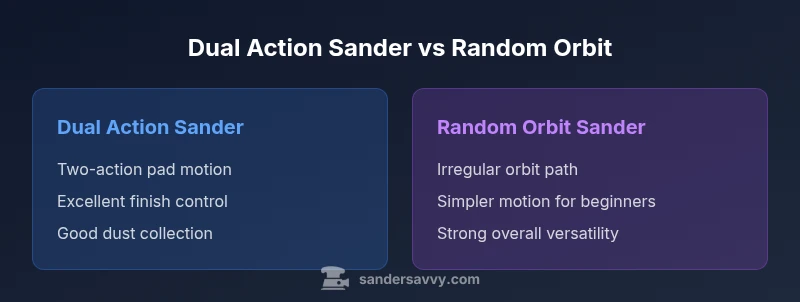
| Action mechanism | Dual-action: two-action pad motion (orbital + rotation) | Random orbit: orbital movement with irregular rotation |
| Finish quality potential | Softens swirls; excellent for fine finishing with proper technique | Excellent swirl control; best with correct grit sequence |
| Aggressiveness / material removal | Moderate to light; optimized for finishing | Moderate; balanced for prep and finishing |
| Vibration & comfort | Typically balanced with good ergonomics | Comparable vibration; depends on model |
| Dust collection | Strong dust port compatibility; works well with vacuums | Effective dust ports; performance improves with a good seal |
| Price range | $60-$180 | $40-$150 |
| Best for | Finish-focused projects and swirl-free surfaces | Budget-conscious projects with emphasis on results |
What's Good
- Smooth finish and reduced swirl marks when used correctly
- Versatile for floors, decks, and walls
- Good dust control with proper setup
- Wide availability and accessible mid-range options
- Ergonomic designs reduce fatigue during long sessions
Weaknesses
- Requires proper technique to achieve best results
- Higher upfront cost than basic sanders or manual sanding
- Can be heavier and bulkier than some alternatives
- Replacement discs and pads add ongoing maintenance cost
Dual action sander generally delivers better finish quality with broader versatility
For most DIYers, the dual-action (random orbit) approach provides an optimal balance of finish quality, control, and ergonomics. Choose a mid-range model for best value and comfort, and tailor your selection to project type and dust-management needs.
Your Questions Answered
Is a dual action sander the same as a random orbit sander?
For most DIYers, yes—the terms often describe the same finishing approach. The difference is primarily marketing language and motion nuance. Focus on finish quality, dust control, and ease of use rather than naming.
In practice, dual action and random orbit are two names for similar tools. Pick the one that feels comfortable and offers good dust control.
Can I sand floors safely with these tools as a beginner?
Yes, with proper technique and protective gear. Start with a medium grit and practice on scrap material before touching actual floors. Always finish with a fine grit for the best look.
Yes, but go slow, wear a mask, and practice on scrap first.
What is the best grit progression for finishing?
A common sequence is 80/120 for initial leveling, followed by 180/220 for finishing. Always test grits on scrap to see how they cut and leave a surface ready for sealant.
Start coarse to smooth, then finish with fine grits for a clean surface.
Do size differences (5-inch vs 6-inch) matter?
Yes. Larger discs cover more area and remove material faster, but they can be harder to control on tight corners. Choose based on project size and maneuverability needs.
Larger discs are faster but less agile; pick based on job and space.
Should I always use a vacuum with these tools?
Using a vacuum or dust collection system reduces airborne dust and helps keep the work area clean. It’s highly recommended for indoor projects and for long sanding sessions.
Yes—vacuuming keeps dust down and your lungs happier.
Are these tools safe for walls or vertical surfaces?
They can be used on walls for sanding and smoothing, but require careful handling to avoid gouging. When possible, use a lighter touch and keep the tool moving steadily.
Yes, with care and a light touch on walls.
Main Points
- Choose a mid-range model for value and performance
- Prioritize dust collection and ergonomic design
- Master technique to minimize swirl and maximize finish
- Match disc size and grit sequence to your project
- Consider use-case: finishing vs material removal