Electric DA Sander vs Air: Which Sander Wins for DIY Projects?
A detailed, objective comparison of electric DA sanders and air-powered sanders for floors, decks, and walls. Learn about power, dust control, ergonomics, maintenance, and cost to decide which tool fits your project.


To decide between electric da sander vs air, focus on dust control, power delivery, and operator comfort. In most DIY projects, electric da sanders offer convenience and steady torque, while air-powered units shine where lightweight speed and minimal vibration matter. This comparison covers performance, cost, maintenance, and safety to help you choose confidently.
Understanding the landscape: electric da sander vs air
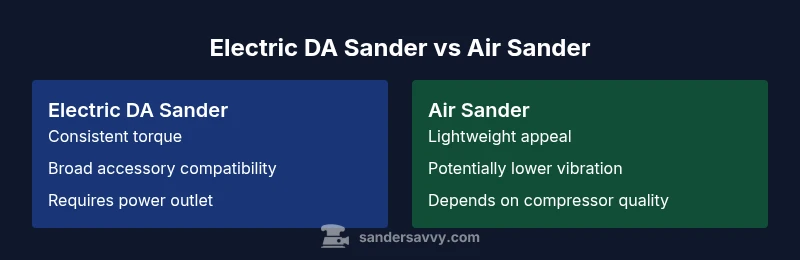
The decision between an electric da sander and an air-powered model hinges on how you balance convenience, control, and the working environment. The phrase electric da sander vs air has become common among DIYers who want a straightforward rule of thumb: electric tools tend to be easier to manage for small to medium projects, while air tools excel when a workshop already has a compressor and a high duty cycle. According to SanderSavvy, the practical impact is most visible in three areas: power delivery, dust management, and operator fatigue over long sessions. For homeowners, this means starting with a clear project profile and a realistic cleanup plan before choosing a tool type. The SanderSavvy team found that most casual projects benefit from the reliability and predictability of electric DA sanders, especially when power access is stable and air lines are not required for every task.
Comparison
| Feature | Electric DA Sander | Air Sander |
|---|---|---|
| Power delivery | Constant torque with adjustable speed (electric) | Pressure-driven torque dependent on compressor and air supply (air) |
| Sanding speed consistency | Stable, predictable performance across routine tasks | Potentially variable performance with fluctuating air pressure |
| Weight and ergonomics | Typically heavier but well-balanced with ergonomic handles | Generally lighter, which reduces fatigue in long sessions |
| Dust management | Integrates with vacuums or dust hood attachments | Dust control depends on hose/collection setup and compressor |
| Maintenance and parts | Brush/armature wear; occasional motor maintenance | Regulator, filters, and hose wear; compressor-related maintenance |
| Operating cost | Moderate to high energy use depending on model | Low energy if the compressor is efficient, but compressor cost applies |
| Best use case | Projects needing consistency, convenience, and portable power | Heavy-duty shop work with a ready compressor and high duty cycle |
What's Good
- Electric DA sanders offer steady torque and adjustable speeds for precise work
- Air sanders are typically lighter and reduce user fatigue on long sessions
- Air systems can be integrated with existing dust collection setups in a shop
- Electric tools avoid compressor dependencies, enabling flexible work without a dedicated air line
Weaknesses
- Electric DA sanders require power outlets and can be heavier to lift
- Air sanders depend on a reliable compressor; pressure fluctuations affect performance
- Air systems can be louder or cause more line noise in some configurations
- Electric motors may require more frequent brush or bearing maintenance over time
Electric DA sander generally offers better control and portability for DIYers, while air sanders excel in pro shops with robust dust collection and high duty-cycle.
For most homeowners tackling flooring, furniture refinishing, or wall prep, the electric DA sander is the balanced choice due to its convenience and consistent results. If your workspace already features a strong compressor and you perform heavy-duty sanding daily, the air sander can provide advantages in speed and weight reduction.
Your Questions Answered
What is the main difference between an electric DA sander and an air sander?
The electric DA sander relies on electrical power for constant torque and adjustable speed, while an air sander uses compressed air for power, which can vary with compressor performance. In practice, electric models are more predictable for DIY tasks, whereas air models excel when a shop already has reliable air supply.
Electric DAs offer steadier control; air sanders depend on your compressor. For most DIYers, the electric option is simpler to manage.
Which is better for floor sanding, electric or air?
For floors, an electric DA sander tends to be more practical due to consistent speed, easier maneuverability, and compatibility with common dust-collection setups. An air sander can be used, but performance may hinge on maintaining steady air pressure across extensive sessions.
Electric DAs are generally preferred for floors because they stay consistent and comfortable over long sessions.
Do electric DA sanders require special power outlets?
Most DIY electric DA sanders run on standard household outlets, though some heavy-duty models may benefit from a dedicated circuit to minimize voltage drop. If you’re around sensitive electronics or long extension runs, plan for adequate outlet provision and safe cord management.
Usually no special outlet is needed, but verify your circuit capacity for longer jobs.
How does dust collection differ between the two?
Dust collection is possible with both types, but electric sanders often integrate more straightforwardly with shop vacuums or dust hoods. Air sanders rely more on the available dust-collection attachments and the quality of the compressor’s filtration.
Dust control is easier with electric sanders if you have a vacuum setup ready.
Are air sanders louder than electric DA sanders?
Noise levels depend on the model and attachments, but air systems can produce more compressor noise in busy workshops. High-quality air tools with proper exhaust management can mitigate some of that effect.
Air sanders can be louder due to the compressor; electric DAs are typically quieter.
What should DIYers consider before buying?
Consider your typical projects, available power, and dust-control plan. If you already own a compressor and need high duty-cycle work, a high-quality air sander can be cost-effective. Otherwise, an electric DA sander offers easier setup and more predictable performance.
Think about power access, dust control, and how often you sand to pick the right tool.
Main Points
- Assess your power setup before buying
- Prioritize dust collection to reduce cleanup
- Balance weight and vibration for comfort
- Consider long-term operating costs
- Match tool to project type: floors, decks, walls
- Air sanders shine with existing compressor setups
- Electric DA sanders suit most DIY projects