Is a DA Sander the Same as an Orbital Sander? A Practical Guide
Is a da sander the same as an orbital sander? This guide compares motion, finish quality, dust control, and use cases for floors, decks, and walls to help homeowners decide which tool fits their project goals best.


This guide compares a DA sander (random-orbit sander) with a traditional orbital sander to clarify the similarities and the key differences in motion, finish, and best-use scenarios. You’ll learn when each tool shines, what jobs they’re best suited for, and how to choose based on finish quality, speed, and dust control. For homeowners, the right choice is usually determined by your project type and desired finish, not by buzzwords.
What is a DA Sander? Definition and terminology
In woodworking, DA typically refers to a random-orbit sander, a tool that combines orbital motion with a secondary rotation. The result is a finer finish than a simple orbital sander and a lower tendency to leave noticeable swirl patterns when used with proper technique. According to SanderSavvy, understanding the distinction between a DA sander and a traditional orbital sander helps homeowners plan finishing work with confidence. A DA sander is widely used for finish preparation on floors, cabinets, and furniture where a smooth surface is essential. While some brands label it as a random-orbit sander, practitioners often treat it as synonymous with DA in everyday shop talk. This nuanced difference matters when you map out a sanding plan and sequence, especially on delicate woods or rounded profiles.
Is a DA Sander the Same as an Orbital Sander? Core differences
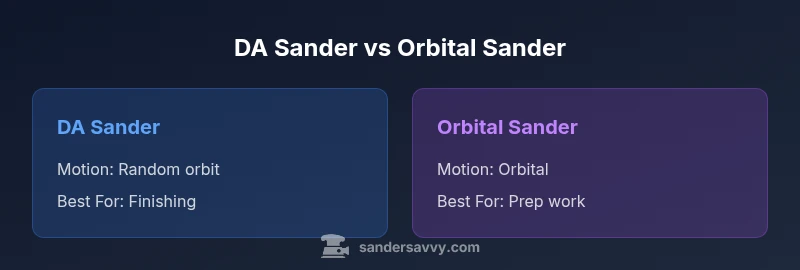
The question is frequently asked in home workshops: is a da sander the same as an orbital sander? The short answer is no, though they share a core sanding wheel and disc system. A DA sander uses a randomized orbit plus a secondary action, which minimizes cross-hatch patterns and produces a finer finish with fewer passes. An orbital sander uses a fixed orbital pattern, which can remove material quickly but may show tiny circular marks if you don’t feather edges carefully. The two tools also differ in vibration profiles, weight distribution, and dust-management options. For many DIY projects, the choice hinges on whether you value finish quality (DA) or speed and simplicity (orbital).
How random orbit motion works and why it matters
Random orbit motion merges two movements: an orbital path and a random rotation of the pad. This dual-action reduces swirl marks on flat panels and helps the sander stay productive across irregular surfaces. In practice, the tool feels stable in the hand, and a light touch tends to deliver a smoother surface without gouging. When you compare a DA sander to a pure orbital sander, you’ll notice the randomized path produces more consistent results on fine finish tasks, especially with finer grits. If your project requires a near-burnished finish on hardwood floors, a DA sander is often the preferred option.
Finish quality vs material removal: what to expect
Finish quality and material removal rate are the two big levers homeowners consider. A DA sander generally yields a finer, more uniform surface with fewer passes, which reduces the risk of visible ridges or paddle marks. An orbital sander can remove material faster and is excellent for aggressive preprocessing or removing finishes quickly. The trade-off is that it may require more careful edge work or multiple passes to minimize swirl marks. Understanding these dynamics is essential when planning a project timeline and selecting sanding grits for each stage.
Applications: floors, decks, and walls
For wood floors and furniture, a DA sander is often the go-to for the final smoothing stages, especially after coarser abrasives have done the bulk of the work. Orbital sanders excel on rough prep tasks and wide flat surfaces where speed matters more than ultimate finish quality. On decks and exterior surfaces, both tools have roles: a DA sander can tame the surface for staining, while an orbital sander is convenient for initial prep before applying sealants. The practical takeaway is to match tool type to job phase and the material you are working with.
Dust control and filtration: optimising dust collection
Dust control is not one-size-fits-all. DA sanders with integrated vacuum adaptors typically integrate with shop vacs, helping minimize airborne dust during finish work. Orbital sanders also support dust-collection bags and hoses, but the efficiency varies by model and dust port design. A key best practice is to connect the sander to a capable vacuum system and use a bag or canister that captures fine dust particles. For occupants and pets, minimizing dust exposure matters more than people realize when sanding interior surfaces.
Ergonomics: weight, grip, and vibration levels
Ergonomics influence both accuracy and comfort during longer sanding sessions. DA sanders tend to be heavier due to their dual-action mechanism, which can affect control on edges. Orbital sanders are often lighter and easier to maneuver for beginners. Regardless of tool choice, look for ergonomic handles, anti-vibration features, and a comfortable grip. If you plan multi-hour sessions, consider models with balanced weight distribution to reduce fatigue and improve control, especially when working on large surface areas.
Sandpaper types, grits, and disc sizes
Sanding outcomes depend on grit selection and disc availability. DA sanders commonly accept 5-inch discs with a broad range of grits, while some models support 6-inch options for faster material removal. Orbital sanders also use similar disc sizes but may have more limited grit compatibility on budget models. Plan your grit progression: start rough for heavy material removal, then move to finer grits for finishing. Stock up on a few mid-range grits (80–120) for prep, plus 180–220 for final smoothing to reduce finish imperfections.
Maintenance, longevity, and keeping performance high
Preventative maintenance extends tool life and ensures consistent results. Clean dust from vents and the pad area after every job, inspect the sanding pad for wear, and replace worn dust bags regularly. For DA sanders, ensure the random-orbit mechanism remains free of debris and apply light lubrication where the manufacturer recommends. Orbital sanders require similar care, with emphasis on the bearings and motor cooling. A clean, well-lubricated sander reduces noise, extends life, and keeps dust collection efficient between jobs.
Noise, vibration, and working comfort in practice
Noise and vibration levels affect perceptual comfort and precision. DA sanders may produce more vibration per minute due to their dual-action mechanism, especially in mid-range models. Orbital sanders can feel smoother but still generate noticeable vibration during extended use. If you’re sensitive to vibration or are sanding for long durations, wear protection (earmuffs, anti-fatigue mats) and take regular breaks. The goal is to maintain control, protect your joints, and avoid fatigue that can degrade finish quality.
How to choose between DA and orbital for your project workflow
Your decision should hinge on project phase and finish quality requirements. For final smoothing on floors or cabinetry where swirl-free results are critical, favor a DA sander. For quick surface prep and heavy material removal on rough stock, an orbital sander is often the better starting point. Consider your dust-control setup, the weight you’re comfortable with, and your willingness to invest in accessories. If you’re new to sanding, starting with an orbital sander may reduce the learning curve before you graduate to a DA sander for high-finish tasks.
Quick-start roadmap: getting the right setup
- Define your project scope and set grit milestones.
- Select one tool as your primary for finishing and another for prep as needed.
- Pair each tool with a compatible vacuum and a handful of 5-inch discs in grits 60–120 for prep and 180–220 for finish.
- Practice on scrap wood to refine pressure control and surface patter before touching your actual project.
Practical examples and scenarios from homeowners
Consider a kitchen cabinet refinish: you’ll typically begin with an orbital sander for rough removal, then transition to a DA sander for the final smoothing and swirless finish. For a floor refinishing project, start with a coarse grit on an orbital sander to level the surface and switch to a DA sander for the final pass. These sequences help maximize efficiency while preserving the material integrity and achieving a uniform appearance.
Comparison
| Feature | DA Sander | Orbital Sander |
|---|---|---|
| Sanding motion | Random-orbit with dual-action | Fixed orbital path |
| Best for | Finish work, fine smoothing, detailed edges | Prep work, rapid material removal on flat surfaces |
| Finish quality | High, swirl-minimized with proper technique | Good, can show swirl marks if overused |
| Dust collection | Good with vacuum hookups; bags or canisters common | Effective with vacuum hoses and dust ports |
| Disc sizes | Typically 5" discs; some 6" options | Typically 5" discs; limited 6" options |
| Vibration/ergonomics | Moderate to high; more grip options | Lower vibration; beginner-friendly |
| Price range | Mid to high depending on features | Lower to mid-range; widely available |
| Best for | Finish work on wood floors, cabinets | General prep work and rough sanding |
What's Good
- Versatile for finishing and prep work
- Produces swirl-free finishes with proper technique
- Good dust control when paired with a vacuum
- Broad compatibility with discs and accessories
Weaknesses
- Steeper learning curve for optimal finish
- Heavier feel on some models can cause fatigue
- Swirl marks can occur with improper technique
- More expensive models may be heavier or bulkier
DA sander wins for finish quality; orbital sander wins for speed and simplicity
For most homeowners, the DA sander is the better all-around choice, delivering finer finishes with careful technique. The orbital sander is ideal for quick prep and material removal, especially on rough stock. Your final pick should align with project goals and your tolerance for technique refinement.
Your Questions Answered
Is a DA sander the same as an orbital sander?
Not exactly. A DA sander combines random orbit with a secondary rotation for a smoother finish, while a traditional orbital sander follows a fixed orbital path for faster material removal. The difference matters when you’re aiming for a flawless finish or tackling heavy prep work.
No—DA and orbital sanders are related but not identical. Use the DA for finish work and the orbital for quicker prep.
Which projects are best for a DA sander?
DA sanders excel on final finishes for floors, cabinets, and furniture where swirl-free appearance is important. Use them after rough or medium sanding when you want the smoothest possible surface with minimal passes.
DA is best for finishing tasks like floors and cabinets.
Can I use a DA sander for deck sanding?
Yes, but be mindful of the surface. DA sanders are great for smoothing after rough prep, but for heavy stock removal on a deck you may prefer an orbital sander or a belt sander for faster results.
DA can work on decks for finishing passes.
What grit sequence should I follow for these tools?
Start with coarse grits (60–80) for heavy material removal, then move to medium (120–150) and finish with fine (180–220). Tailor the sequence to wood type and desired finish.
Begin rough, then gradually go finer for a smooth finish.
How important is dust collection with these tools?
Very important for health and finish quality. Attach a shop vac or dust extractor, and use proper bags or canisters. This helps keep the work area clean and reduces airborne dust.
Dust control is essential for safety and finish quality.
Are cordless models practical for casual DIY?
Cordless models offer flexibility and convenience for small projects, but run time and vibration may limit use on larger surfaces. If you sand a lot, a corded model or high-capacity battery is preferable.
Cordless options exist but watch run-time.
Main Points
- Choose DA for high-quality finishes and swirl-free results
- Use orbital for fast material removal and rough prep
- Pair sanding steps with appropriate grits for best outcomes
- Maintain a dust-collection setup to protect indoor air quality
- Test on scrap pieces before working on the actual project