Difference Between Sander and Polisher: A Practical Guide
Explore the difference between sander and polisher, when to use each, and how to choose grit, pads, and safety tips for floors, decks, and walls. A practical, analytical look for homeowners and DIY enthusiasts.


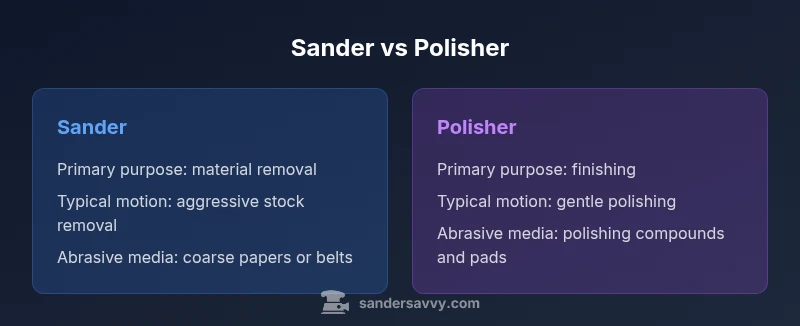
The difference between a sander and a polisher hinges on purpose, motion, and finish. A sander removes material to flatten or shape a surface, while a polisher refines and brightens with fine abrasives. For DIY projects, choosing the right tool depends on whether you need material removal or a final, smooth finish.
Understanding the difference between sander and polisher
Homeowners and pros alike often mix up these two tools, but the difference between sander and polisher is fundamental to achieving a quality finish. According to SanderSavvy, the distinction goes beyond motor size and price: it centers on the job outcome. A sander is designed to remove material, shape edges, and level surfaces, whereas a polisher aims to refine and enhance the surface through controlled abrasion and polishing compounds. When you grasp this core distinction, you can plan a workflow that minimizes waste and protects the substrate. In this guide, we’ll unpack the difference between sander and polisher, explain how each tool operates, and provide practical tips for floors, decks, and walls. The goal is to help you decide, quickly, which tool to reach for at each stage of your project, and how to avoid common pitfalls associated with the difference between sander and polisher.
Core definitions: sander vs polisher in practice
A sander is a material-removal tool. It uses abrasive media (papers, belts, or discs) and a mechanical motion to strip away surface material, flatten irregularities, and strip finishes when needed. The exact result depends on grit, pressure, and the tool type (belt, random orbital, or palm sander). A polisher, by contrast, applies fine abrasives and polishing compounds to create a smooth, high-sheen or satin finish. It relies on cushioned pads and a gentler, more controlled motion to minimize stock removal while enhancing gloss and clarity. The difference between sander and polisher becomes especially clear when you’re deciding whether to prepare a rough substrate or to upgrade the visual appeal of a finished surface. For homeowners, this distinction guides step order and tool selection.
Motion, abrasives, and finishing dynamics
The difference between sander and polisher is most obvious in motion and contact. Sanders are designed for material removal, with aggressive action that can quickly level a blemished surface or strip old coatings. They use coarse to mid grits, depending on the task. Polishers employ a rotating or oscillating motion with soft pads and polishing compounds, focusing on micro-matting, color uniformity, and gloss. The abrasive media for polishers is much finer, and the goal is to reduce micro-scratches rather than remove material. Knowing the difference between sander and polisher helps you choose the right pad, compound, and speed to achieve the desired finish without introducing new imperfections.
Tool families and configurations: what you’ll encounter in practice
Understanding the difference between sander and polisher also means navigating the tool landscape. Sanders include belt, random orbital, and palm types, each optimized for speed and material removal on different substrates. Polishers come in rotary and orbital variants, often paired with foam or wool pads and polishing compounds. The difference between sander and polisher is echoed in their accessory ecosystems: belts and coarse papers for removal versus micro-fiber pads and compound buffing for finishing. When planning a project, map the surface condition to the function: rough prep calls for a sander, while refinishing and enhancing sheen calls for a polisher. This is the practical embodiment of the difference between sander and polisher in real-world scenarios.
Surfaces and finishes: applying the right tool to the job
The difference between sander and polisher also determines surface compatibility. Wood floors and decks, for instance, benefit from an initial sander pass to remove old coatings and level grain, followed by a polisher to achieve a uniform sheen. Walls and ceilings may require gentle sanding to knock down ridges, then a light polish to remove micro-scratches before paint or finish. In all cases, the key is to preserve substrate integrity while achieving the intended aesthetic. The difference between sander and polisher should drive your sequence: prep with a sander, then refine with a polisher for the final look.
Abrasives, pads, and conditioning: a practical grit guide
The difference between sander and polisher hinges on abrasives and pads. Sanders use a range of grits and belt/paper formats; start coarse for stock removal and progress to mid grits for leveling. Polishers rely on premium polishing compounds and soft pads designed to minimize stock removal while promoting brilliance. Pad conditioning and compound compatibility are essential to avoid glazing or uneven finishing. Remember the difference between sander and polisher when selecting grit progression and pad type: think stock removal versus surface refinement, and adjust pressure and speed accordingly.
Safety, dust control, and setup: protecting yourself while pursuing the difference between sander and polisher
Dust control is a critical aspect of the difference between sander and polisher. Sanders generate more dust due to material removal, so use dust collection attachments, temporary enclosure, and respiratory protection. Polishers produce finer particulates and require ventilation and eye protection. Always clamp workpieces, keep hands clear of moving parts, and follow manufacturer safety instructions. Another facet of the difference between sander and polisher is the need to clean and inspect abrasives between passes to prevent cross-contamination of finishes.
Practical workflow: from rough prep to final polish
A common workflow embodies the difference between sander and polisher: begin with a coarse grit on a suitable sander to flatten and remove stock, then switch to progressively finer grits on the same tool or a different sander for final leveling. After achieving the desired texture, move to a polisher with a finishing pad and polishing compound to refine and brighten. The difference between sander and polisher here is workflow logic: separate tasks for removal and finish, or combined steps if you’re experienced. Always test on scrap samples to dial in pressure, speed, and dwell time.
Budget, value, and maintenance considerations
The difference between sander and polisher also influences budgeting. You’ll often need both tools for complete prep and finish, though rental or shared usage can be cost-effective for one-off projects. Sanders demand spare discs, belts, and dust collection; polishers require pads and polishing compounds that match the surface and sheen goals. Maintenance involves cleaning after use, inspecting pads and abrasives for wear, and storing tools away from moisture. Understanding the difference between sander and polisher helps you plan maintenance and replacement strategies that maximize longevity.
Common mistakes and troubleshooting: avoiding the difference between sander and polisher missteps
Common mistakes include using a polisher for heavy stock removal, which can overheat pads and cause poor surface quality, or relying on a sander with too fine a grit for initial prep, leaving deep scratches. Another pitfall is neglecting dust control, which compromises adhesion of finishes and finishes with poor clarity. The difference between sander and polisher is most critical during the transition from removal to refinement: verify the surface is clear, inspect for remaining defects, and ensure you’re applying the correct pad and compound for the desired effect.
Quick-start checklist for homeowners
- Identify the difference between sander and polisher and assign tasks accordingly.
- Begin prep with a sander using coarse grit, then move to finer grits.
- Switch to a polisher with appropriate pad/compound for finishing sheen.
- Use dust collection and PPE at all times to minimize health risks.
- Test on scrap wood to dial in technique before committing to the project surface.
The learning path and next steps
Mastering the difference between sander and polisher takes practice. Start with simple, flat panels to learn through the difference between sander and polisher in practice. As you gain confidence, expand to more complex surfaces like curved edges and uneven boards, always validating results on test pieces before proceeding to the main project.
Comparison
| Feature | sander | polisher |
|---|---|---|
| Primary purpose | Material removal and leveling | Finishing and polishing |
| Typical motion | Aggressive removal with belts or rotary/orbital action | Gentle, controlled rotation or oscillation for finishing |
| Abrasive media | Coarse to mid papers/belts | Polishing compounds and soft pads |
| Finish outcome | Rough leveling and stock removal | Smooth, glossy, or satin finish |
| Best used on | Rough prep, flattening, stripping coatings | Final finishing, sheen enhancement, blemish removal |
| Dust management | Dust extraction and containment vary by model | Often paired with vacuum and proper ventilation |
| Maintenance | Replace belts/papers; check dust collection | Replace pads and recondition pads; ensure compound compatibility |
What's Good
- Clear separation of material removal and finishing tasks
- Helps prevent over-sanding and finish damage
- Increases project efficiency when used with proper technique
- Improves consistency across large or multiple surfaces
Weaknesses
- Requires owning or renting multiple tools for full workflow
- Learning curve for selecting the right grit and pads
- Setup and maintenance can be time-consuming for beginners
Pair for best results: use a sander for prep, then a polisher for finish
For most DIY prep and finishing tasks, separating material removal from surface finishing yields superior results. The SanderSavvy approach is to start with a sander to flatten and remove defects, then finish with a polisher for sheen and uniform appearance. Practically, have both tools ready and practice on scrap pieces to dial in technique.
Your Questions Answered
What is the main difference between a sander and a polisher?
The main difference is material removal versus finishing. A sander removes stock to flatten or shape a surface, while a polisher uses fine abrasives to produce a smooth, glossy finish. The choice depends on whether you need to remove material or improve surface appearance.
Sander takes material off; polisher smooths and shines.
When should I use a sander instead of a polisher?
Use a sander when you need to remove material, strip finishes, or level uneven surfaces. If the goal is to smooth and refine rather than remove material, a polisher is the better choice. Timing and task clarity are key to the difference between sander and polisher.
Use a sander for removal, switch to a polisher for finishing.
Can I use a polisher for heavy stock removal?
Polishers are not intended for heavy stock removal. Using a polisher for this can overheat pads and produce poor results. For substantial material removal, start with a sander or belt sander and move to a polisher for finishing.
Polishers aren’t for heavy removal—stick to finishing.
What safety gear do I need for sanding and polishing?
Wear eye protection, a dust mask or respirator, hearing protection, and gloves. Use a dust collection system and ensure good ventilation. Follow tool-specific safety guidelines for the difference between sander and polisher.
Protective gear plus dust control keeps you safe.
Do I need both a sander and polisher for wood floor refinishing?
Typically yes: a sander for removing old finishes and leveling, followed by a polisher for a uniform sheen. If you’re refinishing infrequently, you might rent or borrow one tool at a time, but expect longer project time.
Usually, yes—use both for best results.
Are belt sanders and random orbital sanders both sanders?
Yes. Belt sanders are aggressive and suited for heavy stock removal, while random orbital sanders are versatile for smoother prep and less gouging. The difference between sander and polisher becomes apparent in their primary tasks, not in their classification.
Two common sander styles exist, each with different jobs.
What grit sequence should I use when transitioning from sanding to polishing?
Start with coarse grits to remove material, then progressively move to finer grits. When you reach polishing, switch to very fine grits or polishing compounds as appropriate. Clean between steps to avoid scratching.
Go from coarse to fine, then polish.
How do I clean after sanding and polishing?
Vacuum thoroughly to remove dust, wipe with a tack cloth, and inspect for remaining scratches. Clean surfaces before applying finishes or polishing compounds to ensure proper adhesion and clarity.
Vacuum, tack cloth, then inspect and proceed.
Main Points
- Assess finish goal before tool choice
- Use sander for stock removal, polisher for finishing
- Match grit and pads to surface and goal
- Prioritize dust control and PPE
- Practice on scraps to dial in technique