Drum Sander vs Planer: Side-by-Side Guide
A practical comparison of drum sander vs planer for floors and panels. Learn when to use each tool, expected finishes, safety notes, and cost considerations to help DIYers choose the right tool.


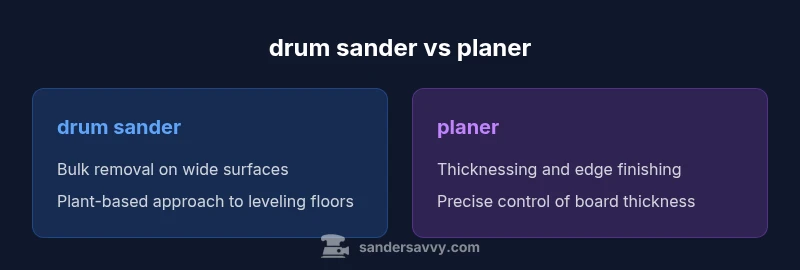
In most DIY projects, the drum sander is the go-to for bulk material removal on wide, flat surfaces, while a planer excels at thickness control and edge finishing on boards. The choice hinges on surface area, finish goals, and access. In short: use the drum sander for rough leveling and the planer for precise thickness work.
What are drum sander vs planer? An overview
Drum sander and planer are two popular wood-removal tools, but they serve different roles in a woodworking workflow. A drum sander uses a rotating abrasive drum to remove material from large, flat surfaces, typically floors or panels. A planer, by contrast, uses cutting blades to shave thickness from boards, delivering uniform thickness and flatness on defined edges and surfaces. For many DIY projects, understanding when to reach for a drum sander vs planer saves time, reduces waste, and minimizes the risk of gouges. This guide compares the two tools across common tasks, safety considerations, and practical workflow patterns so you can decide which tool to reach for first in a given job.
Throughout, you’ll see the phrase drum sander vs planer used to highlight where the distinction matters—especially on floors, decks, walls, and boards. According to SanderSavvy, the right pairing of these tools often yields the best finish with the least effort, especially when you plan a sequence that leverages each tool’s strengths.
If you’re new to sanding, think of the drum sander as a bulk-leveling machine for wide, flat areas and the planer as a precision instrument for boards and edges. The drum sander can remove material quickly across large surface areas, but it can also be less forgiving on edges and corners. The planer, with its blade-driven removal, can produce thinner shavings and very flat boards, yet it cannot reliably flatten a wide floor in a single pass without careful setup.
For homeowners and DIY enthusiasts, the drum sander vs planer decision often boils down to surface area, desired finish, and project scope. The good news is that most projects benefit from using both tools in a planned sequence. This guide will help you map out that sequence and avoid common missteps.
The SanderSavvy team emphasizes that safe operation and proper dust control matter as much as raw power. Treat both tools with respect: plan your workflow, protect your lungs, and clean up thoroughly after each pass. Drum sander vs planer is not just about speed—it’s about achieving a consistent finish with minimal waste.
wordCountOnlyForBlock":null
Comparison
| Feature | drum sander | planer |
|---|---|---|
| Primary purpose | Bulk material removal on wide, flat surfaces (floors, panels) | Thicknessing boards and flatness on edges and boards |
| Surface finish control | Requires careful technique; can leave swirl marks if misused | Produces flat, thicknessed surfaces with blade-edged finish |
| Accessibility | Best on large, open areas; edges require different tools | Edge and board thicknessing; limited to board width and planing depth |
| Dust and debris | Dust is fine and pervasive; requires effective dust collection | Produces chips; easier to manage with dust collection |
| Maintenance | Belt changes and drum wear; regular cleaning | Blade maintenance; frequent blade replacements and calibration |
| Best for | Rough leveling on floors and large panels | Thicknessing boards and edge finishing |
What's Good
- Fast bulk material removal on large flat surfaces
- Excellent for flattening floors when used correctly
- Widely compatible with floor refinishing workflows
- Can be a time-saver on large projects when sequence is planned
Weaknesses
- Risk of gouging or gouge-like scratches if misused
- Not ideal for edges and detailed work without companion tools
- Dust and noise require proper protection and containment
- Requires setup and maintenance to avoid ripples and swirls
Drum sander is the winner for bulk leveling on large flat surfaces; planer shines for thicknessing and precise edge work.
If your project centers on removing material from a wide floor or panel, the drum sander is typically the better initial choice. For achieving exact thickness and a clean edge, the planer is the preferred follow-up. A well-planned sequence using both tools yields the best overall result, and the SanderSavvy team endorses this combined approach for most projects.
Your Questions Answered
Can I replace a drum sander with a planer for floor work?
In most cases, no. A planer handles boards and thickness, while a drum sander is designed for bulk leveling of wide, flat surfaces. For a floor, you typically start with a drum sander to flatten the bulk and then use a planer or edge tools for final finishing on edges. This combination minimizes risk and maximizes efficiency.
A drum sander handles bulk leveling; a planer finishes thickness and edges—use both in sequence for best floor results.
Is a drum sander safe for DIY beginners?
A drum sander can be risky for beginners due to potential gouging and excessive material removal if not used carefully. Start with scrap material, use a slow, steady passage, and maintain a consistent angle and pressure. Protective gear and a dust collection system are essential.
Yes, but with caution—practice first on scrap and use proper dust control.
What surfaces are best suited for each tool?
Drum sanders excel on wide, flat surfaces such as old floors, large panels, and decks where bulk removal is needed. Planers are best for boards, edges, and thicknessing tasks where a precise, flat thickness is required.
Best on floors for the drum sander; best on boards for the planer.
How do you minimize swirl marks with a drum sander?
Maintain even movement, avoid staying in one spot, and release only light pressure as the drum passes over the surface. Frequent checks with a straightedge help identify high spots early so you can adjust your technique.
Keep the motion consistent and don’t dwell on one area.
Should I sand before planing, or plane before sanding?
Typically you plane first to bring boards to a uniform thickness and rough flatness. Then use a drum sander for bulk leveling and final smoothing. The order reduces risk and improves finish quality.
Plane first for thickness, then sand for finish.
What maintenance is required for these tools?
Keep blades sharp and tidy for the planer; replace or rotate sanding belts and clean the drum for the sander. Regular dust collection checks help maintain performance and safety.
Keep belts sharp and the drum clean; check the dust system regularly.
Main Points
- Choose drum sander for bulk removal on wide surfaces
- Use planer for thicknessing and precise edge work
- Plan dust control and PPE before starting
- Test on scrap before touching finished material
- Combine both tools in a deliberate sequence for best results