Oscillating vs Non-Oscillating Drum Sanders: An In-Depth Guide
A detailed, analytical comparison of oscillating and non-oscillating drum sanders for floors, decks, and walls. Learn how each mechanism affects material removal, finish quality, dust control, maintenance, and buying decisions.


Oscillating vs non oscillating drum sander is a fundamental distinction for floor and deck refinishing. The oscillating model uses a small orbit to distribute abrasive pressure, often delivering a smoother finish on large surfaces, while non-oscillating drums rely on a fixed path and can be simpler and more budget-friendly. For most homeowners, the choice hinges on surface size, comfort with control, and project scope.
What Oscillating vs Non-Oscillating Means in Practice
The phrase oscillating vs non oscillating drum sander refers to how the drum moves while the abrasive belt or drum faces the workpiece. An oscillating drum completes a tiny orbital motion as it rotates, which helps distribute wear and reduce obvious scratch patterns on broad surfaces. A non oscillating drum follows a fixed, linear path with less sideways movement, delivering straightforward, predictable results. According to SanderSavvy, understanding these motion patterns is the first step toward choosing the right tool for floors, decks, or walls. This distinction matters not just for speed, but also for how aggressive the tool feels in hand and how much control you have over edge work and transitions.
- Oscillating gear is often paired with a wider belt and a controlled dwell, which helps avoid gouging on uneven planks.
- Non-oscillating drums tend to be lighter on abrasive wear per pass but require more careful steering to avoid flat spots.
- The decision can influence how you sequence grits, the type of abrasives you choose, and the overall time spent on a project.
In practice, most DIY homeowners encounter this choice when renting or buying a drum sander for a floors-only project. The goal is to balance speed with control, minimizing burn marks and ensuring a level, uniform surface. In this guide, we’ll walk through the practical implications of both approaches, backed by general guidelines rather than exact model specs.
Mechanical Design and How It Impacts Results
The core difference between oscillating and non-oscillating drum sanders is mechanical motion. With oscillation, the drum’s contact with the workpiece follows a small elliptical orbit. This motion reduces the chance of creating consistent planer-like lines, helping to blend the wood grain and produce an even finish across wide floors. The trade-off is a slightly more complex mechanism, which can translate to higher purchase price and potentially more maintenance points, such as bearings and linkages that drive the orbit.
Non-oscillating drums move in a steady, unidirectional pattern. This simplicity often results in a lighter machine with fewer moving parts under the hood. The finish can be excellent on flat, well-prepared surfaces, but edges and transitions may need more manual guidance to prevent gouges or tape lines. For the DIY enthusiast, the straightforward control of non-oscillating drums can be appealing, especially when learning proper sanding technique.
From SanderSavvy’s perspective, the choice should align with your tolerance for routine adjustments and the size of the job. If you’re refinishing a whole-wood floor in a single room, the oscillating option may help you achieve a uniform appearance with fewer passes. For small touch-ups or decks with manageable boards, a non-oscillating drum can offer the simplest workflow and lower upfront cost.
Material Removal, Burn Marks, and Finish Quality
Material removal rate and surface quality are the two big levers you’ll notice when comparing these tools. Oscillating drums tend to distribute removal more evenly across the width of the board, reducing the risk of noticeable burn marks on softwood and ensuring a flatter overall plane. The orbital action helps mitigate edge gouges when transitioning from wide planks to tighter areas near walls, making it easier to achieve a seamless look in the final finish.
Non-oscillating drums, when paired with careful technique, can remove material quickly with fewer mechanical indents on flat surfaces. The finish is typically crisp and clean if you maintain consistent pressure and blade alignment. However, without the orbit to blend grain and abrasion, you may see more uniform scratch patterns if you rush passes or neglect gradual grit progression. The key is to pair either drum type with a proper sanding sequence: start coarse, stay methodical on edges, and complete with a finer grit to unify the surface.
Use-Cases by Project Type
For hardwood floors, the oscillating drum often wins on large, open areas where a blended, consistent appearance matters most. Decks with wide boards may also benefit from the smoother transition provided by the oscillating mechanism, particularly if you’re dealing with slightly uneven boards that require more dynamic contact to avoid ridges. Walls or ceilings that have been sheathed with wood paneling can respond well to the evenness of oscillation when you’re removing old coatings or leveling high spots.
Non-oscillating drums can be ideal for smaller rooms, refinishing projects with tight corners, or when budget constraints are a factor. If you’re new to sanding, a non-oscillating drum lets you focus on fundamental technique without wrestling with a more complex motion pattern. For users who expect to perform frequent, mid-range refinishing, a non-oscillating unit offers predictable behavior and quicker setup.
Dust Control, Safety, and Real-World Handling
Dust collection is a constant concern with any drum sander. Oscillating machines often partner with dust extraction systems that capture dust more effectively along the sanding face due to the broader contact surface and modulated movement. In practice, you’ll still want a high-quality dust shroud and an efficient vacuum system to minimize airborne particles and keep air quality comfortable, especially in indoor spaces.
Noise and vibration levels differ as well. Oscillating models can produce more tonal variance due to the orbiting action, potentially increasing fatigue over long sessions. Non-oscillating variants generally offer smoother operation on the same job with lower perceived vibration, which can help with control and comfort for beginners.
Always wear eye protection, a respirator for fine dust, and hearing protection when using any drum sander. Secure the workpiece, use clamps for edges, and keep a careful stance to maintain balance through long passes.
Performance Metrics: Efficiency, Finish, and Control
Two key metrics matter most when assessing oscillating vs non oscillating drum sander performance: efficiency (how quickly you cover surface area) and finish quality (how smooth and uniform the surface is after sanding). Oscillation tends to improve average surface quality on large, flat areas, especially when grain patterns are variable or the wood is dense. Non-oscillating sanders often deliver consistent results with straightforward technique but may require more passes to achieve an even tone across the deck or floor.
Control is the third critical factor. Beginners typically prefer the predictability of non-oscillating drums, while experienced users may take advantage of the refined control that oscillating units offer on edges and irregular surfaces. If you’re working with delicate wood species or trying to minimize sunken grain, the orbiting action can help distribute pressure more evenly and reduce localized wear.
Practical Guidelines: Selecting Based on Skill and Project
- Skill level: Beginners often benefit from non-oscillating drums for their simplicity, while seasoned users may appreciate the smoother finish of oscillating drums on large surface areas.
- Project size: Small rooms or panels are frequently well-suited for non-oscillating sanders; entire floors or decks may demand the blending capability of oscillating action.
- Wood type: Hardwoods with pronounced grain can benefit from the tilting motion of oscillation to avoid burn marks; softwoods are more forgiving but still benefit from even pressure distribution.
- Budget: Oscillating drums typically cost more upfront and may require more maintenance; non-oscillating units are usually lighter on price and consumables, making them attractive for one-off projects.
- Abrasives: Regardless of motion, choose the correct grit progression and keep belts or discs aligned to prevent striations.
Step-by-Step: Getting Started with an Oscillating Drum Sander
- Inspect the work area and set up proper dust collection. 2) Secure the workpiece and check for loose boards or nails that could damage the belt. 3) Begin with a coarse grit (e.g., 36–40) on a fresh belt to establish a baseline, then gradually advance to finer grits. 4) Maintain a light but steady pressure and let the orbit do the work; avoid pressing down aggressively, which can create gouges. 5) Regularly check belt tension and track, adjusting as needed to prevent drifting. 6) Edge work should be done with care—use slower motions near walls to avoid burn marks and uneven edges. 7) Finish with a fine grit to blend transitions and reduce visible scratch marks. 8) Clean the surface before applying any finish to ensure proper adhesion. 9) Inspect for any remaining imperfections and address edge boundaries by hand if necessary.
Maintenance, Longevity, and Belts you’ll Need
Preventive maintenance is essential for consistent results. Regularly inspect the drive belt, bearings, and dust collection fittings for wear. Change belts promptly if you notice glazing or torn edges. Keep the sanding head clean to prevent buildup that could cause uneven contact. Store your drum sander in a dry environment to avoid rust on metal components. When replacing belts, choose the correct grit and width to match your project and preferred finish. Keeping a small spare stock of belts and replacement bearings ensures you won’t lose momentum mid-project.
Common Misconceptions Debunked
- Misconception: Oscillation always means faster removal. Reality: It often improves finish and uniformity, but the actual removal rate depends on grit and pressure.
- Misconception: Non-oscillating drums aren’t powerful. Reality: They can be very effective with proper technique and edge control, especially for small to medium jobs.
- Misconception: More aggressive grit always yields better results. Reality: Coarser grits remove quickly but can leave deeper scratches; speed must be balanced with grit selection and progression.
- Misconception: Drum sanders damage floors beyond repair. Reality: With careful use and proper technique, both drum types can produce high-quality results if you respect grain and substrate.
Price, Availability, and Value Considerations
In general, oscillating drum sanders sit at a mid-to-high price range thanks to the additional mechanism and enhanced control. Non-oscillating drum sanders tend to be more affordable and accessible for casual projects or occasional use. When budgeting, consider not only the machine cost but also consumables — abrasives, replacement belts, and dust collection needs. If you are renovating multiple rooms or projects in quick succession, the upfront investment in an oscillating model may pay off through faster completion times and a higher-quality finish over the long run.
How to Use an Oscillating Drum Sander Safely: A Quick-Start Checklist
- Wear a dust mask and eye protection; ensure good ventilation.
- Check for hidden nails or staples before starting.
- Use a guided stance and avoid overreaching to minimize kickback or loss of control.
- Begin with a quality dust collection setup and maintain belts with proper tension.
- Never run the sander without a belt guard and ensure guards are in good condition.
- Test in a small, inconspicuous area to dial in grit and pressure before proceeding to visible surfaces.
Final Practical Guidance for DIY Enthusiasts
Choosing between oscillating vs non oscillating drum sander boils down to surface area, wood type, and comfort with technique. If your project involves large, uniform floors and you want a high-quality, even finish, an oscillating drum can be a strong choice. For smaller spaces or budget-conscious refinishing, a non-oscillating drum offers dependable results with a simpler workflow. Remember that both types benefit from proper grit progression, consistent pressure, and meticulous edge work to deliver a polished final surface.
Comparison
| Feature | Oscillating drum sander | Non-oscillating drum sander |
|---|---|---|
| Material removal approach | Even, blended removal via orbital motion | Direct, steady removal with less surface blending |
| Finish quality on large flat surfaces | Typically smoother due to orbit causing fewer visible lines | Excellent for straightforward surfaces; edges may require more manual guidance |
| Edge and corner handling | Better blend near edges due to orbit | Requires careful steering near edges; edges can be flatter with technique |
| Setup and maintenance | Slightly more complex; more moving parts | Simpler design; generally lower maintenance |
| Ease of learning for beginners | Medium; requires adaptation to orbit pattern | High; intuitive motion and control |
| Typical price range (tool + consumables) | Moderate-to-high upfront cost; higher maintenance | Lower upfront cost; cheaper consumables |
| Best use case | Large floors, wide planks, hard-to-even surfaces | Small rooms, edges, tight corners, budget projects |
What's Good
- Offers smoother finish on large, flat surfaces due to orbiting motion
- Can reduce burn marks and gouges with even abrasion distribution
- Better for blending grain and transitions on floors and decks
Weaknesses
- Higher upfront cost and potentially more maintenance
- More complex operation may have a steeper learning curve
- Edge work can be trickier and may require more setup
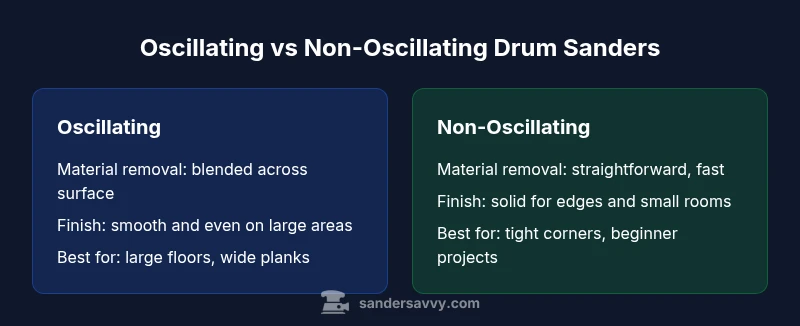
Oscillating drum sanders are preferred for large, uniform surfaces and finish quality; non-oscillating models excel in small, edge-heavy projects and lower upfront costs.
Choose oscillating when you need fast, even removal across wide areas and a refined finish. Pick non-oscillating for budget projects, tighter spaces, or when you’re new to sanding and want a straightforward workflow. The right choice depends on project size, wood type, and your comfort with technique.
Your Questions Answered
What is the fundamental difference between oscillating and non-oscillating drum sanders?
Oscillating sanders move the drum in a small orbital path as it spins, which helps blend surfaces and reduce edge gouges. Non-oscillating sanders follow a fixed path, delivering straightforward removal with a simpler motion. Both require proper technique and the right grit progression for best results.
Oscillating sanders have a tiny orbit that smooths the surface; non-oscillating sanders move in a fixed line for a straightforward pass.
Which type is best for hardwood floors?
For hardwood floors, oscillating drum sanders are often favored because the orbit helps blend grain and reduce visible scratch lines over large areas. They can deliver a more uniform surface with fewer passes. If you’re new to sanding, you may start with a non-oscillating option to learn control before moving to an oscillating unit.
Oscillating drums are typically preferred for hardwood floors due to better grain blending.
Can I use a non-oscillating drum sander for decks or walls?
Yes, a non-oscillating drum sander can be used for decks and walls, especially for smaller projects or edges where simplicity and predictability are beneficial. For large deck refinishing or surfaces requiring smooth blending, an oscillating model can offer advantages in speed and uniformity.
Non-oscillating sanders work for decks and walls when the job is small or edge-focused.
What maintenance is required for drum sanders?
Regularly inspect belts and bearings for wear, keep the dust collection system connected and clean, and replace belts when glazing or hooks appear. Clean the sanding head after use to prevent buildup and inspect guards to ensure safe operation.
Keep belts in good shape and clean the head to prevent wear and tear.
Are there safety concerns unique to drum sanders?
Dust is a major safety concern; use an appropriate respirator and ensure good ventilation. Wear eye and hearing protection, secure the workpiece, and follow manufacturer guards and guidelines for safe operation, especially near edges and corners.
Wear protective gear and follow guards to stay safe while sanding.
How do I decide which type to buy or rent?
Assess project size, your experience level, and budget. If you’re refinishing a full floor or large deck, oscillating sanders offer smoother results and faster completion. For quick, edge-heavy tasks or one-off projects, a non-oscillating sander may suffice and save money.
Think about project size and budget to decide if you should buy or rent.
Main Points
- Prefer oscillating for large floors to reduce running lines
- Choose non-oscillating for small rooms and edge work
- Plan grit progression and dust control before starting
- Factor in total project cost including consumables
- Practice on a scrap area to dial in pressure and path