Palm Sander vs Random Orbital Sander: A Practical Guide
Comprehensive, data-driven comparison of palm sander vs random orbital sander, covering finish quality, dust control, ergonomics, and best-use scenarios for DIYers and pros.


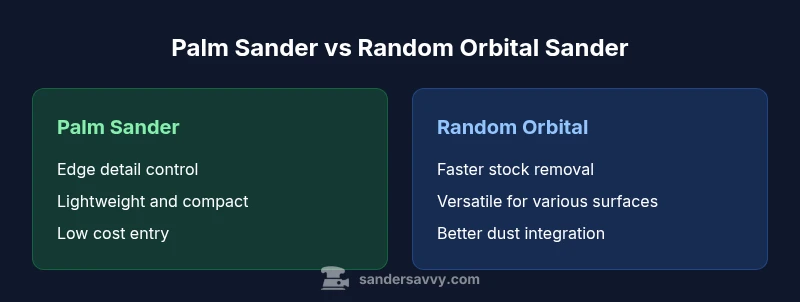
For most DIYers, a palm sander offers precise control for edges and detail, while a random orbital sander delivers faster material removal and broader versatility. In the palm sander vs random orbital sander decision, choose the palm sander for tight corners and finishing work, and a random orbital sander for quicker, flat-surface prep and general use.
What Are Palm Sander and Random Orbital Sander?
A palm sander is a compact, handheld finishing tool with a flat, typically rectangular base designed to be gripped in one hand. It accepts sheet sandpaper that is clamped or attached with a hook-and-loop system, and its light weight makes it ideal for edging, curves, and trim where precision is important. A random orbital sander uses a round pad that moves in a randomized orbit, which helps prevent visible cross-grain patterns and minimizes the risk of gouging on flat surfaces. The random orbital action means the tool can remove material more quickly on large, flat areas while still delivering a smooth finish when used with appropriate grits. In the palm sander vs random orbital sander comparison, the fundamental difference is control and finish versus speed and versatility. For DIY projects like refinishing a patio deck, cabinets, or furniture, understanding these basics aligns tool choice with the work at hand.
Sander models vary in speed settings, weight, and dust-management features. Some palm sanders are purely low-speed finishers focused on detail, while many random orbital sanders offer variable speeds, better dust ports, and more model variety. These distinctions influence not just finish quality but also user fatigue and workflow efficiency. The SanderSavvy team emphasizes that the best choice depends on project goals, workspace, and how much time you’re willing to invest in finishing versus material removal.
This section lays the groundwork for evaluating palm sander vs random orbital sander performance across common DIY tasks, from edge work on rails to smoothing large tabletop surfaces. The key is matching tool behavior to the shape of the work, the desired finish, and the time budget you have for your project.
verificationNeededdoctoring? null comment: null
Comparison
| Feature | palm sander | random orbital sander |
|---|---|---|
| Sanding action | rectangular, controlled pressure for edges and detailed work | round pad with randomized orbit for broad surfaces and even finish |
| Finish quality | excellent control for fine finishing with proper technique | very good overall finish with reduced streaks on flat areas |
| Aggressiveness/stock removal | slower per pass; spot removal requires more passes | faster material removal on flat surfaces with less gouging |
| Dust collection compatibility | often compatible with basic dust bags; needs clean surfaces for best results | works well with built-in ports and adapters; best when paired with a vacuum |
| Ease of use in corners | superior for tight corners and curves | less ideal for tight corners due to circular motion |
| Best use case | detail work, edges, small refinishing tasks | large flat surfaces, general purpose prep, and speed |
| Disc/pad compatibility | uses rectangular sheets (often 3x4 inches) with clamps or hooks | uses round discs (commonly 5-6 inches) with hook-and-loop backs |
| Weight/ergonomics | lighter, easier to maneuver in narrow spaces | slightly heavier but versatile and stable for long sessions |
| Cost range | lower entry price for basic models | broader range with higher-end options; generally higher upfront cost |
What's Good
- Better finish control on edges and detailed work
- Lighter weight and easier maneuverability in tight spaces
- Lower upfront cost for basic tools
- Simple maintenance with fewer moving parts
- Good for beginners learning sanding technique
Weaknesses
- Slower material removal on heavy stock or large areas
- Requires more passes to achieve even flat surfaces
- Dust collection may be less efficient without a shop vac
- Limited versatility for very large or aggressive jobs
Random orbital sander generally offers more versatility for most projects; palm sander excels at detail work and edges.
If your work involves a lot of edge work, corners, or fine finishing, a palm sander is the better choice. For quicker prep on large flat surfaces and general-purpose sanding, the random orbital sander is typically the more efficient option. Your final decision should align with project type, finish goals, and available dust-control setup.
Your Questions Answered
What are the primary differences between a palm sander and a random orbital sander?
The palm sander is small and emphasizes precision for edges and details, while the random orbital sander uses a round pad with a randomized orbit for faster material removal and a smoother overall finish. The choice depends on the project geometry and finish requirements.
Palm for edges and detail; orbital for speed and even finish.
Can I use a palm sander on curved edges without leaving marks?
Yes, with proper technique and light pressure, a palm sander can work well on curves. Move slowly along the curve and keep the sanding surface flat to avoid gouges, and switch to finer grits as needed.
Yes, with careful technique and light pressure.
Is a random orbital sander better for decks or large flat surfaces?
For large, flat deck surfaces, a random orbital sander often delivers faster stock removal and a uniform finish. It’s still advisable to test on a small area first and monitor dust collection.
Great for large flat deck prep.
What grit progression is recommended for these tools?
Begin with a coarse grit for initial material removal and switch to medium and then fine grits to achieve a smooth finish. Always follow with a final super-fine pass for the best appearance.
Start coarse, progress to fine for a smooth finish.
How important is dust collection with these tools?
Dust collection is important for visibility and health. Use a model with a good dust port and connect it to a shop vacuum or dust extractor for best results.
Dust control matters; connect to a vacuum when possible.
Should I buy new or consider a used tool for this comparison?
Consider new if you value reliability and warranty; a used tool can be cost-effective if it’s in good condition and you inspect the motor, pad, and switch. Prioritize safety and performance over price alone.
New offers reliability; used can work if in good condition.
Main Points
- Choose palm sander for tight corners and fine finishing
- Opt for random orbital sander when speed and versatility matter
- Pair a sander with a vacuum for dust control
- Dust collection effectiveness varies by model; test before large jobs
- Invest in quality discs/pads to maximize finish quality